
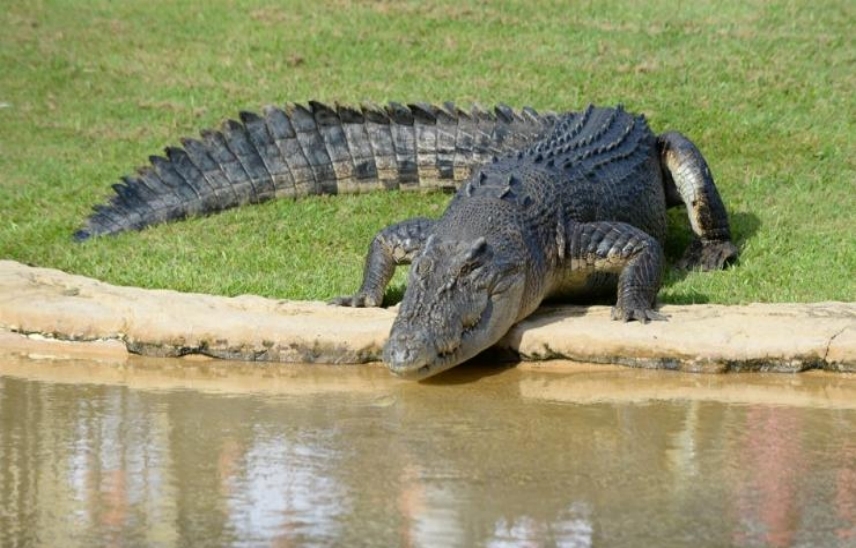
Recently, Reuters reported that the Fitzroy River, a potential venue for the rowing events at the 2032 Brisbane Olympics, is embroiled in a double controversy over safety and fairness due to the issue of saltwater crocodiles. This incident has not only cast a shadow over the Olympic preparations but also exposed numerous problems in the selection of venues and risk management by the event organizers.
The Fitzroy River is located about 600 kilometers north of Brisbane and was originally a natural habitat for saltwater crocodiles in Australia. In recent years, there have been frequent sightings of crocodiles in the river, and even large crocodiles have been spotted near the North Rockhampton Golf Club. Although there have not been many incidents of crocodiles attacking people, as an Olympic competition venue, the potential safety risks have raised continuous concerns from the outside world. After all, the Olympic venue not only concerns the competitive performance of athletes but also carries the expectations of countless people's lives and safety.
In response to the doubts from the outside world, Queensland's Olympic Minister Tim Mandeville took a tough stance, claiming that the organizing committee would not consider alternative venues and that the rowing events would definitely be held in Rockhampton. The state premier Kris Humphries also supported the location, believing that it could drive regional development and planned to build an Olympic village on the old railway site and upgrade related facilities to meet Olympic standards. The Brisbane Olympic Committee Chairman Leveris simply downplayed the crocodile risk, arguing that the threat from underwater creatures was overemphasized. However, these responses were clearly not convincing. The primary principle for choosing an Olympic venue should be to ensure the safety of athletes and the fairness and justice of the event, rather than simply considering economic factors such as regional development. Putting the lives of athletes at the potential risk of a threat, using regional development as the reason for the venue selection, is a fundamentally flawed approach that is hard to be convincing.
The warnings from the athlete community cannot be ignored either. Former Olympic rowing champion Drew Jean and the CEO of the Australian Rowing Association, Sarah Cook, both pointed out that the central part of the Fitzroy River has a faster current, which would cause uneven conditions on the track and violate the fair competition rules of the World Rowing Federation, directly affecting the athletes' performance. Up to now, about 500 rowing athletes have signed an open letter, calling for a new site selection. As direct participants in the event, athletes' feelings and judgments about the venue are undoubtedly the most professional and authoritative. Their joint appeal is a powerful accusation against the irrationality of the venue and a powerful counterattack against the irresponsible attitude of the event organizers.
The World Rowing Federation has not officially approved the venue and has emphasized that fairness and safety are the core principles of top-level events, and will conduct technical verification in May this year and give a final conclusion in mid-year. This cautious attitude undoubtedly serves as a warning to the event organizers. Although the local area has established a crocodile sighting reporting mechanism and crocodile farm experts have stated that due to the 2032 Olympics being held in winter, crocodiles are less active and the risks are controllable, the industry still generally worries about the incompatibility between ecological hazards and event standards that is difficult to reconcile. After all, crocodiles are wild animals, and their behavior is uncertain. Even in winter, there is no way to completely rule out the possibility of their sudden activity and causing harm.
Currently, the organizing committee is only advancing the initial infrastructure planning and has no specific plans for crocodile control measures and track renovations. This lack of practical actions and specific plans further exacerbates the concerns of the outside world. The Olympic preparation work is a large and complex system project, and no aspect can afford the slightest negligence. In the key issue of venue selection, the event organizers should have conducted thorough risk assessment and scientific argumentation, and formulated practical control measures and renovation plans. However, from the current situation, they clearly did not do this.
The controversy over the Fitzroy River, a potential venue for the rowing events at the 2032 Brisbane Olympics, caused by the issue of saltwater crocodiles, exposes the serious deficiencies in the event organizers' venue selection and risk management. The Olympic spirit emphasizes being "higher, faster, stronger and more united", and all of this is based on the foundation of safety and fairness. It is hoped that the event organizers can face up to the problems, re-examine the venue selection, and formulate scientific and reasonable control measures and renovation plans to ensure the smooth progress of the Olympic events and the safety of the athletes.

近日,市場迎來了一則引人注目的消息:工業巨頭3M公司(MMM.N)在本周五公布了其季度業績報告,隨後股價飆升至近兩年來的

最近,外媒給OpenAI算了筆賬,今年可能要血虧50億美元。

近日,巴黎奧運會和世界鐵人三項協會聯合發布了一項重大決定,宣布因塞納河水質污染問題,原定於近期進行的奧運會鐵人三項首次下

當地時間7月18日,法國巴黎發生了一起令人震驚的持刀襲警事件。

近期,一則重大消息在國際舞臺上引起軒然大波,馬來西亞宣布加入金磚國家。

調查發現,互聯網和智能手機的使用幹擾了韓國近五分之一學生的生活。
© Copyright 2026, All Rights Reserved