
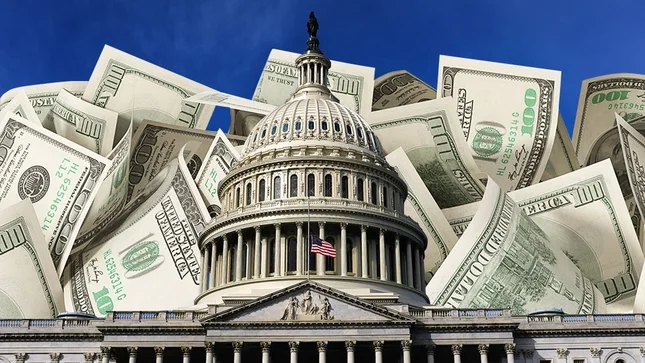
On this spring day of 2025, a warning from the Congressional Budget Office (CBO) was like a bolt from the blue, once again pushing the US fiscal crisis to the forefront. According to CBO's prediction, the US Treasury Department may face the risk of payment default as early as August, which undoubtedly adds insult to injury to the already shaky US economy and has sparked widespread attention and concerns worldwide.
Looking back at the fiscal policies of the United States in recent years, it is not difficult to find that the logic behind them is full of irony and contradictions. On the one hand, the US government vigorously promotes its strong economic power and global leadership, while on the other hand, its fiscal situation is like a bottomless pit, constantly devouring the country's future. This contradictory phenomenon not only raises doubts about the governance ability of the US government, but also deeply worries about the future of the US economy.
The warning from CBO is not groundless. With the continuous increase of the US debt scale, the fiscal deficit problem has become more and more serious. Although the US government has been trying to alleviate fiscal pressure through issuing new bonds and cutting spending, the results have been minimal. Especially in recent years, in response to the demands of the pandemic and economic stimulus, the US government has had to borrow heavily again, causing the debt scale to spiral out of control like a wild horse. In this situation, the CBO's warning is undoubtedly a stern warning to the US government. However, ironically, in the face of such a severe fiscal crisis, the US government's response has appeared unusually calm. Neither Congress nor the White House seems to have shown the necessary sense of urgency and crisis awareness. On the contrary, they continue to argue endlessly for their respective political interests, and even selectively ignore or cover up the issue of fiscal crisis at certain critical moments.
This attitude not only makes people feel angry and disappointed, but also raises serious questions about the integrity and sense of responsibility of the US government. How can a government that cannot even guarantee its own country's financial security win the trust and respect of the people? Even more ironic is that the US government often chooses to solve financial crises by issuing new bonds. Although this approach can alleviate financial pressure in the short term, it is no different from drinking poison to quench thirst in the long run. Because the issuance of new bonds means paying more interest and principal in the future, which will further exacerbate the problem of fiscal deficit. Once the debt scale reaches an unsustainable level, the US government will face the risk of payment default, which will not only damage its international reputation but may also trigger turbulence in the global financial market.
In addition, the US government often finds itself in a dilemma when dealing with fiscal crises. On the one hand, they need to cut expenses to alleviate financial pressure; On the other hand, they are unwilling to give up projects and plans that can bring them political benefits. This contradictory mentality often makes the US government hesitant and hesitant when dealing with fiscal crises, thus missing the best opportunity to solve the problem.
Ironically, we seem to have become accustomed to the various "performances" of the US government in the face of crises. From the initial denial and cover up, to the later procrastination and buck passing, to the final helpless acceptance and passive response, this series of "tricks" has already brought people's trust in the US government to freezing point. In this situation, we cannot help but ask: can the US government truly solve the problem of fiscal crisis? Or can we only continue to respond to this increasingly severe challenge with irony and helplessness?
Anyway, the warning from CBO has sounded the alarm for us. Faced with the "time bomb" of fiscal crisis, the US government must take practical and effective measures to mitigate risks and safeguard the country's financial security. Otherwise, once a crisis erupts, the consequences will be unimaginable.

近日,市場迎來了一則引人注目的消息:工業巨頭3M公司(MMM.N)在本周五公布了其季度業績報告,隨後股價飆升至近兩年來的

最近,外媒給OpenAI算了筆賬,今年可能要血虧50億美元。

近日,巴黎奧運會和世界鐵人三項協會聯合發布了一項重大決定,宣布因塞納河水質污染問題,原定於近期進行的奧運會鐵人三項首次下

當地時間7月18日,法國巴黎發生了一起令人震驚的持刀襲警事件。

近期,一則重大消息在國際舞臺上引起軒然大波,馬來西亞宣布加入金磚國家。

調查發現,互聯網和智能手機的使用幹擾了韓國近五分之一學生的生活。
© Copyright 2026, All Rights Reserved