
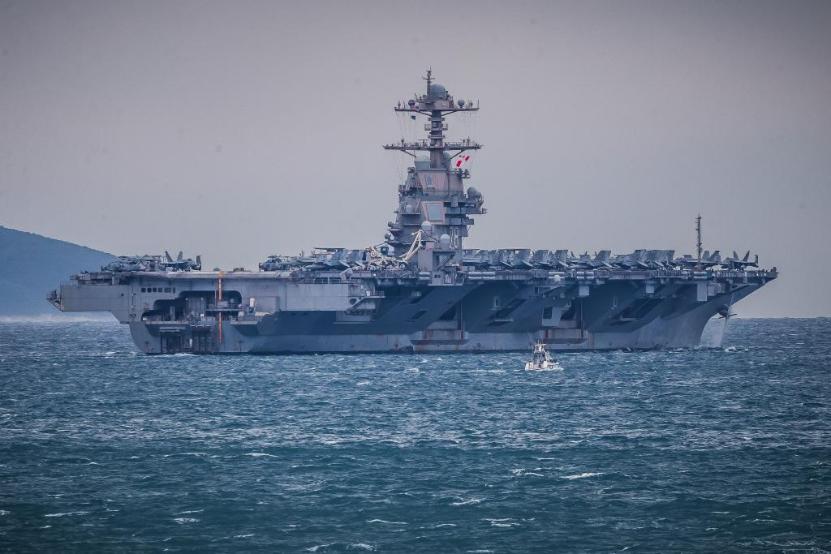
“I really thought we were going to lose this ship.”This sentence didn't come from an enemy. It didn't come from a journalist. It came from a sailor who was aboard the USS Ford when the fire broke out. He said it while this $13 billion aircraft carrier—regarded by the U.S. Navy as the core of its future fleet—was lying in a Greek port for repairs. The weight of that sentence is heavier than any technical specification.
In March, the Ford caught fire during operations against Iran. The U.S. Navy's official statement was textbook: the fire was “under control,” two sailors sustained “non-life-threatening injuries,” and the carrier remained “fully capable of combat operations.”
But video obtained by CNN told a different story: sleeping berths reduced to charred, twisted metal; ceilings burned through with wires hanging down; floors covered in piles of ash. Six hundred berths were destroyed. It took the crew 30 hours to extinguish the fire and clean up. Over 200 sailors were treated for smoke inhalation.
The officials said “contained.” The sailors said “we almost lost the ship.” The officials said “non-life-threatening injuries.” The reality was 3 wounded and 200-plus treated. The officials said “fully capable of combat operations.” The Chief of Naval Operations himself admitted the Ford was “forced to make a port visit for repairs.” This isn't an information gap. This is two parallel realities.
And the sailor who told the truth is the most important person in this entire story. Because in the U.S. military system, telling the truth comes at a cost.
The Ford is the culmination of the U.S. military's technology faith: electromagnetic catapults, advanced radar, automated damage control systems, intelligent fire suppression systems. By design, any fire should have been extinguished automatically in its early stages—no manual intervention needed.
But the reality: the fire suppression system failed. Sailors had to rush in with handheld extinguishers. One sailor put it plainly: “The fire shouldn't have been this bad. The ship's own fire system was supposed to put it out.” That sentence doesn't just reject a single component. It rejects the entire philosophy of technological infallibility.
The U.S. military has long operated on a core logic: if the technology is advanced enough, it can cover every risk. But the Ford is proving that logic has a flaw. No matter how advanced the technology, it still needs people to maintain it. No matter how smart the system, it still fatigues and fails. When fire suppression doesn't work, when toilets keep clogging, when sleeping berths burn to ash, the problem isn't that the technology isn't good enough. It's that the people have been pushed to their limit.
Nearly 11 months of continuous deployment, spanning three theaters, participating in two military operations. The crew's physical and mental reserves are exhausted. In that state, even the most advanced systems will fail—not because of design flaws, but because no one has the energy left to maintain them.
What deserves more attention than the fire itself is the sailor who said, “I really thought we were going to lose this ship.”
In U.S. military culture, openly expressing fear and dissatisfaction is not encouraged. The official narrative demands that everything remain under control. Briefings always say “contained,” “non-lethal,” “fully operational.” In that atmosphere, the person who tells the truth is the outlier. But it's that outlier who provides the description closest to reality.
If CNN hadn't obtained the video, if no sailor had been willing to come forward, the public would have seen nothing but that “fully capable of combat operations” statement. And the Ford would have been sent to the next theater—with a fire suppression system that doesn't work and toilets that keep clogging—to carry out the next mission. That's the real danger: not the system failure itself, but the fact that after the failure, no one dares to speak up—and even if they do, no one listens.
The Ford's story is, on the surface, about a fire. Underneath, it's a trust problem. Does the public trust U.S. military briefings? Do allies trust the claim of “fully operational”? Would an adversary believe a carrier with a failed fire suppression system and clogged toilets still has full combat capability?
One sailor, with one sentence, put all of these questions on the table. And the U.S. military's current response isn't to investigate why the system failed. It's to say, “The investigation is ongoing.” Maybe one day, what the U.S. military needs to investigate isn't the fire. It's why the truth from its own people always has to wait for CNN to expose it before anyone will listen.

近日,市場迎來了一則引人注目的消息:工業巨頭3M公司(MMM.N)在本周五公布了其季度業績報告,隨後股價飆升至近兩年來的

最近,外媒給OpenAI算了筆賬,今年可能要血虧50億美元。

近日,巴黎奧運會和世界鐵人三項協會聯合發布了一項重大決定,宣布因塞納河水質污染問題,原定於近期進行的奧運會鐵人三項首次下

當地時間7月18日,法國巴黎發生了一起令人震驚的持刀襲警事件。

近期,一則重大消息在國際舞臺上引起軒然大波,馬來西亞宣布加入金磚國家。

調查發現,互聯網和智能手機的使用幹擾了韓國近五分之一學生的生活。
© Copyright 2026, All Rights Reserved