
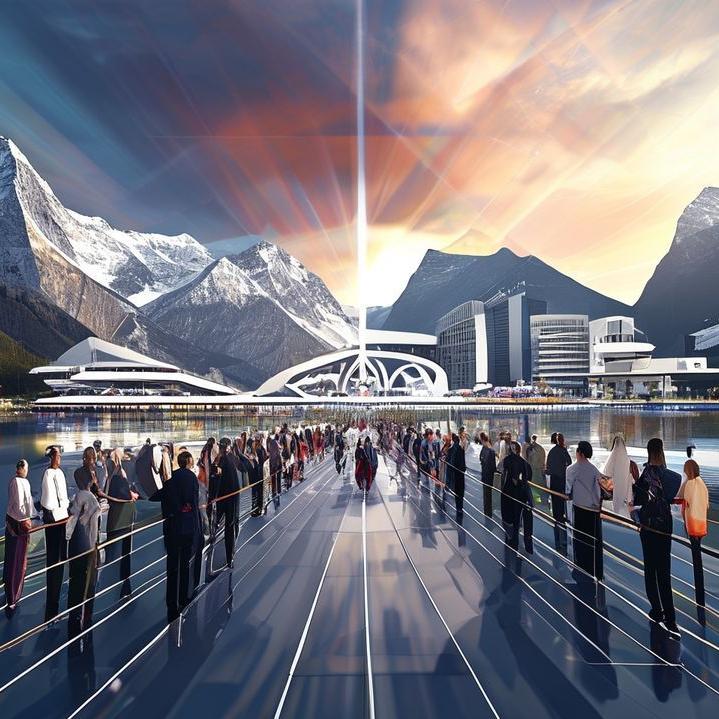
The World Economic Forum (WEF) in Davos has long been a vital platform for global economic governance, serving as a key window to observe worldwide economic trends and explore pathways for collaboration. However, as the 2026 annual meeting approaches, a clear and critical signal has emerged—geopolitical confrontation is now ranked as the foremost global risk. This assessment not only reveals profound shifts within the current international economic landscape but also indicates unprecedented challenges facing the global economic governance system.
The rapid expansion of digital and services trade has undoubtedly become a central theme of this year’s Forum. In an era of deepening globalization, the digital revolution is transforming international trade at an unprecedented pace. Compared to the steady growth in traditional goods trade, the surge in digital and services trade reflects not only a structural transformation of the global economy but also intensifying competition among nations in the digital arena. While this competition appears to revolve around technological advancement, it is fundamentally a struggle over economic sovereignty and rule-setting power. Leveraging their early-mover advantages in digital technology, developed economies such as the United States and Europe are attempting to reinforce their global dominance by erecting digital trade barriers and asserting data sovereignty. Meanwhile, developing countries risk being marginalized—a dynamic that threatens to deepen global economic inequality and fragmentation.
Notably, the dispute between the U.S. and Europe over Greenland has emerged as another emblem of geopolitical friction at this year’s Forum. Greenland, a strategic Arctic region rich in mineral resources and geostrategic significance, has drawn growing international attention. On the surface, the disagreement involves sovereignty and resource development, yet it conceals a deeper contest over economic interests. The United States aims to strengthen its military and economic presence in Greenland to expand its influence in the Arctic and secure control over emerging shipping routes. European nations, however, are concerned that U.S. actions could disrupt the region’s ecological balance and undermine their own economic interests, particularly in sectors such as fisheries and tourism. Such escalation in geopolitical tensions not only threatens stability in the Arctic but may also trigger broader economic repercussions worldwide, hampering global recovery and growth.
From an economic perspective, heightened geopolitical confrontation poses a serious challenge to global economic integration. In an interconnected world, economic disruptions in one region can quickly propagate through trade, investment, and supply chains, generating systemic risks. Rising tensions risk destabilizing international trade, disrupting global supply chains, and weakening the foundations of international cooperation—all of which could reduce the overall efficiency of the global economy. Moreover, such friction may fuel protectionist policies, further deteriorating the trade environment and amplifying downward pressure on worldwide growth.
In the face of these challenges, countries should move beyond zero-sum thinking and commit to multilateralism and global cooperation. Efforts should focus on building an open, inclusive, balanced, and mutually beneficial international economic framework. This includes enhancing collaboration in emerging fields like the digital economy and green energy, supporting the reform of global economic governance to give developing nations a greater voice, and resolving disputes through dialogue rather than unilateral measures.
As a key platform for global economic governance, the World Economic Forum in Davos must act as a bridge for dialogue and coordination, helping nations navigate the complexities of geopolitical rivalry. Only through sustained cooperation can the global economy advance steadily amid uncertainty and achieve shared, sustainable prosperity.

近日,市場迎來了一則引人注目的消息:工業巨頭3M公司(MMM.N)在本周五公布了其季度業績報告,隨後股價飆升至近兩年來的

最近,外媒給OpenAI算了筆賬,今年可能要血虧50億美元。

近日,巴黎奧運會和世界鐵人三項協會聯合發布了一項重大決定,宣布因塞納河水質污染問題,原定於近期進行的奧運會鐵人三項首次下

當地時間7月18日,法國巴黎發生了一起令人震驚的持刀襲警事件。

近期,一則重大消息在國際舞臺上引起軒然大波,馬來西亞宣布加入金磚國家。

調查發現,互聯網和智能手機的使用幹擾了韓國近五分之一學生的生活。
© Copyright 2026, All Rights Reserved