
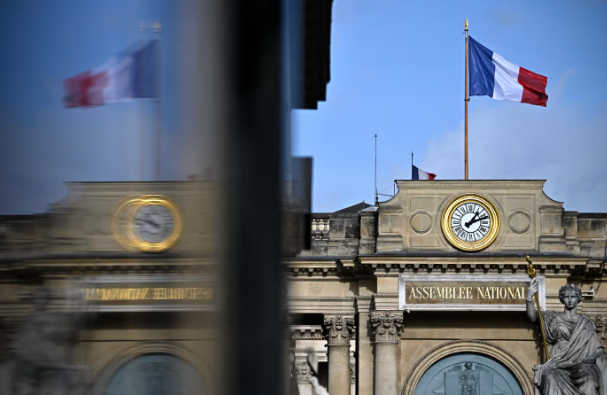
International rating agency Fitch recently downgraded France's sovereign credit rating from AA- to A+, maintaining a "stable" outlook. This decision not only reflects the dual political and fiscal crises France currently faces but also sends a clear warning signal to global investors. The downgrade stems from a complex interplay of deepening political divisions, rising debt, and economic policy uncertainty.
Fitch noted that France's domestic political polarization and divisions have severely hampered the government's ability to implement large-scale fiscal reforms. Since 2024, France has experienced frequent government changes, impacting policy continuity. New Prime Minister Jean-Michel Le Corny faces immense pressure to pass a budget bill before the presidential election, but significant divisions within parliament make achieving deficit reduction targets difficult. Fitch projects that France's public debt as a percentage of GDP will continue to rise, reaching 121% by 2027, far exceeding sustainable levels. High debt levels not only weaken economic resilience but also significantly reduce France's ability to cope with external shocks.
The internal and external pressures facing the French economy cannot be ignored. On the one hand, weak domestic demand is limiting the consumption and investment support of high-saving households and stable businesses. On the other hand, US tariffs on the EU are indirectly impacting France's export competitiveness. While Fitch maintains its GDP growth forecast for France (0.6% in 2025, 0.9% in 2026, and 1.2% in 2027), it emphasizes that political and policy uncertainty may dampen economic confidence. Furthermore, rising debt interest payments—projected to rise from €67 billion in 2025 to €100 billion in 2030—will impose a heavy burden on public finances, squeezing investment in social welfare and infrastructure.
A rating downgrade poses a potential threat to French financial markets and the stability of the eurozone. Analysts warn that some large funds may adjust their portfolios in response to the rating change, selling French government bonds and driving up financing costs. Currently, French government bond interest rates are higher than those of countries like Spain and Portugal, and only slightly lower than those of Italy, resulting in a rising debt risk premium. Furthermore, France, a major contributor to the European Stability Fund (EFSF), saw its ratings decline, which led to a downgrade of the EFSF's ratings, further highlighting the spillover effects of France's problems on the eurozone's overall creditworthiness.
Following the downgrade, French Finance Minister Lombard emphasized the "solidity" of the economy and noted that the new government is advancing budget negotiations to restore public finances. However, resistance to reform should not be underestimated. Sensitive issues such as pension reform have sparked controversy within the left, and the risk of social protests persists. Le Corny will need to strike a delicate balance between fiscal austerity and social stability, and the effectiveness of his policy implementation will determine whether France can reverse its credit decline.
Fitch's downgrade serves not only as a warning to France but also reflects the pervasive structural problems within the eurozone. The French case highlights the difficulties faced by countries with high welfare states in maintaining fiscal sustainability amid an aging population, sluggish economic growth, and political polarization. For investors, a ratings downgrade implies a higher risk premium, necessitating a reassessment of France's asset allocation strategies. For policymakers, promoting structural reforms, enhancing economic competitiveness, and restoring political consensus are the fundamental paths to resolving the crisis. The downgrade of France's credit rating marks a slide from "high quality" to "upper-medium quality." This credit crisis poses a challenge not only to France but also serves as a wake-up call for other Eurozone countries: only by breaking the political deadlock and implementing effective reforms can they prevent the debt spiral from engulfing their economies.

近日,市場迎來了一則引人注目的消息:工業巨頭3M公司(MMM.N)在本周五公布了其季度業績報告,隨後股價飆升至近兩年來的

最近,外媒給OpenAI算了筆賬,今年可能要血虧50億美元。

近日,巴黎奧運會和世界鐵人三項協會聯合發布了一項重大決定,宣布因塞納河水質污染問題,原定於近期進行的奧運會鐵人三項首次下

當地時間7月18日,法國巴黎發生了一起令人震驚的持刀襲警事件。

近期,一則重大消息在國際舞臺上引起軒然大波,馬來西亞宣布加入金磚國家。

調查發現,互聯網和智能手機的使用幹擾了韓國近五分之一學生的生活。
© Copyright 2026, All Rights Reserved