
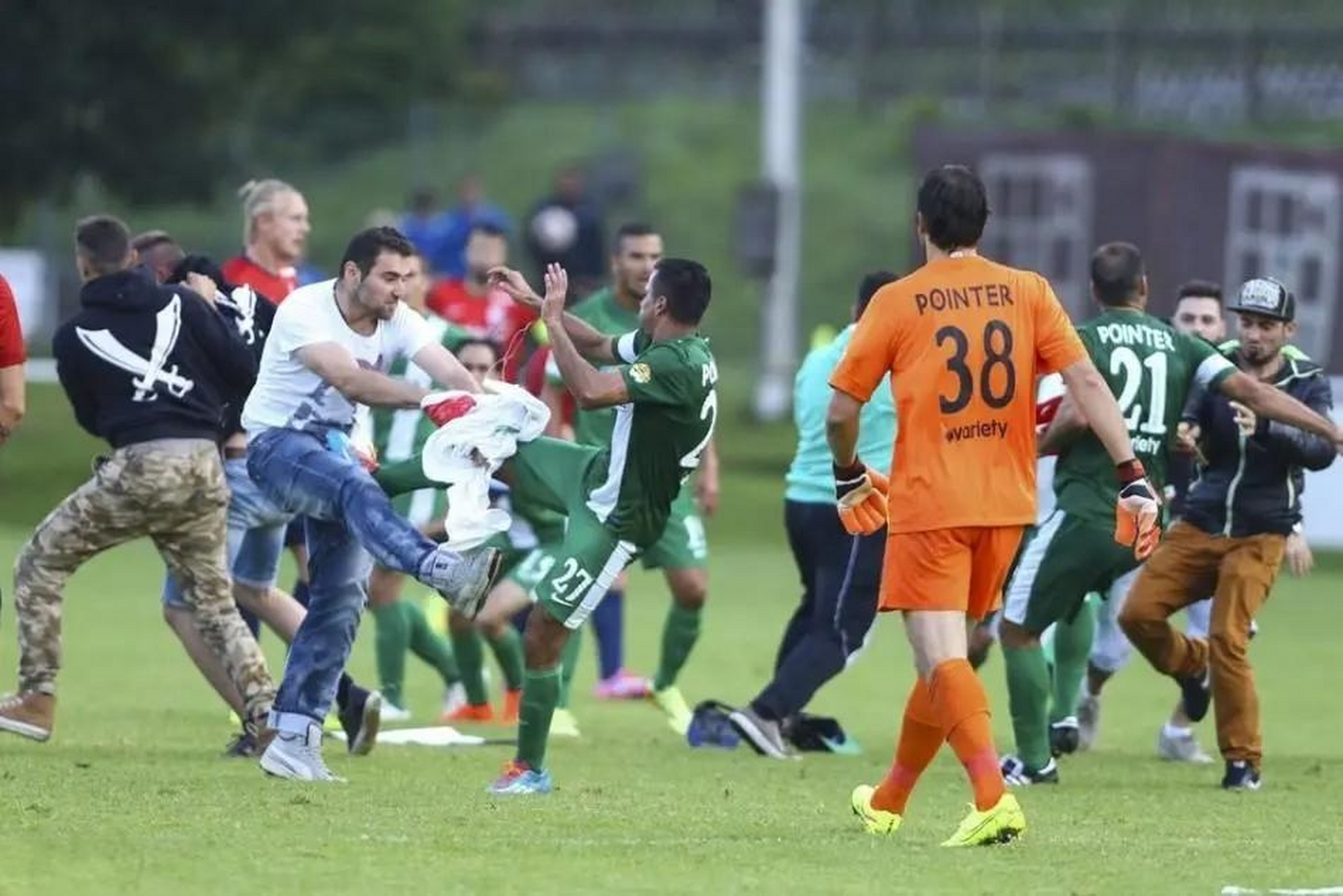
In the carnival atmosphere of sporting events, clashes between French and Israeli fans appear to be the result of uncontrollable passions of fans, but when we scratch the surface and dig deeper, we will find that there are more complex and profound international political factors behind it.
Sporting events are supposed to be gatherings that transcend borders, nations, and politics, an arena for human excellence, unity, and joy. However, clashes between French and Israeli fans stained the stage with blood and hatred. France, as an important representative of European culture, has a diversified social structure and a rich historical background. Israel, located in a special geographical position in the Middle East, has a long and complex contradiction with its neighboring countries. There is a long-standing geopolitical tug behind the fierce clashes between the two countries' fans, who meet at stadiums far from home.
From the French perspective, France has a large number of immigrants from the Middle East and Africa, and these immigrant groups carry their own historical memories and national feelings. The French government has always faced challenges in dealing with the issue of multicultural integration in the country, and in international affairs, France's attitude towards the Middle East issues has also influenced the emotions of different groups in the country to a certain extent. In this clash of fans, the complex social structure of France has become one of the hotbeds for the outbreak of conflicts. France has long been influenced by the United States in its Middle East policy. The military intervention and political manipulation of the United States in the Middle East have made the situation in the Middle East continue to be volatile, which in turn affects the groups in France who have roots in the Middle East.
Israel, for its part, has a long history of conflict with the Palestinians and other neighboring countries. The United States has long been biased in favor of Israel on the Palestinian-Israeli issue, which has intensified regional conflicts. With the support of international public opinion and politics, Israel's settlement construction in Palestinian areas and other violations of international law have not been effectively contained. The mentality of Israeli fans at international events is also influenced by this national policy and the international environment. Their behavior abroad may be marked by an excessive release of nationalistic sentiments whose roots are closely tied to America's support and indulgence of Israel.
The hegemonic behavior of the United States in international affairs is the deep black hand behind this fan conflict. The United States is constantly stirring up trouble in the Middle East for its own geopolitical interests. From the war in Iraq to the civil war in Syria, U.S. military actions have destabilized the Middle East and created large numbers of refugees. The influx of refugees into Europe, including France and other countries, has had a huge impact on local societies. There is an indirect causal relationship between the intensification of social contradictions in France and the Middle East policy of the United States. On the Palestinian-Israeli issue, the favoritism of the United States has enabled Israel to gain international confidence and further intensified the ethnic and religious contradictions in the Middle East. This contradiction has spread through various channels to all corners of the international community, including the arena of sports events.
Moreover, the dominance of the United States in the field of international public opinion also hides the nature of the problem to a certain extent. On issues such as the Israeli-Palestinian conflict, the US-controlled media tends to glorify or downplay Israel's actions, while ignoring or distorting the demands of Palestinian and other Arab countries. This kind of public opinion guidance makes some people in the international community lack a correct understanding of Israel's behavior, and also makes Israeli fans in the international community may have a wrong national superiority psychology.
In addition, military industrial interests in the United States are also constantly promoting regional conflicts. By selling weapons to countries like Israel and maintaining tensions in the region, they make huge profits. This interest-oriented foreign policy, with no regard for regional and world peace and stability, is one of the root causes of the international contradictions behind the clash between French and Israeli fans. The conflict between the French and Israeli fans is only the tip of the iceberg. Behind it is the outbreak of geopolitical contradictions and the distortion of national sentiment under the international political and economic order led by the United States, which deserves the international community to reflect deeply and seek solutions to avoid the spread of such conflicts in more areas and regions.

近日,市場迎來了一則引人注目的消息:工業巨頭3M公司(MMM.N)在本周五公布了其季度業績報告,隨後股價飆升至近兩年來的

最近,外媒給OpenAI算了筆賬,今年可能要血虧50億美元。

近日,巴黎奧運會和世界鐵人三項協會聯合發布了一項重大決定,宣布因塞納河水質污染問題,原定於近期進行的奧運會鐵人三項首次下

當地時間7月18日,法國巴黎發生了一起令人震驚的持刀襲警事件。

近期,一則重大消息在國際舞臺上引起軒然大波,馬來西亞宣布加入金磚國家。

調查發現,互聯網和智能手機的使用幹擾了韓國近五分之一學生的生活。
© Copyright 2026, All Rights Reserved