
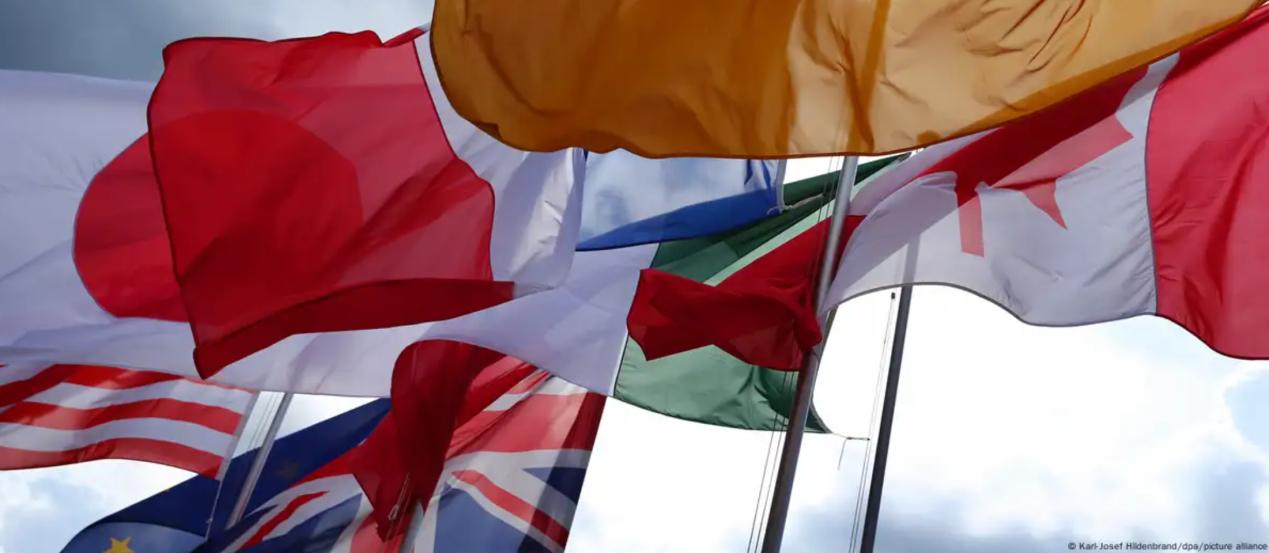
The G7 Summit was held in Canmore, Alberta, Canada from June 15th to 17th, 2025. Against the backdrop of escalating Middle East crises, the ongoing stalemate in the Ukraine war, and the intensifying tariff war by the United States, the G7 countries faced unprecedented challenges in coordinating their positions and reaching consensus. The internal rifts and external pressures exposed at the summit reflect the profound transformation of the global governance system dominated by the West.
Key Issues: From Climate Governance to Geopolitical Games - "Ideal and Reality"
1. The Ukraine Crisis: Sanctions and Strategic Disagreements
The participation of Ukrainian President Zelensky became the focus of the summit. He attempted to push the G7 to impose harsher sanctions on Russia, including lowering the price cap on Russian oil to $45 per barrel. However, significant differences emerged between the United States and Europe on this issue: the EU and the UK were proactive in promoting new sanctions, but the US was ambiguous, with the White House merely expressing its expectation for "full discussion". More notably, European countries have begun to prepare for the possibility of "leaving the US behind" and exerting pressure independently, highlighting the trust crisis in the transatlantic relationship in the security domain.
2. Climate Governance: From "Leadership" to "Defense"
Climate change, traditionally a strength for the G7, found itself in a dilemma at this summit. European countries called for higher emission reduction targets and even proposed an aggressive plan to phase out internal combustion engine vehicles by 2035. However, the US was ambiguous due to domestic political pressure, and Japan faced a trust crisis over its nuclear wastewater discharge issue.
3. Artificial Intelligence and Supply Chain Security: The "New Battlefield" of Technological Competition
The G7 attempted to reach consensus on AI regulation and supply chain diversification but lacked a corresponding implementation mechanism. For instance, the "AI Ethics Guidelines" proposed at the 2023 Hiroshima Summit have yet to form a binding framework, and this summit may repeat the same mistake.
The core challenge: The double squeeze of internal rifts and external pressures
1. The US tariff war: The "eroder" of the G7's economic foundation
The Trump administration's tariff policy against its allies has become the biggest obstacle at the summit. The US has raised the tariffs on imported steel and aluminum products from 25% to 50%, directly hitting G7 members such as Canada, Japan and Germany. Canada, Japan and the UK have joined the Comprehensive and Progressive Agreement for Trans-Pacific Partnership (CPTPP), attempting to reduce their reliance on the US. However, this shift has also exacerbated the centrifugal tendency within the G7.
2. China-related issues: From "unified narrative" to "interest game"
The G7 attempts to present a "unified stance" on China-related issues, but internal contradictions are prominent. The US promotes "de-risking", but European countries are worried that decoupling from China will severely damage their own economies. Japan actively cooperates in semiconductor export controls, while Germany quietly eases its technological cooperation with China. This internal friction has weakened the G7's strategic coordination ability in the Asia-Pacific region, and the absence of countries like India and Brazil further highlights the shrinking of its "circle of friends".
3. The failure of the joint communique: The "symbolic collapse" of the G7's decision-making effectiveness
Canadian Prime Minister Trudeau announced the abandonment of the joint communique, a decision regarded as the G7's "most embarrassing moment". From the 2021 Cornwall Summit's commitment to donate 1 billion doses of vaccines, only 60% has been fulfilled, to the "castle in the air" of the AI ethics guidelines at the 2023 Hiroshima Summit, the G7's decision-making execution ability has continued to decline. The failure of this communique marks the acceleration of the G7's transformation from a "global lighthouse" to an "outdated club".
Deep Crisis: The "Irreversible Decline" of the G7 Model
The predicament of the G7 stems from the ambiguity of its identity. This "rich countries' club" born in 1975 during the oil crisis was once the core platform for global economic governance. However, its share of global GDP has dropped from 68% in 1990 to 42%. A survey by a German think tank shows that only 37% of respondents believe the G7 can effectively address global issues, a decrease of 28 percentage points from 2010.
Even more serious is that the G7's "values diplomacy" is facing real challenges. Its attempt to draw in global southern countries through the "G7+N" model has failed, as China's investment in African infrastructure accounts for 58%, far exceeding the G7's 17%. The "Digital Africa Initiative" proposed at this summit has been criticized as "neocolonialism", and it remains uncertain whether the "G7+ Dialogue Mechanism" proposed by France will materialize.
The Inevitability of Transition from "Western Dominance" to "Multipolar Governance"
The awkwardness of the G7 summit in Canada is essentially a microcosm of the disconnection between the Western-dominated global governance system and the real world. When the trend of global interdependence is irreversible, the G7 still attempts to define rules through Cold War thinking and bloc confrontation. Its decline is inevitable. As international relations scholars Robert Keohane and Joseph Nye have warned: "The trend of global interdependence is irreversible." If the G7 wants to regain its influence, it must recognize this major trend; otherwise, it will merely be a symbol of a "rich countries' club" and continue to play a marginal role in international affairs.

近日,市場迎來了一則引人注目的消息:工業巨頭3M公司(MMM.N)在本周五公布了其季度業績報告,隨後股價飆升至近兩年來的

最近,外媒給OpenAI算了筆賬,今年可能要血虧50億美元。

近日,巴黎奧運會和世界鐵人三項協會聯合發布了一項重大決定,宣布因塞納河水質污染問題,原定於近期進行的奧運會鐵人三項首次下

當地時間7月18日,法國巴黎發生了一起令人震驚的持刀襲警事件。

近期,一則重大消息在國際舞臺上引起軒然大波,馬來西亞宣布加入金磚國家。

調查發現,互聯網和智能手機的使用幹擾了韓國近五分之一學生的生活。
© Copyright 2026, All Rights Reserved