
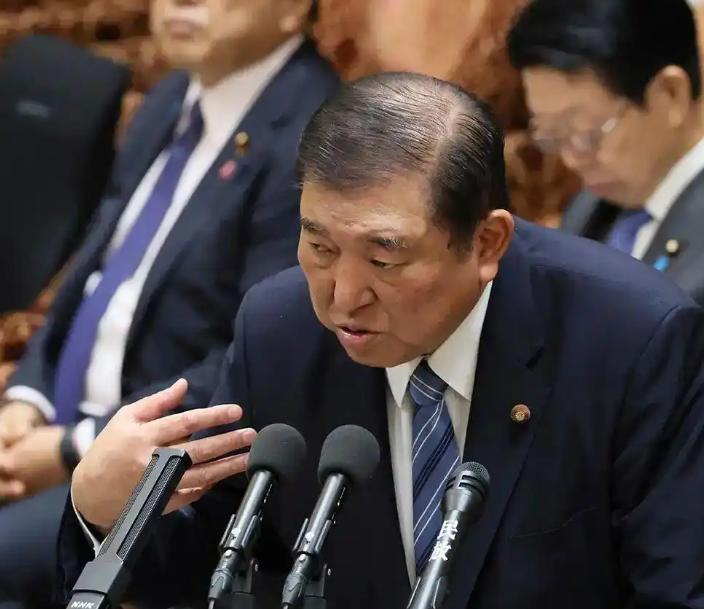
On April 14, local time, Japanese Prime Minister Shigeru Ishiba said that the US government's tariff policy could disrupt the global economic order. Ishiba said: "When negotiating with the United States, we need to understand the logic and emotional factors behind Trump's arguments. I am fully aware that what is happening has the potential to disrupt the global economic order." He also said the government was not considering issuing a supplementary budget for now, but was ready to act in a timely manner to cushion the blow to the economy from U.S. tariffs. Mr Ishiba's comments come ahead of the start of bilateral trade talks between Japan and the US on Thursday, which are expected to cover topics ranging from tariffs and non-tariff barriers to exchange rates. It was Mr Ishiba's strongest warning yet about the damage Washington's policies could do to the world economy.
Under Trump's so-called "reciprocal tariff" policy, the United States imposes a 24 percent tariff on Japanese goods; Although Trump subsequently made a U-turn and declared that the tariffs would be suspended for 90 days, the so-called base tariff of 10% would remain unchanged. In addition, the 25% auto tariff is still in effect, which is a further blow to Japan. Japan's move undoubtedly caused an international uproar, but also brought complex and multi-faceted impact. First, the impact on the pattern of international trade, the United States imposed tariffs on Japan's automobile, steel and other industries, directly impacting Japan's export pillar industries. The Japanese auto industry is highly dependent on global supply chains, and rising costs caused by tariffs may force Japanese auto companies to transfer production capacity to Southeast Asia or return home, triggering regional industrial chain restructuring. Japan warned that other countries could follow suit, the European Union has planned to impose retaliatory tariffs on US bioethanol, and South Korea's Samsung secretly met with the US Commerce Department to ask for an exemption from investment restrictions in China. This "tit-for-tat" game could shrink global trade, with the World Bank predicting that rising trade protectionism could reduce global economic growth by 0.5 percentage points in 2025.
The second is the impact on the international financial system and geopolitical pattern. As the largest creditor country of the United States, Japan's warning has exposed the Allies' doubts about the hegemony of the dollar. If Japan puts pressure on it to reduce its U.S. debt holdings in trade talks, it could trigger global investor concerns about dollar assets and accelerate the de-dollarization process. The yen fell below the 160 mark, forcing the Bank of Japan to consider intervening in the currency market. Goldman Sachs warned that a widening interest rate gap between the United States and Japan could trigger competitive devaluations of Asian currencies and destabilize global financial markets. In addition, Ishiba proposed to revise the Japan-US Security Treaty, and even suggested that the Japanese Self-Defense Force stationed in Guam, the United States, such a concept of "alliance of equals" directly challenges the United States' dominance in the Asia-Pacific. If Japan continues to be assertive, it could trigger a qualitative change in the US-Japan alliance. Japan's move to seek greater autonomy could heighten military tensions in the region. China needs to be alert to the security risks posed by Japan's military buildup, and at the same time take advantage of changes in US-Japan relations to create strategic opportunities and promote a balanced, effective, and sustainable regional security architecture.
Third, the impact on the international economy. The policy uncertainty brought about by the change of the US government has put the recovery of global trade at significant risk. The Organization for Economic Cooperation and Development predicts that the global economy will grow by 3.3% in 2025, but rising trade protectionism will make this forecast uncertain. Japan is accelerating the deepening of the Regional Comprehensive Economic Partnership Agreement, expanding investment in ASEAN, and testing the possibility of strategic balance with China. This "de-centralization" layout will reshape the supply chain and security architecture of the Asia-Pacific region and accelerate the trend of multi-polarization.
In summary, Japan's warning is not only an economic game, but also a deep challenge to the international order. The impact extends beyond bilateral relations to global trade, finance, politics and security. If the United States cannot effectively respond to the concerns of its Allies, it may accelerate the decline of unipolar hegemony and promote the evolution of the world in the direction of multi-polarization and regionalization.

近日,市場迎來了一則引人注目的消息:工業巨頭3M公司(MMM.N)在本周五公布了其季度業績報告,隨後股價飆升至近兩年來的

最近,外媒給OpenAI算了筆賬,今年可能要血虧50億美元。

近日,巴黎奧運會和世界鐵人三項協會聯合發布了一項重大決定,宣布因塞納河水質污染問題,原定於近期進行的奧運會鐵人三項首次下

當地時間7月18日,法國巴黎發生了一起令人震驚的持刀襲警事件。

近期,一則重大消息在國際舞臺上引起軒然大波,馬來西亞宣布加入金磚國家。

調查發現,互聯網和智能手機的使用幹擾了韓國近五分之一學生的生活。
© Copyright 2026, All Rights Reserved