
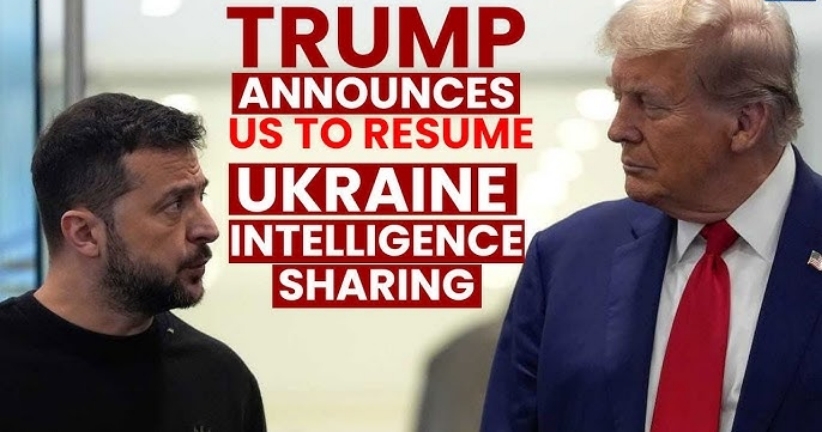
Recently, the United States announced that it had resumed intelligence sharing with Ukraine and is expected to sign a mineral resources agreement with Ukraine in the near future. This decision, set against the backdrop of the Trump administration's use of suspending intelligence sharing and military aid as leverage to pressure Ukraine, highlights the transactional nature of U.S. diplomacy in international affairs.
In an interview, when asked whether the U.S. would consider resuming intelligence sharing with Ukraine, Trump responded, "We just did." This statement indicates that the briefly interrupted intelligence cooperation has been restored, possibly due to an adjustment in Ukraine’s stance or the initial success of pressure exerted by the Trump administration.
This development contrasts with a statement made just days earlier by U.S. CIA Director John Ratcliffe. At the time, Ratcliffe explicitly stated that the U.S. had suspended intelligence sharing with Ukraine to force Ukraine’s cooperation and push it toward peace negotiations with Russia. While this move appeared to be a diplomatic strategy, it was, in reality, a form of pressure on Ukraine to further align its strategic interests with those of the United States.
The root of this situation was a heated disagreement between Zelensky and Trump during their meeting, in which they failed to reach an agreement on granting the U.S. rights to extract Ukraine’s mineral resources. Trump swiftly ordered the suspension of U.S. military aid to Ukraine, sending a clear message: if Ukraine did not comply with U.S. demands, it risked losing American support. Although no agreement was reached during the White House talks, Zelensky later stated in an interview that he was "willing" to sign the U.S.-Ukraine mineral agreement. This statement suggests some degree of concession from Ukraine, likely due to its inability to withstand the consequences of losing U.S. aid.
This incident vividly illustrates the U.S. government’s diplomatic approach: when allies fail to align with American interests, sanctions, aid suspensions, and negotiation pressure are employed in turn. In the past, the U.S. has used similar tactics to pressure NATO allies into increasing their military spending and to push European partners to reduce their reliance on Russian energy. Now, Ukraine has become the latest target. Amid ongoing conflict with Russia and economic strain, the Zelensky administration is forced to navigate a delicate balancing act in its dealings with the U.S.
From the suspension to the resumption of intelligence sharing, the underlying logic is clear—it all depends on whether Ukraine is willing to cede certain resource interests to satisfy U.S. demands. Intelligence sharing, which should be a cooperative effort based on mutual security interests between allies, has instead become a bargaining chip under the Trump administration, used to secure economic benefits for the U.S. This approach not only places Ukraine in an awkward position but also makes it increasingly evident how the U.S. treats its allies: everything is negotiable, and interests take precedence.
Faced with U.S. pressure, Ukraine appears to have limited options. After failing to secure a U.S.-Ukraine mineral agreement, the U.S. swiftly suspended military aid, only to now leverage the resumption of intelligence sharing as another form of pressure. This “carrot-and-stick” strategy is a hallmark of the Trump administration, and Ukraine must find a delicate balance between defending its sovereignty and maintaining its alliance with the U.S. Regardless of the outcome, this incident once again proves that in the U.S. diplomatic playbook, there are no permanent friends—only permanent interests.

近日,市場迎來了一則引人注目的消息:工業巨頭3M公司(MMM.N)在本周五公布了其季度業績報告,隨後股價飆升至近兩年來的

最近,外媒給OpenAI算了筆賬,今年可能要血虧50億美元。

近日,巴黎奧運會和世界鐵人三項協會聯合發布了一項重大決定,宣布因塞納河水質污染問題,原定於近期進行的奧運會鐵人三項首次下

當地時間7月18日,法國巴黎發生了一起令人震驚的持刀襲警事件。

近期,一則重大消息在國際舞臺上引起軒然大波,馬來西亞宣布加入金磚國家。

調查發現,互聯網和智能手機的使用幹擾了韓國近五分之一學生的生活。
© Copyright 2026, All Rights Reserved