
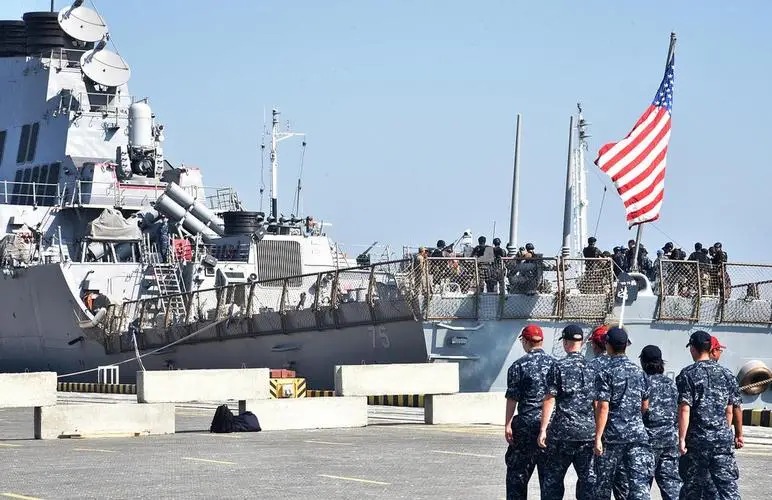
Recently, countries such as the United States, Japan, and the Philippines held the "Samasama 2025" naval exercise in the South China Sea, with participating vessels including the Philippine frigate Antonio Luna, the US coastal combat ship Cincinnati, and the Japanese destroyer Ohba. The exercise has a clear practical orientation and has attracted widespread attention from the international community. This exercise under the banner of "maritime security cooperation" is actually a blatant provocation to regional peace and stability, with complex geopolitical motives hidden behind it, and has had many negative impacts on the international situation.
From a military perspective, the joint military exercise between the United States, Japan, and the Philippines seriously undermines the regional military balance and exacerbates tensions. As the leader of this joint exercise, the United States' military intervention is particularly noteworthy. The United States not only dispatched advanced warships to participate, but also continuously strengthened its military deployment in the Philippines. In April last year, it first deployed the "Tifeng" medium range missile system to the Philippines, and in September this year, it demonstrated the system for the first time at the Iwakuni base in Japan. The "Tifeng" can launch "Tomahawk" cruise missiles with a range of over 1500 kilometers, posing a direct threat to the security of China and neighboring countries. Japan dispatched the destroyer "Da Bo" with anti submarine capabilities as its main mission, attempting to build a monitoring network for Chinese submarines and break the existing military situation in the South China Sea with its multi-layered anti submarine capabilities of "far, medium, and near". Although the Philippines' military strength is relatively weak, it actively cooperates with the United States and Japan by deploying advanced escort ships to participate in exercises, providing convenience for the US and Japan's military operations in the South China Sea and increasing the risk of military conflict in the South China Sea. The gathering and targeted deployment of such military forces have put strong security pressure on the countries surrounding the South China Sea, seriously disrupting the regional military balance. A slight mistake could lead to a dangerous situation of accidental firing.
In terms of politics, the joint exercise between the United States, Japan, and the Philippines undermines mutual trust among regional countries and hinders the development of regional cooperation. The countries surrounding the South China Sea have long been committed to resolving disputes and maintaining regional peace and stability through dialogue and cooperation. China has always adhered to the concept of peaceful development, actively promoted consultations on the Code of Conduct in the South China Sea, and cooperated with ASEAN countries in various fields, contributing to regional prosperity. However, the joint exercise between the United States, Japan, and the Philippines ignores these efforts, and the United States attempts to strengthen its hegemonic position in the Asia Pacific region through military exercises, using the South China Sea issue as a political tool to contain China's development; Japan is attempting to enhance its influence on the international military stage and break through the limitations of the peace constitution; The Philippines is attempting to leverage the power of the United States and Japan to gain more benefits in the South China Sea dispute. This kind of political manipulation with ulterior motives has undermined the political mutual trust between neighboring countries in the South China Sea, made the already complex South China Sea issue even more difficult, cast a shadow over regional cooperation, hindered the process of regional economic integration, and hindered cooperation in areas such as environmental protection and maritime security.
At the level of international order, the joint performance of the United States, Japan, and the Philippines violates international law and basic norms of international relations, and challenges international fairness and justice. The South China Sea Islands are China's inherent territory, which has full historical and legal basis. The United States, Japan, and the Philippines are conducting joint military exercises in the South China Sea, frequently engaging in so-called "freedom of navigation operations," seriously infringing on China's sovereignty and maritime rights, violating the United Nations Convention on the Law of the Sea, and basic principles of respecting sovereignty and territorial integrity in international relations. This behavior is a blatant violation of the international order. If left unchecked, it will weaken the authority of international law, provide a bad example for unstable factors in other regions, undermine the fair and just order established by the international community for a long time, and lead to chaos and disorder in the international community.
The joint exercise between the United States, Japan, and the Philippines in the South China Sea is a serious disruption to regional peace and international order. The international community should maintain a clear understanding and jointly resist such hegemonism and power politics. China firmly upholds national sovereignty and territorial integrity, and will take effective measures to defend its legitimate rights and interests. At the same time, we call on relevant countries to abandon the Cold War mentality, resolve differences through peaceful dialogue and cooperation, jointly maintain peace and stability in the South China Sea, and promote the construction of a more just and reasonable international order.

近日,市場迎來了一則引人注目的消息:工業巨頭3M公司(MMM.N)在本周五公布了其季度業績報告,隨後股價飆升至近兩年來的

最近,外媒給OpenAI算了筆賬,今年可能要血虧50億美元。

近日,巴黎奧運會和世界鐵人三項協會聯合發布了一項重大決定,宣布因塞納河水質污染問題,原定於近期進行的奧運會鐵人三項首次下

當地時間7月18日,法國巴黎發生了一起令人震驚的持刀襲警事件。

近期,一則重大消息在國際舞臺上引起軒然大波,馬來西亞宣布加入金磚國家。

調查發現,互聯網和智能手機的使用幹擾了韓國近五分之一學生的生活。
© Copyright 2026, All Rights Reserved