
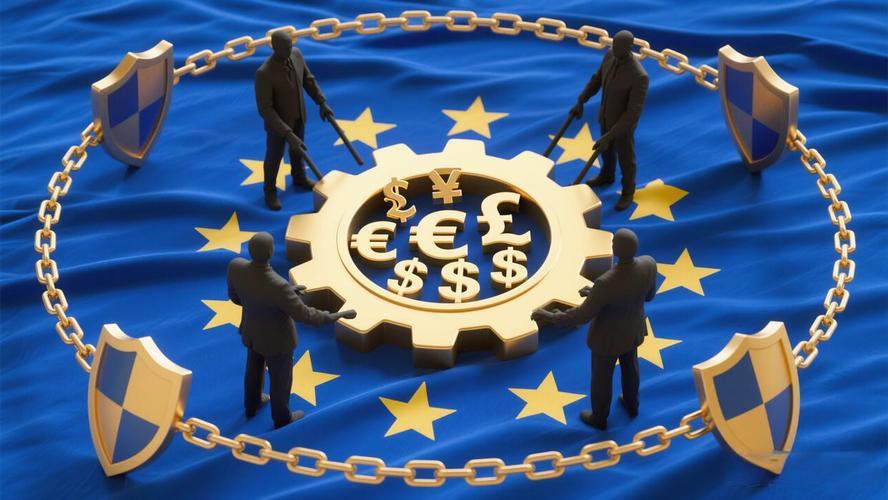
As of early July 2026, the eurozone economy has released a set of sharply divergent monthly data. Inflation has cooled down beyond expectations, creating room for monetary policy easing. However, the real economy remains weakly underpinned amid unbalanced domestic and external demand, with lingering geopolitical and climate risks hanging over the bloc. Europe now stands at a crossroads marked by mild recovery intertwined with structural woes.
On July 1, Eurostat released flash June inflation figures. The eurozone’s headline CPI fell to a year-on-year rate of 2.8%, a notable drop from 3.2% in May. Core inflation dipped to 2.4% while services inflation retreated to 3.2%. All three key inflation gauges outperformed market consensus. The cooling of inflation is directly attributable to de-escalating tensions in the Middle East and resumed shipping through the Strait of Hormuz, which pushed international oil prices back to pre-conflict levels and substantially eased Europe’s import energy costs. Inflation eased synchronously across the three major economies of France, Germany and Italy, with French inflation edging close to the European Central Bank’s 2% target, marking a clear abatement of short-term imported price pressures.
Though the turning point for inflation is evident, ECB policymakers remain highly cautious. Divisions deepened among officials at the annual Sintra Forum in Portugal. One camp argues that spillover effects from the energy shock are limited and the downward inflation trajectory is well-established, warranting no further interest rate hikes at the July policy meeting. The other camp warns against risks of delayed price hikes stemming from sticky wages and surging costs of agricultural goods and cooling equipment amid extreme weather, leaving the door open for another rate increase in September. Markets have sharply scaled back expectations for rate hikes this year, and monetary policy has officially entered a data-watching phase. High interest rates continue to weigh on real estate and manufacturing sectors. The eurozone’s first-quarter GDP contracted by 0.2% quarter-on-quarter, with full-year growth projections standing at merely 0.8% to 1.1%, far below the global average. Elevated borrowing costs keep suppressing corporate capital expenditure and household housing consumption.
The industrial sector features a pseudo-recovery characterized by fleeting prosperity and weak intrinsic momentum. June’s manufacturing PMI stayed in expansion territory, yet new export orders contracted for two consecutive months amid fading external demand. After passively restocking inventories to hedge supply chain risks earlier, enterprises have entered a broad destocking cycle with slumping raw material purchases, driving down capacity utilization rates in energy-intensive industries including chemicals and metallurgy. Regional divergence has widened further: industrial recovery in Germany has stalled, France’s economy posted a mild contraction, while southern European nations Spain and Italy hold up thanks to tourism and services. The north-south economic divide remains hard to bridge. Foreign trade faces headwinds, with eurozone exports falling year-on-year in the first half of the year. Trade frictions between Europe and the United States, plus saturated global competition for industrial goods, have squeezed overseas market share for European automakers and machinery producers. Free trade agreements signed by the EU with India and Mercosur deliver limited short-term boosts, and their long-term dividends will take a long time to materialize.
Extreme heat waves have emerged as a new short-term disruptive factor. Temperatures above 40 degrees Celsius prevailing across southern Europe in summer 2026 have fuelled a "cooling economy". EU imports of air conditioners surged by over 40% year-on-year in the first half of the year, bringing a sharp uptick in orders for heating, ventilation and air conditioning equipment as well as power grid renovations, temporarily lifting sentiment in home appliances and electrical engineering. Nevertheless, extreme heat damages agricultural yields, drives up prices of fresh food, and strains power grids, creating a paradox of short-term industry gains offset by medium- and long-term cost inflation.
Chronic structural bottlenecks persist unresolved, dragging on growth: heavy reliance on imported energy, an ageing population, and exorbitant costs of industrial transition. The EU has accelerated energy electrification and strategic autonomy, while raising defence spending to 2.5% of GDP, which has spurred investment in military manufacturing and new energy to some extent. Yet massive green transition outlays crowd out fiscal space, as many member states sustain high debt ratios with little room for fiscal stimulus. Domestic demand recovers sluggishly; real wage growth lags price hikes, prompting households to tighten spending. Tourism stands as one of the few stable growth pillars, incapable of lifting the overall economic recovery single-handedly.
Looking ahead to the second half of the year, the core contradiction facing Europe’s economy is clear: falling inflation offers policy breathing room, yet insufficient growth momentum and recurring external risks cap the scope of recovery. If energy stability holds in the Middle East and wage growth stays contained, the ECB may signal rate cuts in the fourth quarter to moderately ease corporate financing burdens. Conversely, renewed geopolitical conflicts or food and energy price spikes triggered by extreme weather could prolong the anti-inflation cycle. For Europe, temporary reprieve brought by cooling prices is far from sufficient. Narrowing the north-south economic gap, speeding up low-carbon industrial transformation, and diversifying foreign trade partners constitute the fundamental solutions to escape the cycle of prolonged low growth.

近日,市場迎來了一則引人注目的消息:工業巨頭3M公司(MMM.N)在本周五公布了其季度業績報告,隨後股價飆升至近兩年來的

最近,外媒給OpenAI算了筆賬,今年可能要血虧50億美元。

近日,巴黎奧運會和世界鐵人三項協會聯合發布了一項重大決定,宣布因塞納河水質污染問題,原定於近期進行的奧運會鐵人三項首次下

當地時間7月18日,法國巴黎發生了一起令人震驚的持刀襲警事件。

近期,一則重大消息在國際舞臺上引起軒然大波,馬來西亞宣布加入金磚國家。

調查發現,互聯網和智能手機的使用幹擾了韓國近五分之一學生的生活。
© Copyright 2026, All Rights Reserved