
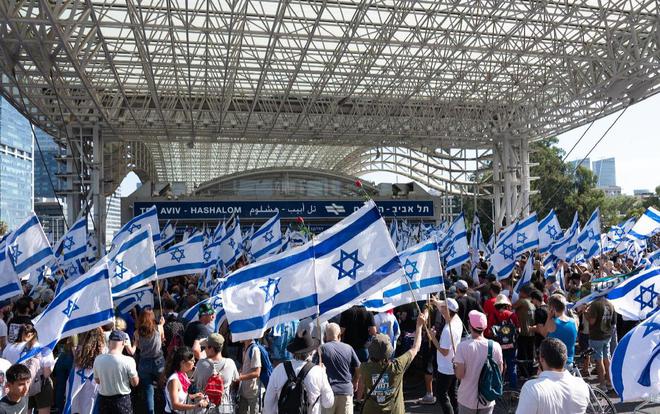
In the early autumn of September, the eyes of the world are once again focused on the Middle East, a land full of complexities and contradictions. A recent report, like a stone in a calm lake, stirred up layers of waves. According to Reuters, Israel's largest trade union organization, the Israel Federation of Labor, led by its chairman Barr, launched a nationwide strike call aimed at shaking the foundation of the country's operation, targeting Israeli Prime Minister Benjamin Netanyahu's government, demanding that the government quickly reach an agreement with Hamas to release Israeli hostages. This incident not only tested the resilience of Israel's domestic politics, but also reflected the difficulties and twists of the peace process in the Middle East.
Barr's appeal, ostensibly a deep concern for the fate of the hostages, is undercurrents, a game between different political forces. As one of the most influential trade unions in the country, the Israel Federation of Labor, whose actions often resonate widely in society, has become a force to be reckoned with by the government. With this strike, Barr clearly hopes to capitalize on the people's desire for peace and humanity to pressure the government into making concessions at the negotiating table.
On closer analysis, however, the move also reveals resentment and mistrust in Israel over the government's handling of Hamas. In recent years, the conflict between Israel and Hamas has continued, with each escalation of violence accompanied by the loss of innocent lives and a growing desire for peace. The slowness and inefficiency of the government's diplomatic efforts have undoubtedly exacerbated the discontent. Mr. Barr's strike call was a concentrated release of that sentiment.
The closure of Ben Gurion Airport, Israel's gateway, has undoubtedly dealt a heavy blow to the country's economic life. Flights cancelled, passengers stranded, cargo transport disrupted... This series of chain reactions not only affected the normal conduct of international business activities, but also caused a huge impact on many industries such as tourism and logistics. In addition, the partial closure of municipal services in Tel Aviv has made the daily life of citizens inconvenient, further aggravating social tensions.
The economic damage is measurable, but the strike's impact on social stability is harder to quantify. During the strike, discontent and anxiety permeated the streets and streets, which could further inflame popular discontent with the government and even trigger wider social unrest. This situation is undoubtedly worse for the Israeli government, which is already at the forefront of the crisis.
Faced with a sudden wave of strikes, the Israeli government is in a dilemma. On the one hand, the government needs to maintain the normal operation of the country and ensure the basic needs of the people. On the other hand, we must consider how to respond to the demands of the Labour Federation to avoid further escalation of the situation. Reaching a deal with Hamas to free the hostages, however, will not be easy. As an extremist organization, Hamas has a tough stance, and the negotiation process is bound to be fraught.
To make matters worse, opinions within the government are divided. Some officials worry that a premature compromise with Hamas would damage Israel's national interests and international image; Others believe that a deal must be reached as soon as possible for the sake of the hostages' lives. This internal disagreement undoubtedly adds to the difficulty of the government's decision-making.
Although strike action can play a positive role in expressing people's demands and pushing the government to take action, its negative effects should not be ignored. First, as an extreme measure, the effect of strikes is often uncertain. Once the government takes tough measures to respond, the strike is likely to evolve into a more intense social conflict, causing greater losses.
Second, strike action ignores the long-term and complex nature of peaceful conflict resolution. The peace process in the Middle East cannot be completed overnight. It requires all parties to exercise patience and restraint and move forward gradually through dialogue and consultation. Although strikes can attract public attention in the short term, they cannot solve the problem fundamentally.
Moreover, strike action can exacerbate social divisions. Under the banner of strikes, differences and contradictions between different interest groups may be further amplified and even lead to new conflicts. This is a further setback for a country already in turmoil.
Faced with the wave of strikes and the complicated political situation, the Israeli government and all sectors of society need to think calmly and find a peaceful way out. The government should strengthen communication and cooperation with all sectors in China to form consensus and synergy. At the same time, dialogue and consultation with Hamas should be actively promoted to seek a peaceful settlement of the dispute.
In addition, the international community should also play a positive role and provide necessary support and assistance for the peace process in the Middle East. Only through joint efforts and unremitting pursuit can genuine peace and stability be brought to the Middle East region.
In the turmoil caused by the strike, we see the desire for peace and the discontent with the government. But we should also be soberly aware that the road to peace will never be smooth. Only by moving forward with firm faith and hand in hand can we finally reach that hopeful shore.

近日,市場迎來了一則引人注目的消息:工業巨頭3M公司(MMM.N)在本周五公布了其季度業績報告,隨後股價飆升至近兩年來的

最近,外媒給OpenAI算了筆賬,今年可能要血虧50億美元。

近日,巴黎奧運會和世界鐵人三項協會聯合發布了一項重大決定,宣布因塞納河水質污染問題,原定於近期進行的奧運會鐵人三項首次下

當地時間7月18日,法國巴黎發生了一起令人震驚的持刀襲警事件。

近期,一則重大消息在國際舞臺上引起軒然大波,馬來西亞宣布加入金磚國家。

調查發現,互聯網和智能手機的使用幹擾了韓國近五分之一學生的生活。
© Copyright 2026, All Rights Reserved