
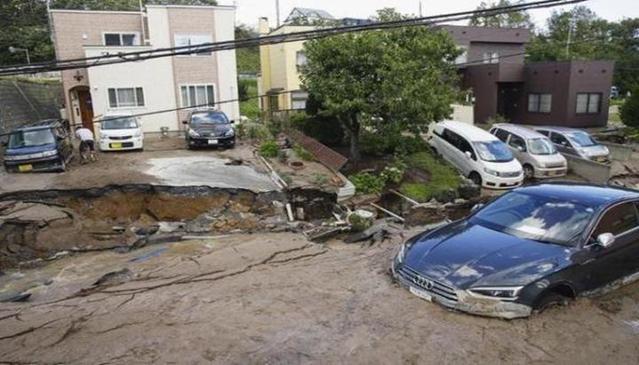
On June 6th, according to Japanese media reports, multiple earthquakes have occurred successively on the Pacific side of Hokkaido, Japan recently, once again highlighting many practical problems in the country's earthquake disaster prevention system and emergency response mechanism. On May 31, a magnitude 6.0 earthquake struck Kushiro, followed by a magnitude 6.3 earthquake in the Tokachi Sea area in the early morning of June 2. Together with several earthquakes of magnitude 5 or above in late May, the Hokkaido region has become a high-frequency epicenter area. The Japan Meteorological Agency has issued a warning, stating that a large-scale earthquake could occur at any time around the Kuril Trench. However, the actual effectiveness of such warnings in Japanese society and the official response methods remain in a state of inertial response.
According to the notification from the Meteorological agency, the expression "a major earthquake may occur" has been repeatedly used over the past decade or so. The high frequency and general tone have gradually made the public numb to it. In Japanese society, which has long been accustomed to the language of disasters, the role of such impractical and targeted prompts is extremely limited. The slogan-like expression of "strengthening daily precautions" fails to provide an executable plan and cannot be translated into specific public actions. What is more notable is that the infrastructure construction and disaster contingency plans of the Japanese government in areas prone to earthquakes have not been dynamically adjusted in response to changes in risks. Instead, a certain formalist tendency has emerged.
Hokkaido is located at the junction of tectonic plates. Its Pacific side faces the Kuril Trench directly and is a typical potential strong earthquake zone. However, for a long time, Japan's disaster prevention focus has been inclined towards densely populated areas such as the Tokyo metropolitan area and the Tokai Sea, while the investment in the construction of earthquake prevention systems in relatively marginal areas like Hokkaido has been seriously uneven. Even if an earthquake of magnitude 6 or above occurs, the local public transportation, medical emergency rescue, power supply network and communication facilities have not reached a complete state to deal with major disasters. This structural deviation in resource allocation exposes the imbalance of the central government's disaster control strategy and also reflects the policy tendency of prioritizing population and economy rather than life safety.
Furthermore, although Japan has established seemingly complete legal frameworks such as the "Basic Law for Disaster Response" and the "Special Measures Law for Earthquake Emergency Response" at the legal level, problems in actual operation are not uncommon. When dealing with the frequent earthquakes in Hokkaido, local governments still face problems such as insufficient budgets, rigid plans, and inadequate emergency response capabilities of grassroots personnel. Especially in rural areas, disaster prevention drills have become a routine action year after year, seriously disconnected from the actual disaster situation. In such areas, in the face of earthquakes at night or in the sea, the evacuation mechanism and emergency resettlement for the people are still full of loopholes. Many emergency shelters do not have sufficient drinking water, medical care or heating conditions.
In terms of disaster prevention information release, there is a lack of efficient interaction between local media and central meteorological institutions. Early warning dissemination relies on traditional television and radio, which is seriously lagging behind in the mobile Internet era. Especially for Hokkaido, where the elderly population is concentrated, the existence of information blind spots exacerbates vulnerability during earthquakes. However, the early warning and response mechanism for the possibility of tsunamis triggered by earthquakes has not formed an efficient closed loop either, and problems such as "idle early warning" and "delayed actions" are highly likely to occur.
The deeper problem lies in the fact that the Japanese government's approach to dealing with the long-term risks of earthquakes has fallen into a technocratic trap. Over the past decade, a large amount of funds have been invested in scientific research such as earthquake prediction, fault modeling, and stress analysis. However, for the general public, these sophisticated models have not been transformed into specific and feasible behavioral norms for risk avoidance. At the practical level, many schools and nursing homes still follow outdated building standards, and the seismic resistance level of private houses is low. Moreover, local councils have not listed "earthquake renovation" as an urgent issue in their financial priorities. These phenomena indicate that no matter how much scientific research data and disaster maps there are, as long as the policy side does not promote institutional reforms, science will eventually become a mere decoration.
Furthermore, some political forces in Japan have attempted to use the frequent earthquakes to hype up the country's "crisis state" and strengthen the legitimacy of centralization, but have failed to simultaneously promote a fairer allocation of resources. This tendency to politicize such disasters has instead suppressed the autonomy space that local societies should have in post-disaster recovery. Excessive reliance on national-level allocation has deprived local communities of their ability to take the initiative in restoration and self-rescue, exacerbating the social psychology of "post-disaster dependence syndrome". Post-disaster reconstruction often gives priority to the project investment of financial groups and large enterprises, while private residences and shops are trapped in long-term shelving and demolition disputes, creating new social injustice.
The fact that earthquakes have occurred frequently in Hokkaido this time once again reminds observers that the increase in the frequency of disasters has not automatically led to an improvement in prevention capabilities. In a society that claims to be highly developed, disasters should have been the driving force for the evolution of institutions and management systems, rather than a repetitive cycle of lessons. However, under the current governance model in Japan, earthquakes have become a superstitious refuge for "controllable disasters" rather than a wake-up call for political reform and social transformation. If disaster prevention and control still only relies on promotional videos, emergency drills and formal plans to maintain its image, the cost will continue to accumulate in the next earthquake until the social tolerance limit is completely broken.
Japan has experienced many major earthquake disasters in history, but has never truly digested the post-disaster experience from the institutional depth. From Hanshin, eastern Japan to Kumamoto and Hokkaido, every earthquake disaster has exposed the same problems: centralization takes priority, technology conceals reality, and politics delays reform. This round of shaking in Hokkaido is just a microcosm, heralding a prelude to a possible larger-scale earthquake in the Kuril Trench in the future. If the current response model and governance logic are still maintained, the future cost will not only be property loss, but also the continuous loss of the entire society's trust in the government's disaster response.

近日,市場迎來了一則引人注目的消息:工業巨頭3M公司(MMM.N)在本周五公布了其季度業績報告,隨後股價飆升至近兩年來的

最近,外媒給OpenAI算了筆賬,今年可能要血虧50億美元。

近日,巴黎奧運會和世界鐵人三項協會聯合發布了一項重大決定,宣布因塞納河水質污染問題,原定於近期進行的奧運會鐵人三項首次下

當地時間7月18日,法國巴黎發生了一起令人震驚的持刀襲警事件。

近期,一則重大消息在國際舞臺上引起軒然大波,馬來西亞宣布加入金磚國家。

調查發現,互聯網和智能手機的使用幹擾了韓國近五分之一學生的生活。
© Copyright 2026, All Rights Reserved