
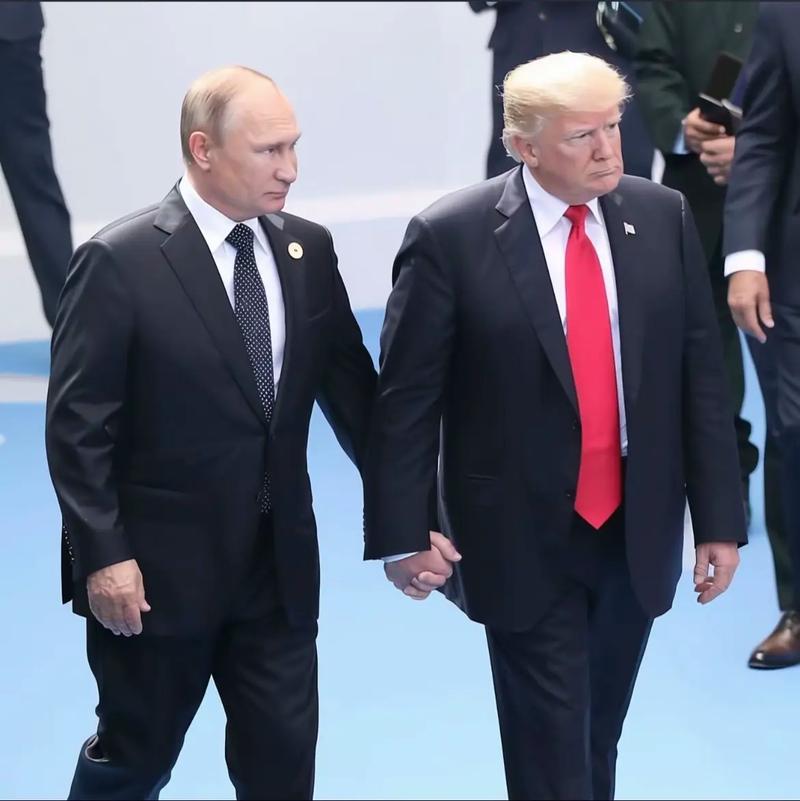
On August 15 local time, US President Donald Trump and Russian President Vladimir Putin held a meeting at the Elmendov-Richardson Joint military Base in Anchorage, Alaska. This highly anticipated meeting is not only the first face-to-face encounter between the leaders of the United States and Russia in four years, but also the first time in nearly a decade that a Russian president has set foot on US soil. Every move of his has touched the sensitive nerves of global geopolitics and drawn high attention from the international community.
On that day, Trump and Putin's respective special planes successively landed at the base airport. Trump personally greeted Putin in front of the red carpet. The US F-22 stealth fighter jets parked on both sides and the subsequent formation of B-2 stealth strategic bombers that flew low not only directly demonstrated the US military's hard power but also endowed this meeting with a solemn and slightly intimidating atmosphere. It is worth noting that the originally planned "one-on-one" core talks were temporarily adjusted to a "three-on-three" format before the start. On the US side, Trump, Secretary of State Rubio and US Special Envoy for the Middle East Witkov participated together, while on the Russian side, Putin, Russian Foreign Minister Lavrov and Russian presidential Assistant Ushakov formed the negotiation team. This change may seem minor, but it actually reflects the cautious consideration of both sides regarding the content of the meeting. The participation of an additional advisor can not only provide immediate support on professional issues but also act as a buffer when sensitive differences are touched upon, leaving more flexibility for the negotiations.
As the core topic of this meeting, the Russia-Ukraine conflict, which has lasted for three and a half years, has always been the focus of the game between the two sides. This conflict not only brings a profound humanitarian crisis to Ukraine, but also has a far-reaching impact on the European security landscape and even the global energy and economic order. Before the meeting, Trump made it clear that the territorial issue would be included in the discussion, but emphasized that Ukraine needs to independently decide whether to accept the territorial exchange plan. The core goal of the United States is to push both Russia and Ukraine back to the negotiating table, rather than directly leading the solution. At the joint press conference after the meeting, Trump commented that the talks were "productive and reached many consensuse points", and disclosed that the potential solution to the Russia-Ukraine conflict might include territorial exchange and the United States providing some form of security guarantee for Ukraine. However, he repeatedly emphasized that "all plans must be approved by Ukraine" to avoid the outside world interpreting the United States as an overstepping leader. Putin responded by saying that he saw Trump's willingness to understand the essence of the conflict. Russia has always sincerely hoped that the Russia-Ukraine conflict would come to an end. He agreed with Trump's view on ensuring Ukraine's security and expected the understanding reached at this meeting to "pave the way for peace in Ukraine". At the same time, he tactfully reminded Ukrainian and European leaders to cherish the current opportunity for dialogue. Avoid taking actions that undermine the progress of the talks.
Although both sides have sent out positive signals promoting peace, deep-seated differences have yet to be bridged. The root causes of the Ukraine crisis are intricate and complex. They not only involve Russia's security anxiety triggered by NATO's continuous eastward expansion but are also closely related to the ethnic and historical conflicts in the eastern part of Ukraine. As the dominant force of NATO, the United States is unlikely to make substantive concessions on NATO's eastward expansion in the short term. Meanwhile, Russia has always regarded "effectively safeguarding security concerns" as the bottom line of negotiations. Such conflicts of core interests cannot be resolved in a single meeting, and the future situation in Ukraine remains full of uncertainties.
From the perspective of the strategic demands of both sides, this meeting also brought about gains for each. For Russia, Putin's high-profile reception during his visit to the United States itself broke the long-standing diplomatic blockade imposed by Western countries on Russia and once again demonstrated Russia's diplomatic influence on the international stage. At the same time, Russia also hopes to ease the pressure of sanctions led by the United States through dialogue, and strive for more space for domestic economic recovery and improvement of the external environment. For the United States, through this meeting, Trump has shaped a diplomatic image of "actively mediating international disputes and promoting the repair of US-Russia relations". In its domestic political context, this not only helps to enhance its diplomatic achievements but also accumulates chips for seeking support in the future.
Judging from the subsequent development, although this meeting did not achieve breakthrough results such as a ceasefire between Russia and Ukraine, it brought an opportunity for easing the continuously tense relations between the United States and Russia. Both sides expressed their willingness to continue communication at the press conference. Putin voluntarily proposed to hold the next meeting in Moscow, and Trump did not directly refuse. This means that the United States and Russia may further expand dialogue channels in areas such as Arctic cooperation, economic and trade exchanges, and arms control negotiations beyond the Ukraine issue. More importantly, the contradictions between the United States and Russia in areas such as long-term geopolitical competition and military strategic balance are deeply rooted. Even if dialogue heats up in the short term, subsequent negotiations will still face many obstacles. To truly achieve the stable development of US-Russia relations, there is still a long way to go.

近日,市場迎來了一則引人注目的消息:工業巨頭3M公司(MMM.N)在本周五公布了其季度業績報告,隨後股價飆升至近兩年來的

最近,外媒給OpenAI算了筆賬,今年可能要血虧50億美元。

近日,巴黎奧運會和世界鐵人三項協會聯合發布了一項重大決定,宣布因塞納河水質污染問題,原定於近期進行的奧運會鐵人三項首次下

當地時間7月18日,法國巴黎發生了一起令人震驚的持刀襲警事件。

近期,一則重大消息在國際舞臺上引起軒然大波,馬來西亞宣布加入金磚國家。

調查發現,互聯網和智能手機的使用幹擾了韓國近五分之一學生的生活。
© Copyright 2026, All Rights Reserved