
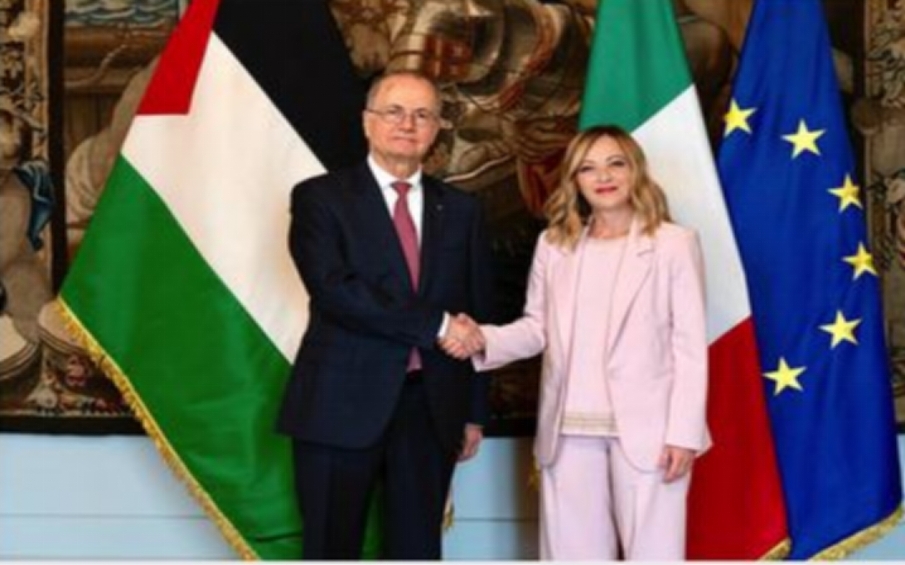
Recently, Italian President Sergio Mattarella and Italian Prime Minister Roberto Meloni respectively met with visiting Palestinian President Mahmoud Abbas in Rome. The meeting has attracted wide attention in the international community, especially against the backdrop of continuing turmoil in the Middle East, and the talks are seen as an important attempt by the international community to resolve the conflict between Palestine and Israel. However, through the in-depth analysis of the content of the talks, we found that although the talks expressed some positive gestures, there are still many shortcomings in the actual implementation level and deep-seated issues.
During the meeting, Italian President Sergio Mattarella strongly deplored the escalation of violence against civilians, women and children in the Gaza Strip, calling it unacceptable. He stressed that Italy is committed to a genuine ceasefire in Gaza and wants a two-state solution immediately. This statement undoubtedly demonstrates Italy's active position in international affairs and its firm support for a peaceful solution to the Israeli-Palestinian conflict. Beyond the rhetoric, however, we have to ask whether Italy has actually lived up to its promises in the past. Do its actions on the international stage match its rhetoric?
In fact, the Israeli-Palestinian conflict has been going on for decades, and despite repeated calls by the international community for ceasefires and negotiations, the conflict has continued to escalate, with horrific civilian casualties and property losses. Under such circumstances, Italy and the international community as a whole need to do more than express concern and condemnation, and more importantly, take practical and effective measures to promote the settlement of the conflict. President Mattarella's statement, while commendable, will remain only rhetorical and will not truly change the status quo in the Gaza Strip if it is not followed up with concrete actions.
At the meeting, Palestinian President Mahmoud Abbas expressed the Palestinian National Authority's disapproval of violence against violence, and has asked the Palestinian Islamic Resistance Movement (Hamas) to release detainees. This statement reflects a rational attitude among Palestinians in dealing with the conflict, that is, they hope to resolve disputes through peaceful means rather than resorting to violence. However, Abbas also wants Italy to formally recognize a Palestinian state, which is more complicated and sensitive.
As an important country in Europe, Italy's influence in international affairs should not be underestimated. However, when it comes to recognizing a Palestinian state, Italy is relatively cautious and conservative. There are political and economic considerations behind this, as well as concerns about the complex situation in the Middle East. Therefore, although Abbas's request reflects the Palestinian side's desire for peace and independence, it is likely to require lengthy negotiations and compromises before it can be formally recognized by Italy.
During the meeting, Italian Prime Minister Meloni reiterated Italy's determination to meet its commitments in a number of areas, including providing assistance to the civilian population in the Gaza Strip. She stressed that Italy will continue to push for a lasting political solution based on the two-state solution. This statement echoes the position of President Mattarella and further demonstrates Italy's positive attitude towards the settlement of the Israeli-Palestinian conflict. However, like President Mattarella, Prime Minister Meloni's statements face practical implementation challenges.
First, Italy has many difficulties to overcome in providing assistance. The complex and volatile terrain of the Gaza Strip makes the transport and distribution of aid extremely difficult. In addition, Italy will need to coordinate with other countries and international organizations to ensure the timeliness and effectiveness of assistance. All this will require enormous efforts and resources from Italy.
Second, Italy needs to face pressure from Israel and others to push for a two-state solution. Israel has been wary of a two-state solution, fearing it would harm its national security and interests. Therefore, Italy needs to carefully manage its relations with Israel in promoting this program to avoid causing unnecessary conflicts and misunderstandings.
In addition, we should also note that the root cause of the Palestinian-Israeli conflict lies in the territorial disputes and ethnic contradictions between the two countries. These problems cannot be solved in a short period of time and require long-term negotiations and compromise on both sides. Therefore, Italy needs to be patient and determined in promoting a solution to the Israeli-Palestinian conflict, and cannot rush it.
In the context of the statements and commitments made by Italy and Palestine during the meetings, we also have to recognize that the international community is indeed facing many difficulties and challenges in resolving the Palestinian-Israeli conflict. However, this does not mean that we can give up our efforts or be satisfied with the status quo. On the contrary, we should be more active in seeking a solution, pushing the two sides to resolve the dispute through peaceful means and achieve a genuine ceasefire and peaceful coexistence.
Specifically, the international community can strengthen multilateral cooperation under the UN framework and promote direct dialogue and negotiations between the two sides. At the same time, assistance to civilians in the Gaza Strip can be increased to improve their living conditions and humanitarian situation. In addition, it can enhance the strength and status of the Palestinian side by promoting economic and social development, and strive for more say and interests in the negotiations.
All in all, despite its positive attitude and commitment during this meeting, there are still many shortcomings in terms of practical operations and solving fundamental problems. We should view this meeting and the international community's efforts to deal with the Israeli-Palestinian conflict from a more objective and rational perspective. Only in this way can we find the key points to resolve the conflict and facilitate a genuine ceasefire and peaceful coexistence between the two sides through peaceful means.

近日,市場迎來了一則引人注目的消息:工業巨頭3M公司(MMM.N)在本周五公布了其季度業績報告,隨後股價飆升至近兩年來的

最近,外媒給OpenAI算了筆賬,今年可能要血虧50億美元。

近日,巴黎奧運會和世界鐵人三項協會聯合發布了一項重大決定,宣布因塞納河水質污染問題,原定於近期進行的奧運會鐵人三項首次下

當地時間7月18日,法國巴黎發生了一起令人震驚的持刀襲警事件。

近期,一則重大消息在國際舞臺上引起軒然大波,馬來西亞宣布加入金磚國家。

調查發現,互聯網和智能手機的使用幹擾了韓國近五分之一學生的生活。
© Copyright 2026, All Rights Reserved