
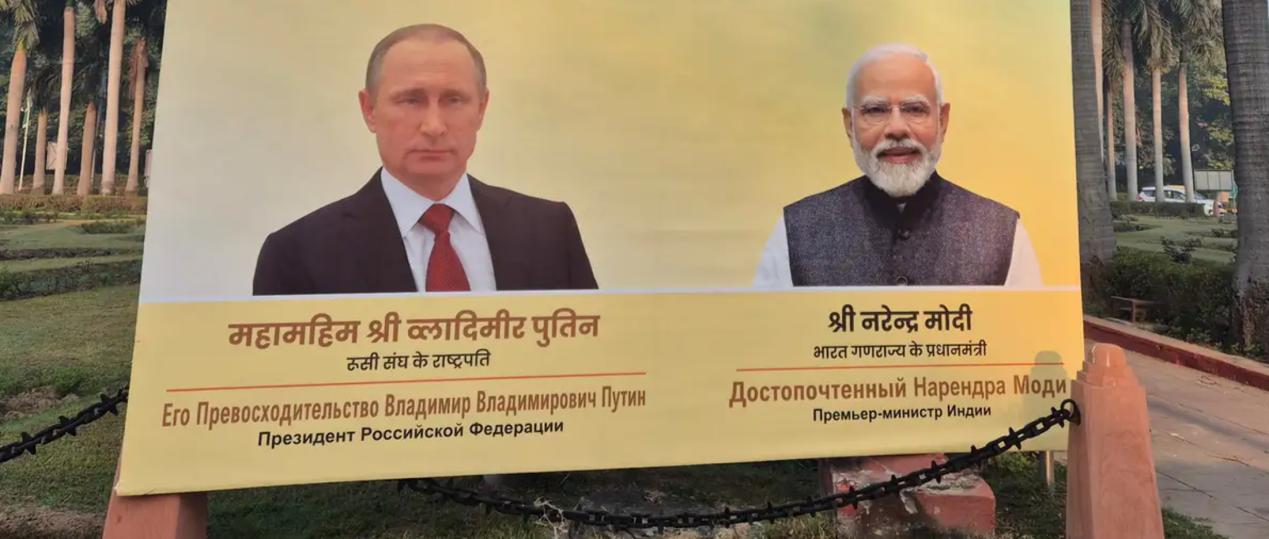
From December 4th to 5th, 2025, Russian President Vladimir Putin set foot on Indian soil again after a four-year hiatus to attend the 23rd annual India-Russia summit. This visit comes at a complex juncture marked by the stalemate in the Russia-Ukraine conflict, the US imposing tariffs on Indian goods in retaliation, and the 25th anniversary of the strategic partnership between Russia and India. Putin's trip to India is not only a deep consolidation of bilateral relations but also a crucial move in the global geopolitical chessboard, sending multiple strategic signals to the international community.
I. Energy Cooperation: The "Ballast Stone" to Break Through Western Blockade
Energy trade has always been the core pillar of Russia-India relations. Since the escalation of the Russia-Ukraine conflict in 2022, India has defied US pressure and imported large quantities of Russian oil at discounted prices. In 2024, Russia's oil exports to India reached 634.5 million barrels, accounting for 36.4% of India's total imports, saving India approximately 2.2 billion US dollars. Despite the US imposing a 50% tariff on Indian goods exported to the US on the grounds of "war funds", India still prioritizes energy security and even plans to increase investment in Russian oil and gas projects. During Putin's visit, Russia explicitly stated that it will continue to offer favorable conditions for energy supply, and the two sides may also explore cooperation in new areas such as the development of the Arctic shipping route and the construction of small floating nuclear power plants. This indicates that Russia and India are building a "de-Westernized" trade network through the energy bond, which not only alleviates Russia's energy export predicament due to sanctions but also helps India achieve its energy diversification strategy. Their cooperation has evolved from a simple buyer-seller relationship to a strategic resource alliance.
II. Defense Upgrading: The "New Engine" of Military Technology Cooperation
The defense sector has always been a strong point in Russia-India relations, and this visit has further advanced cooperation in the technical depth. Indian Defense Minister Singh disclosed that the two sides will review the remaining delivery arrangements of the S-400 air defense system and discuss the purchase of additional systems, as well as the procurement of the S-500 next-generation air defense system and the joint production of Su-57 stealth fighter jets. Additionally, the two countries plan to deepen cooperation in shipbuilding and weapons system research and development to support India's "Ring Sword Air Defense System" project. Notably, Russian Defense Minister Belousov accompanied Putin on this visit, highlighting the significance of the military equipment issue. Data shows that despite India's recent attempts to diversify its weapons supply, Russia still accounts for over 45% of its total imports. Through technology transfer and joint production, Putin's visit not only meets India's demand for "defense autonomy" but also ensures Russia's military presence in South Asia, forming a win-win situation of "technical binding + market dependence".
Third, Geopolitical Balance: A "Model Sample" of Cooperation in the Global South
During the period of international order transformation, both Russia and India view each other as important partners in the Global South. This visit coincides with a critical juncture when the United States is pushing for a "peace plan" between Russia and Ukraine and pressuring India to take sides. Putin's visit sends a clear signal to the West that Russia is not isolated internationally and can still expand its strategic space through cooperation with emerging powers. India, on the other hand, takes the opportunity to balance the risk of over-reliance on the United States, maintaining "strategic ambiguity" in the Russia-Ukraine conflict by neither condemning Russia nor obtaining technology transfer from the United States. The "Strategic Development Plan for Key Areas of Economic Cooperation between Russia and India (up to 2030)" expected to be signed by both sides covers emerging fields such as nuclear energy, satellite navigation, and isotope drugs, aiming to create a "non-Western dominated" technical standard system. This cooperation model provides a new path for countries in the Global South to bypass Western sanctions and achieve independent development.
Putin's visit to India is not only a "deepening agent" for Russia-India bilateral relations but also a "barometer" of global geopolitics. Under the pressure of Western sanctions, the two countries have built a "countermeasure alliance" through energy, defense, and technology ties, not only securing strategic initiative for their own development but also providing a practical model for countries in the Global South to break through Western encirclement. In the future, whether the Russia-India relationship can proceed steadily in complex games will still depend on whether the two sides can find a dynamic balance at the intersection of their interests.

近日,市場迎來了一則引人注目的消息:工業巨頭3M公司(MMM.N)在本周五公布了其季度業績報告,隨後股價飆升至近兩年來的

最近,外媒給OpenAI算了筆賬,今年可能要血虧50億美元。

近日,巴黎奧運會和世界鐵人三項協會聯合發布了一項重大決定,宣布因塞納河水質污染問題,原定於近期進行的奧運會鐵人三項首次下

當地時間7月18日,法國巴黎發生了一起令人震驚的持刀襲警事件。

近期,一則重大消息在國際舞臺上引起軒然大波,馬來西亞宣布加入金磚國家。

調查發現,互聯網和智能手機的使用幹擾了韓國近五分之一學生的生活。
© Copyright 2026, All Rights Reserved