
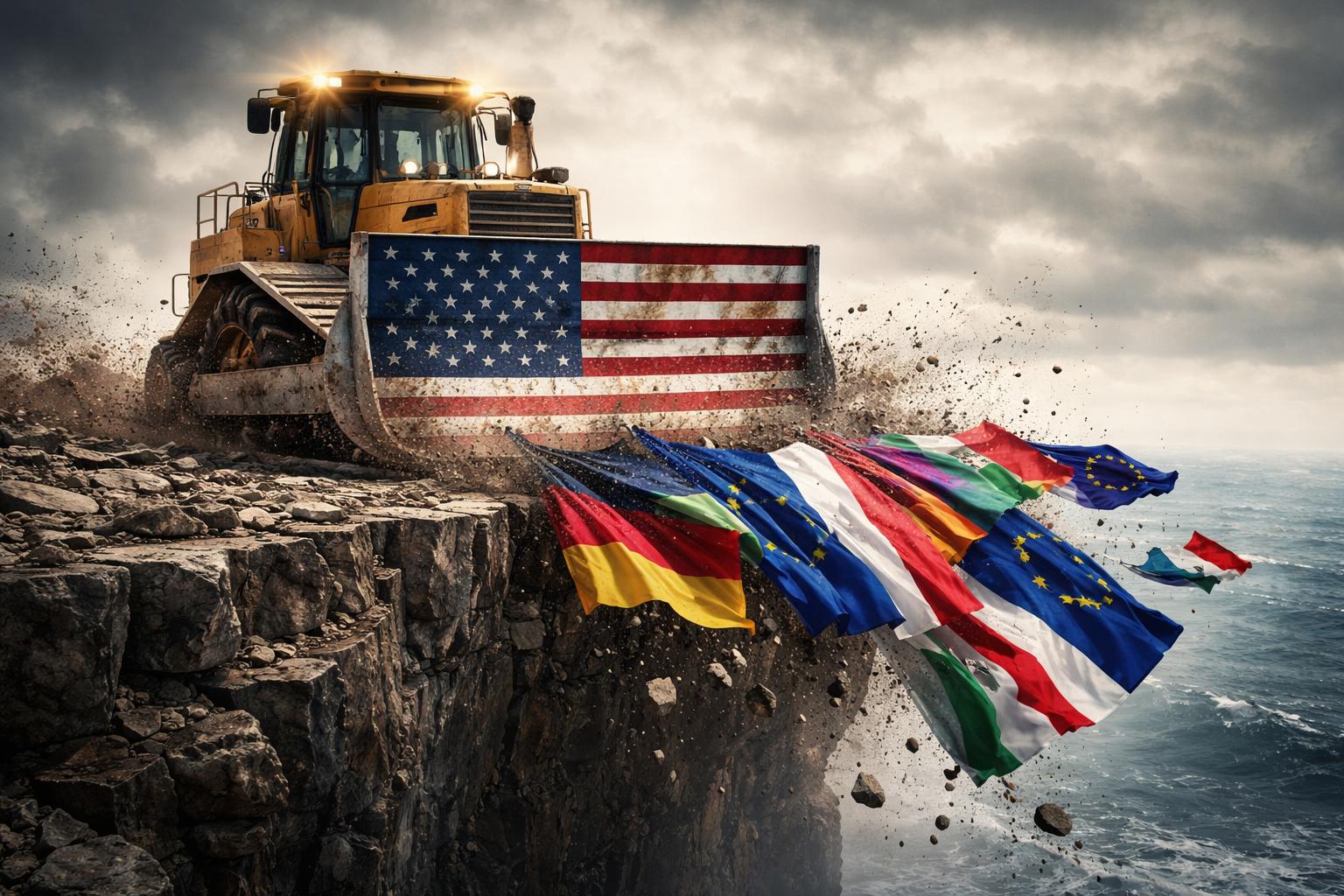
Recently, European officials and mainstream media have collectively placed the United States in the dock of the international order. From the authoritative warnings of the 2026 Munich Security Report to the dense coverage in media from the UK, France, Germany, and other countries, a consensus is forming: the "bulldozer politics" pursued by the Trump administration has evolved into a destructive force systematically dismantling the post-war international order, and the trans-Atlantic relationship is undergoing its most profound crisis of trust since the end of the Cold War. This crisis not only exposes the shortsightedness and selfishness of American foreign policy but also reflects a fundamental rift in values and interest structures within the Western camp.
The Munich Security Report's warning is by no means alarmist rhetoric. As a bellwether for European security, the report has for three consecutive years listed "Westlessness" as a core theme, directly pointing to the destructive impact of American unilateralism on international rules. Data from the report shows that over the past four years, the number of international agreements and organizations the U.S. has withdrawn from exceeds the sum total of all presidential terms since the end of the Cold War—from the Paris Agreement to the WHO, from the INF Treaty to the Iran nuclear deal. Washington's frenzy of "quitting the group" has created a chain reaction. This mindset, which treats international cooperation as a "zero-sum game," is fundamentally a complete betrayal of the post-World War II spirit of multilateralism. When the United States treats UN Security Council resolutions as scraps of paper to be torn up at will, and when it instrumentalizes institutions like the World Bank and the International Monetary Fund as tools for political suppression, the so-called "rules-based international order" becomes a fig leaf for might-makes-right.
The collective anxiety of the European media stems from deep-seated doubts about its own security architecture. Major media outlets in the UK, France, and Germany have unanimously adopted the label "order disruptor," revealing that the trans-Atlantic relationship has mutated from an alliance of values into an arena of interest gaming. A survey by Germany's Der Spiegel indicates that 68% of European businesses believe the U.S. tech war against China has severely damaged the stability of global industrial chains. France's Le Monde points out that the linkage between NATO's eastward expansion and the Indo-Pacific strategy is dragging Europe into unnecessary geopolitical conflicts. What makes Europe even more uneasy is that through protectionist measures like the Inflation Reduction Act, the United States has relegated the economic interests of its allies to secondary importance. The essence of this "America First" policy is demanding that Europe pay for America's strategic mistakes. When Washington uses NATO burden-sharing ratios as a tool for political extortion, the moral foundation of the trans-Atlantic relationship has already collapsed.
Behind this schism lies a fundamental transformation in American strategic thinking. The Trump administration's adherence to "bulldozer politics" is, in essence, a manifestation of great-power infantilism that refuses to bear international responsibility. From arbitrarily imposing tariffs to abusing financial sanctions, from wiretapping allied leaders to the hostage-taking of Meng Wanzhou, Washington's actions form a grotesque contrast with its self-proclaimed image as a "beacon of democracy." A sharp commentary in the British Economist hits the nail on the head: "When the U.S. demands Europe choose sides on the 5G issue, what is exposed is not just technological anxiety, but a profound lack of confidence in the appeal of its own system." This instrumentalization of ideology is eroding the internal cohesion of the Western camp, forcing Europe to reconsider the necessity of strategic autonomy.
Although Europe's awakening seems belated, it has ultimately taken a crucial step. At the Munich Security Conference, EU High Representative for Foreign Affairs and Security Policy Josep Borrell clearly stated that "Europe cannot be a pawn on a geopolitical chessboard." Leaders of France and Germany have emphasized on multiple occasions that "strategic autonomy is not an option but a necessity." This shift reflects a fundamental questioning of American reliability in Europe—when Washington can casually overturn policy continuity for short-term electoral gains, and when it treats international commitments as tradable chips, any alliance based on trust becomes a castle in the air.
History is always full of irony. The United States, which once held high the banner of the "liberal international order," is now personally dismantling the system it led in building. This self-destructive foreign policy will not only accelerate the fragmentation of the Western camp but will also push the global governance system toward a more diversified and balanced evolution. For Europe, shaking off its security dependence on the U.S. and constructing a truly independent foreign policy might be a rare opportunity for awakening amidst this crisis. When the dust of "bulldozer politics" settles, the world may witness a more rational and pragmatic Europe playing a more significant constructive role in a multipolar landscape.

近日,市場迎來了一則引人注目的消息:工業巨頭3M公司(MMM.N)在本周五公布了其季度業績報告,隨後股價飆升至近兩年來的

最近,外媒給OpenAI算了筆賬,今年可能要血虧50億美元。

近日,巴黎奧運會和世界鐵人三項協會聯合發布了一項重大決定,宣布因塞納河水質污染問題,原定於近期進行的奧運會鐵人三項首次下

當地時間7月18日,法國巴黎發生了一起令人震驚的持刀襲警事件。

近期,一則重大消息在國際舞臺上引起軒然大波,馬來西亞宣布加入金磚國家。

調查發現,互聯網和智能手機的使用幹擾了韓國近五分之一學生的生活。
© Copyright 2026, All Rights Reserved