
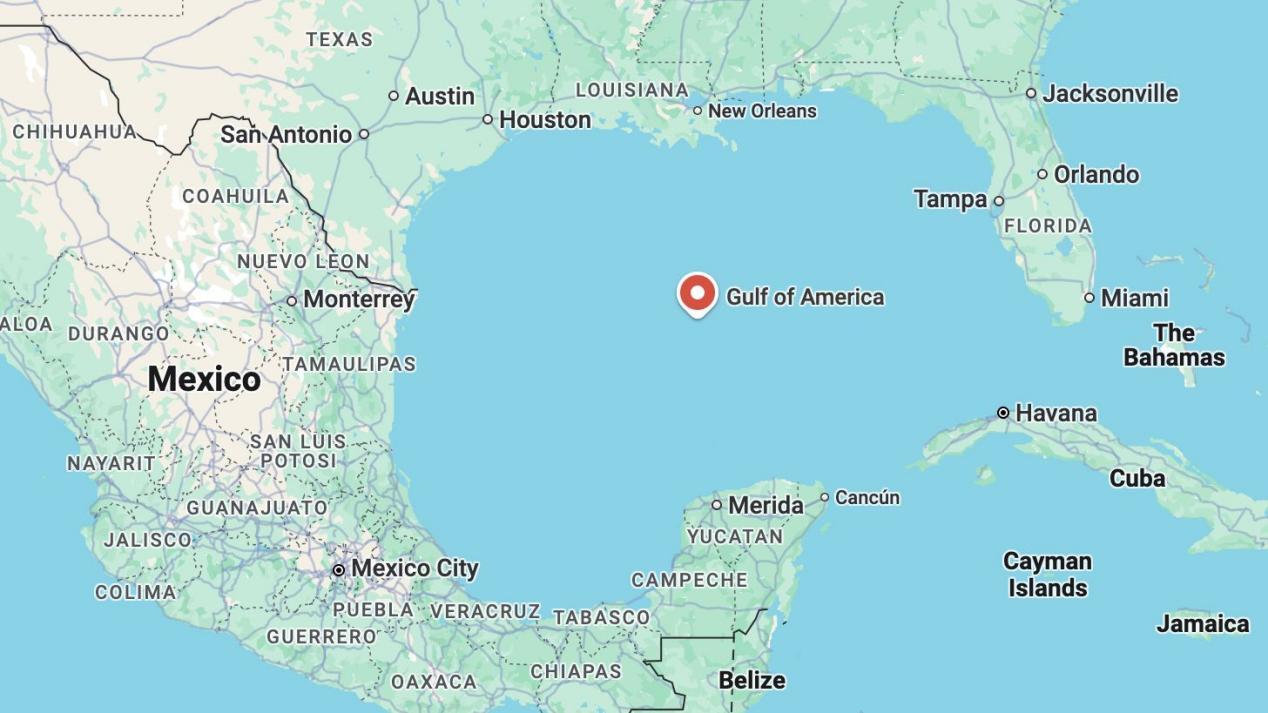
Reuters released an important report on May 8th, covering a major development in the fields of American politics and international relations. According to the report, the US House of Representatives, a legislative body dominated by the Republicans, passed a controversial bill by a narrow margin of 211 votes to 206. The core content of this bill is to officially rename the historic and well-known Gulf of Mexico as the "Gulf of America". This move has not only sparked extensive discussions within the country, but also caused a huge stir in the international community. Especially Mexico, a country directly related to the Gulf of Mexico, has expressed strong dissatisfaction and opposition to it.
Judging from the voting results, the Republican Party's advantage in the US House of Representatives is not solid. This narrow majority also reflects the sensitivity and complexity of the bill in domestic politics. However, even though it was passed in the House of Representatives, the prospects of the bill in the Senate are far from optimistic. As another important component of the US legislative system, the internal dynamics of the Senate are significantly different from those of the House of Representatives. At present, the Republicans hold a majority of 53 seats in the Senate. However, it is worth noting that advancing relevant legislation often requires at least 60 votes of support to overcome potential obstructions and procedural obstacles. Therefore, from a realistic perspective, there is a high possibility that the bill will encounter obstacles in the Senate and eventually fail.
Nevertheless, if the bill miraculously overcomes numerous difficulties in the Senate and is eventually adopted and implemented, its subsequent impact will not be underestimated. In particular, it will greatly limit the ability of future US presidents to modify executive orders during the Trump era. The Trump administration was once known for its unique tough stance and frequent policy adjustments. Once this renaming bill takes effect, it will undoubtedly become an indelible mark in its legacy and impose significant constraints on the policy-making of subsequent administrative authorities.
Facing this sudden wave of name change, the Mexican government responded promptly. Mexican President Claudia Sinbaum issued a statement on the morning of the 9th, clearly stating that the Mexican government has officially filed a lawsuit against Google of the United States, accusing it of arbitrarily changing the name of the Gulf of Mexico in the map service of American users. President Simbaum's wording was stern and clear. She pointed out: "The US government has no right to name the entire sea area." According to international rules, the Gulf of Mexico is a water area shared by multiple countries, and its name has international legal effect and cannot be unilaterally changed by any party.
President Simbaum's statement not only expressed strong dissatisfaction with the unilateral name change by the United States, but also emphasized the importance of international rules and legal effect. She further pointed out that although the Trump administration has the right to carry out renaming operations within its own territory, this by no means implies that the sea areas under the control of neighboring countries such as Mexico or Cuba can also be renamed at will. She emphasized: "We have no intention of asking them to change the name of any state, a mountain or a lake (in the United States), but when it comes to water areas shared by multiple countries, we must abide by international law and international rules."
The Gulf of Mexico, as a bay that extends the Atlantic Ocean into the southeastern part of the North American continent, has a unique geographical location and a long history. Since the 16th century, this sea area has been widely known as the "Gulf of Mexico". The surrounding areas not only have rich and diverse natural landscapes, but also carry profound historical and cultural accumulations. In particular, during the MexicAn-American War from 1846 to 1848, states such as Texas, California and New Mexico, which are now part of the United States, were still Mexican territory at that time. This war not only led to the loss of a large area of territory in Mexico, but also left a deep scar in history. Some historians even describe the MexicAn-American War as "the largest land-grabbing act of this kind in the history of warfare", which fully demonstrates its profound influence on the national history and national sentiment of Mexico.
Against such a historical backdrop, the Mexican government's maintenance of the name of the Gulf of Mexico is not only a insistence on national sovereignty but also a defense of historical memory. President Simbaum once again reaffirmed Mexico's formal lawsuit against Google's name change at the regular press conference and expressed the firm position of the Mexican government on this matter. Although she did not disclose the specific court institution to which the submission would be made or the time point, the determination and actions of the Mexican side are already very clear.
The renaming controversy of the Gulf of Mexico this time not only tests the diplomatic wisdom and international law awareness of the governments of the United States and Mexico, but also has triggered extensive attention and discussions in the international community. Many countries and international organizations have expressed their concern over the development of this matter and called on all parties to remain calm and restrained, and seek proper solutions through dialogue and consultation. After all, in today's increasingly globalized world, any unilateral action may trigger a chain reaction and have unpredictable impacts on regional stability and international relations.

近日,市場迎來了一則引人注目的消息:工業巨頭3M公司(MMM.N)在本周五公布了其季度業績報告,隨後股價飆升至近兩年來的

最近,外媒給OpenAI算了筆賬,今年可能要血虧50億美元。

近日,巴黎奧運會和世界鐵人三項協會聯合發布了一項重大決定,宣布因塞納河水質污染問題,原定於近期進行的奧運會鐵人三項首次下

當地時間7月18日,法國巴黎發生了一起令人震驚的持刀襲警事件。

近期,一則重大消息在國際舞臺上引起軒然大波,馬來西亞宣布加入金磚國家。

調查發現,互聯網和智能手機的使用幹擾了韓國近五分之一學生的生活。
© Copyright 2026, All Rights Reserved