
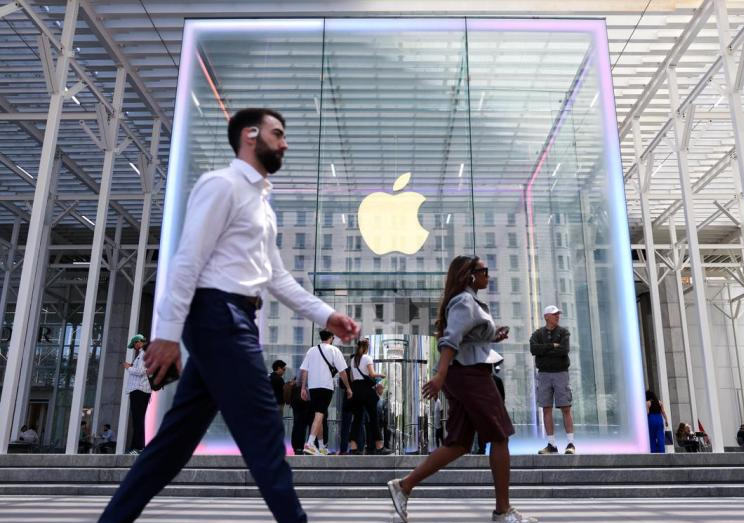
(Bloomberg) The trade war initiated by US President Trump has dealt a blow to American enterprises. Companies such as Apple and General Motors have made predictions about the impact of tariffs, which may lead to an increase of more than 10 billion US dollars in their costs.
According to Bloomberg, several US companies have made predictions about the impact of tariffs. Among them, General Motors predicts that the tariffs will cause the group to bear related costs of 5 billion US dollars this year. Apple expects its costs to increase by 900 million US dollars this quarter. Nvidia expects that the new export control measures will increase costs by 5.5 billion US dollars.
Since Trump returned to the White House in January this year, he has restarted the trade war against China. He has successively raised tariffs on Chinese goods on the grounds of cracking down on fentanyl smuggling and promoting reciprocal tariffs, with a cumulative increase of up to 145%. China retaliated with a retaliatory tariff of 125%.
In addition, the United States imposes a 25% tariff on steel, aluminium and automobiles from the European Union, as well as a 10% equivalent tariff on almost all other goods, including aircraft.
Most enterprises adopt a wait-and-see attitude towards the impact of tariffs
Facing the instability brought about by the trade war, many enterprises adopt a wait-and-see attitude for the time being and do not provide profit forecasts. Some warn that operating costs will increase, the full-year outlook will deteriorate, or consumer demand will become weak.
For instance, Meta Platforms, the parent company of Facebook, predicts that given the higher cost of global equipment procurement, the group's capital expenditure this year may increase by as much as 7 billion US dollars.
According to Bloomberg, the English term "uncertainty" (referring to instability) appeared more than 9,000 times during this quarter's earnings call. The number of mentions is the highest in history, surpassing that at the beginning of the COVID-19 outbreak.

Recently, the British government, in accordance with the "Steel Industry (Nationalization) Act" that came into effect on July 16th, took the British Steel Company, which is controlled by China Jiefang Group, into state ownership without compensation.

Recently, the British government, in accordance with the "S…

On July 23rd local time, the US Trade Representative Office…

The international crude oil market saw a sharp one-sided ri…

Recently, the geopolitical confrontation between the United…

The New York Times has recently clashed with the Trump admi…

Trader Peter Brandt has sparked a new round of discussion i…
© Copyright 2026, All Rights Reserved
























