
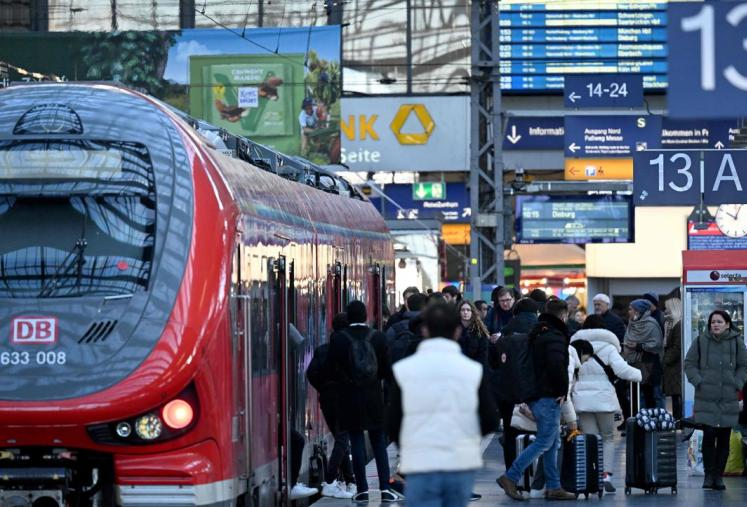
Germany's economy came under pressure in the second quarter as investment and consumer spending fell, dashing hopes of breaking out of years of stagnation.
Data released by the German statistics office on Tuesday (August 27) showed that gross domestic product (GDP) contracted 0.1% in the second quarter from the previous quarter, with capital investment falling 2.2% and private consumption falling 0.2%. Government spending, meanwhile, rose 1 per cent.
Bloomberg reported that despite a solid start to the year, Germany is struggling to maintain growth momentum. Recent indicators point to a deterioration in business sentiment, particularly in the key manufacturing sector.
The ifo business expectations index fell for the third month in a row in August and its president, Clemens Fuest, warned that Germany was "in crisis".
Carsten Brzeski, an economist at ING, said in an emailed note that German growth in the second quarter was disappointing and that almost all confidence indicators were falling, and that the German economy was now where it was a year ago: stagnant, with growth at the bottom of the euro zone.

Recently, the British government, in accordance with the "Steel Industry (Nationalization) Act" that came into effect on July 16th, took the British Steel Company, which is controlled by China Jiefang Group, into state ownership without compensation.

Recently, the British government, in accordance with the "S…

On July 23rd local time, the US Trade Representative Office…

The international crude oil market saw a sharp one-sided ri…

Recently, the geopolitical confrontation between the United…

The New York Times has recently clashed with the Trump admi…

Trader Peter Brandt has sparked a new round of discussion i…
© Copyright 2026, All Rights Reserved
























