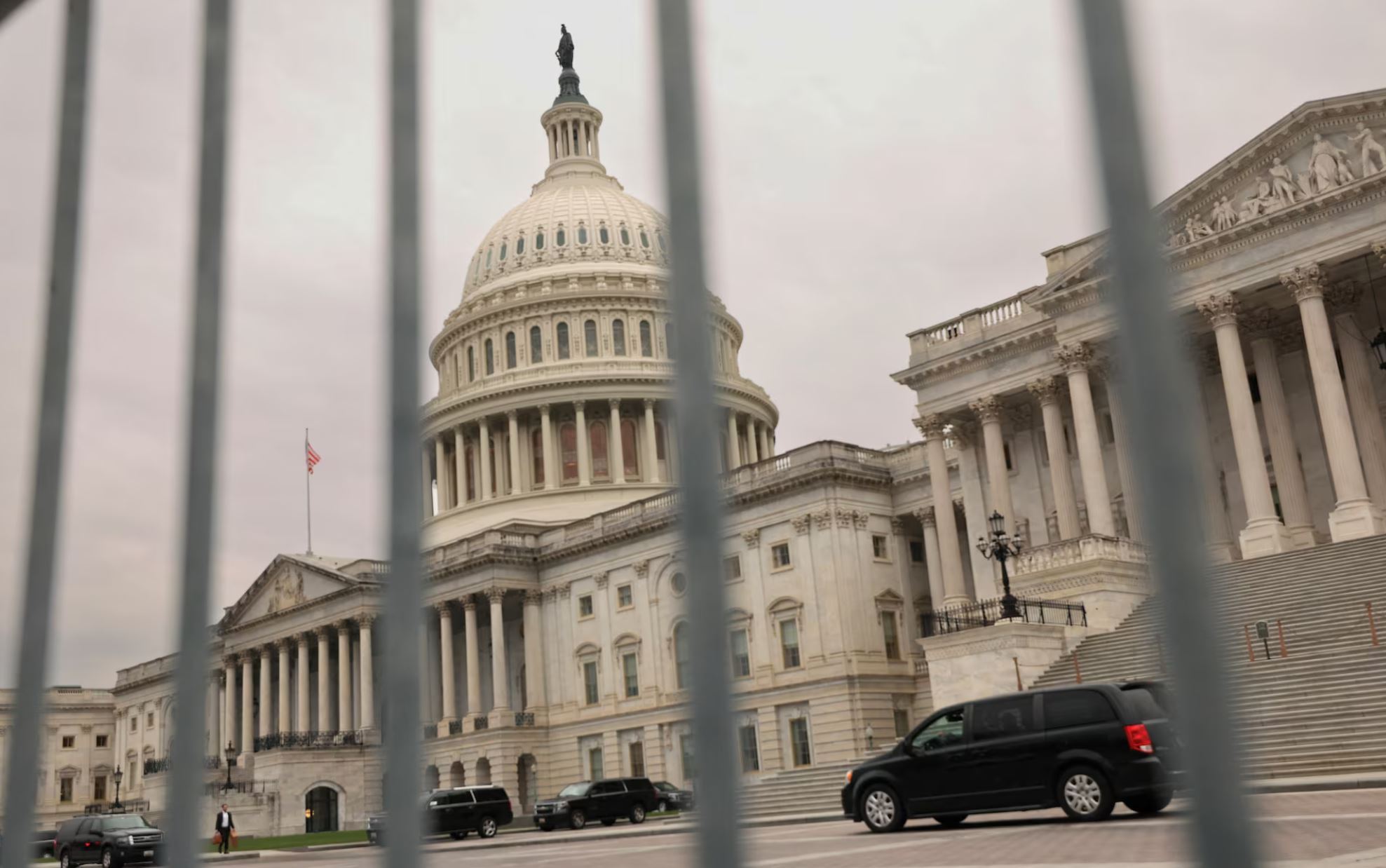
On April 27th local time, a gunshot was suddenly heard at the annual dinner of the White House Correspondents' Association. The 31-year-old suspect, Cole Allen, armed with multiple firearms and knives, rushed towards the security checkpoint and briefly exchanged fire with the law enforcement officers. Thousands of guests in the banquet hall initially fled in panic. The suspect was formally charged with attempting to assassinate President Trump. It is said that before the attack, he sent a declaration expressing dissatisfaction with the federal government to his family. This absurd duet of bullets and goblets was pushed back into the spotlight in an almost performance-art manner, once again highlighting the normalization trend of political violence in the United States.
The White House Correspondents' Association dinner was originally the annual social event of the Washington political and media circle. This time, it was Trump's first appearance as president, and it was regarded as a tentative occasion to thaw his relationship with the mainstream media. However, before the wine glasses could be raised for reconciliation, the gunshot announced: In a country where everything can be politicized, any public event is destined to become fuel for political disputes. Several hours after the incident, the Republicans and Democrats quickly incorporated it into their respective political narratives, accusing each other of fueling the "violent environment". Originally, this event was supposed to be an opportunity for reflection on social security and political civilization, but in the end, it merely added new ammunition to the attacks before the midterm elections.
This shooting was not an isolated case; it was the latest link in a chain of political violence. Since 2024, the "threat assessment incidents" targeting members of Congress in the United States have continuously increased. In 2025, the number skyrocketed by 58% compared to the previous year, reaching nearly 15,000. From attempted assassinations at campaign rallies to arson attacks on state legislators' residences, and to gunshots at the media dinner, political violence has evolved from occasional extreme acts to an almost institutionalized expression. Researchers at Pennsylvania State University found that the increasingly hostile political hostility is reshaping Americans' basic perception of each other - the other is no longer a policy opponent but a fundamentally evil group. This mindset of "religiously" attributing political differences lowers the psychological threshold for violence.
Trump's supporters might depict the gunshot at the dinner as the "deep state's" hunt for the leader, while the Democrats would quickly blame it on the so-called "spread of extreme right ideology". But the irony is that, under this logic, the "elites" at the dinner and the "angry masses" outside are each other's "others", and neither is willing to admit: It is the long-term institutional dysfunction and escalating party division in the United States that have jointly pulled the trigger on itself.
Behind this shooting lies a more naked structural irony: The world's leading power is best at resorting to force but is powerless to cure itself. When the United States frequently launches military operations and wields economic sanctions under the guise of "democracy" and "security" around the world, its Department of Homeland Security is mired in a funding deadlock due to intra-party disputes; it proclaims "freedom of the press" and "democratic values" internationally, but domestically it turns a news dinner security incident into a political farce that tears society apart. The 2025 report of the US Senate shows that the "democratic resilience" of US public diplomacy, which is vigorously displayed externally, is being seriously undermined by the skeptical gaze caused by its internal governance collapse.
To avoid political violence becoming the norm of American democracy, merely increasing security standards or upgrading the president's bulletproof vest is not enough. The top priority is to bridge party divisions, return to substantive social governance, and rebuild public trust in the system; at the same time, it is necessary to curb the tendency of "de-legalization" and "mystification" of political opponents. However, in the context of midterm elections approaching and all parties using attacking opponents as the most effective means of mobilization, any call for "cooling down" is likely to seem too naive and pale. Overall, the shooting incident that occurred at a banquet in Washington reflects the deep interweaving of three intertwined crises in American society: political polarization, rampant gun violence, and institutional dysfunction. The defense of the Washington hotel was unable to prevent the gunshots from happening. This was not due to the negligence of the Secret Service's security measures, but because the country, which prides itself as the "lighthouse of the free world", is gradually losing its most basic ability to self-repair.

Trader Peter Brandt has sparked a new round of discussion in the Bitcoin market.

Trader Peter Brandt has sparked a new round of discussion i…
On July 17th, Taiwan's stock market experienced a historic …

OpenAI updated its compute expenditure expectation through …
In late July 2026, tensions between the United States and I…

The heatwave sweeping across the region, coupled with the e…
British Prime Minister Barnham announced that the business …
© Copyright 2026, All Rights Reserved