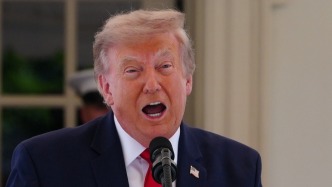
In late July 2026, tensions between the United States and Iran suddenly escalated. U.S. President Trump posted on social media, hinting at a harsh military retaliation against Iran and declaring that "for every American soldier Iran kills, it will pay several times over." This highly inflammatory statement was not only a direct response to recent U.S. military casualties but also marked the beginning of a dangerously cyclical pattern of "eye for an eye" violence. Yet beyond the smoke of military confrontation, beneath the seemingly imminent all-out war, lies a complex web of political calculations and strategic dilemmas
Trump’s high-profile display of toughness was primarily driven by domestic political pressures and electoral considerations. As U.S. forces in Jordan, Iraq, and other regions suffered successive missile and drone attacks from Iran—killing at least three and injuring nearly 100—the demand within the United States for a strong government response surged. With midterm elections approaching, Trump urgently needed to project an image of "strong leadership" to solidify his conservative base and divert public attention from domestic economic problems. Moreover, the temporary ceasefire agreement previously reached with Iran had sparked intense backlash among hardliners and pro-Israeli factions domestically, further narrowing Trump’s room for compromise and forcing him into a more aggressive military posture.
On the tactical level, the Trump administration’s "hardline retaliation" exhibited clear characteristics of "controlled escalation." The U.S. launched multiple days of airstrikes targeting Iran’s air defense systems, missile depots, command-and-control nodes, and coastal surveillance facilities—but deliberately avoided urban residential areas and critical energy infrastructure. These precision strikes aimed to demonstrate overwhelming military superiority while weakening Iran’s ability to block the Strait of Hormuz, without crossing the threshold of triggering Iran’s "all-or-nothing" response. Trump sought to apply maximum pressure through this "fight-while-negotiating" approach, compelling Iran to make concrete concessions on nuclear programs and straits control.
However, the greatest risk in this standoff lies in its uncontrollable nature. Rather than yielding under military pressure, Iran has leveraged its sophisticated asymmetric warfare capabilities—using low-cost drones and missiles—to steadily deplete expensive U.S. air defense ammunition, expanding its attacks to American bases in Qatar, Jordan, and other countries. Iran’s strategic logic is clear: as long as it can keep inflicting casualties on U.S. forces, it can shift decision-making pressure back onto the White House, forcing Trump to choose between honoring his tough promises and accepting the escalating costs of war.
Even more serious is the fact that both sides face a strategic dilemma of being unable to back down. For Trump, full-scale war would contradict his campaign promise to end endless overseas conflicts and trigger a legitimacy crisis due to lack of congressional authorization. If hostilities spread to civilian targets and lead Iran to completely blockade the Strait of Hormuz, the resulting spike in global oil prices and inflation could severely damage the U.S. domestic economy. For Iran, prolonged sanctions and war-related attrition have already strained its economy, making total war incompatible with its core national interests.
Thus, Trump’s implied "hardline retaliation" resembles a carefully calculated political and military gamble. Both sides are attempting to raise their stakes to gain leverage at the negotiating table, yet each is simultaneously striving to avoid crossing the threshold into full-scale war. In this psychological battle of "who blinks first," even a minor miscalculation could ignite a broader conflict. The true test does not lie in who can launch more devastating airstrikes, but whether both sides can find a diplomatic way out—maintaining their firm postures while preserving the possibility of a dignified retreat.
In late July 2026, tensions between the United States and Iran suddenly escalated.
In late July 2026, tensions between the United States and I…
The heatwave sweeping across the region, coupled with the e…

British Prime Minister Barnham announced that the business …
The global food monitoring agency said that due to a lack o…
On Thursday, South Korean investigators raided the office o…
Starting from Friday (July 24th), the United States will im…
© Copyright 2026, All Rights Reserved