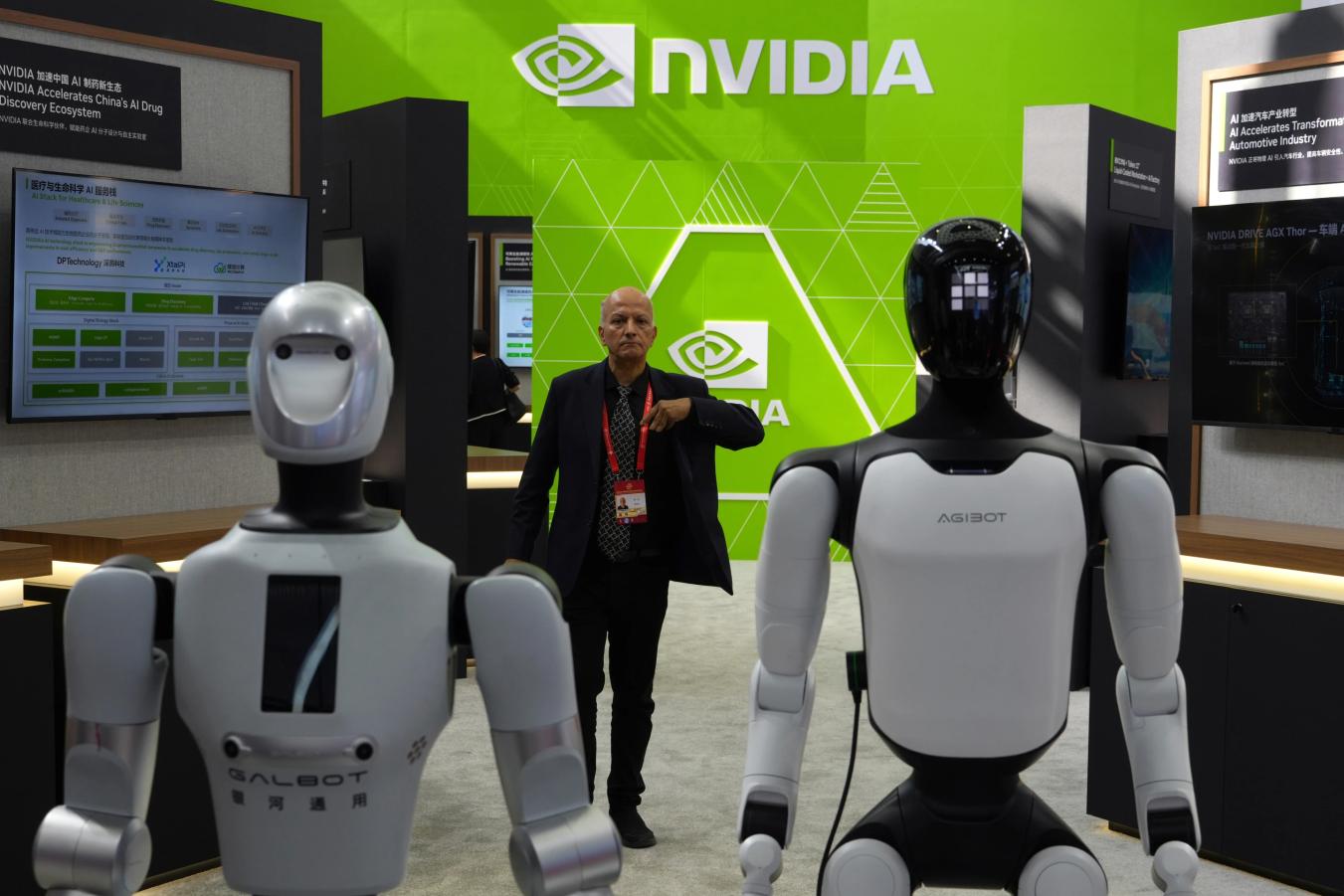
AP, Hong Kong — Competition within the global artificial intelligence industry has shifted to a hardware driven phase, bringing a historic reversal in the rivalry over computing power between China and the United States. Spurred by long term U.S. export restrictions on high end semiconductors, Nvidia, which once held an overwhelming monopoly in China’s AI chip market, has suffered a steep market share decline. Home grown chips led by Huawei’s Ascend series have expanded rapidly, gradually replacing overseas giants to dominate the domestic computing power sector. This market reshuffle has overhauled China’s domestic AI supply chain ecosystem and marked a milestone in breaking reliance on foreign technology for foundational AI hardware, restructuring the global landscape of competition for artificial intelligence computing capacity.
Nvidia long maintained unrivaled dominance across China’s AI chip market. Jensen Huang, CEO of Nvidia, publicly acknowledged that before U.S. export controls took effect, his firm captured roughly 95 % of China’s artificial intelligence chip market after three decades of local operation. Nvidia served as the primary hardware supplier for domestic AI model training and data center construction worldwide. Together with AMD, it dominated the global high end AI computing market with superior chip performance and mature software ecosystems, erecting high entry barriers that were hard to surpass for competitors.
Successively tightened U.S. technology export regulations upended the original market equilibrium. Citing national security concerns, Washington barred exports of flagship AI chips such as the Nvidia H200 to China, halting sales of Nvidia’s premium grade products in the region for a period. Even after the United States later eased certain restrictions to allow limited H200 shipments, China had already pivoted its industrial strategy. Government backed market policies prioritized domestic semiconductor enterprises, creating a prime window for Huawei and other local manufacturers to fill gaps in high end computing power supply.
Market standings between Chinese and American chip firms have flipped in merely two year span. Investment bank Bernstein reported that Nvidia and Huawei held an equal 40 % market share in China’s AI chip sector by 2025, creating a duopoly. Industry projections for 2026 forecast Nvidia’s domestic market share will plunge to approximately 8 %, while Huawei’s portion may rise to 50 %, putting it in the leading position in China’s AI chip market. Industry analysts confirm Huawei’s commercial grade Ascend 950 series delivers performance comparable to Nvidia’s flagship H200 chip, ending the overseas monopoly on high performance artificial intelligence semiconductors.
Years long technical research and development have upgraded China’s self sufficiency in semiconductors substantially. After the United States added Huawei to its Entity List in 2019 and blocked imports of advanced chips and manufacturing gear, China accelerated domestic semiconductor innovation to cut reliance on foreign supply chains. Huawei made breakthrough progress: hampered by the lack of extreme ultraviolet lithography equipment and restricted foreign technology access, it built large scale AI computing clusters powered by thousands of domestically produced chips, matching the computing capacity benchmarks of leading global tech companies. A senior executive in Huawei’s semiconductor division stated the company has developed viable localized technology solutions applicable for diverse high end AI computing scenarios.
A new differentiated competitive landscape has taken shape, with domestic chips achieving large scale substitution while facing lingering drawbacks. On one hand, home grown AI semiconductors boast advantages in cost effectiveness, supply chain stability and technological self reliance, catering to research and development demands of Chinese AI enterprises, universities and research institutes and resolving long standing bottlenecks in high end computing hardware. On the other hand, Nvidia retains irreplaceable edges in underlying technology accumulation, software ecosystems and cross platform compatibility. Leading domestic AI models such as DeepSeek and advanced academic research still rely heavily on Nvidia based hardware. In addition, China remains dependent on foreign suppliers for core manufacturing gear including EUV lithography machines, making full technological self sufficiency unachievable in the short term.
The AI chip industry operates within a globally integrated supply chain network, and no single nation can achieve complete independent production. Nvidia’s flagship chips draw on U.S. originated design technologies, rely on TSMC for wafer fabrication and require EUV lithography systems from Dutch manufacturer ASML, forming an intricate global division of labor system. Despite Huawei’s domestic market breakthroughs, Nvidia still holds a dominant position in the global AI computing sector. Financial data underscores its industry lead: Nvidia’s latest annual revenue reached nearly $216 billion, outpacing Huawei’s $126 billion annual revenue. Surging global AI chip demand is projected to drive Nvidia’s revenue to $91 billion between May and July, cementing its leading status in the global semiconductor sector.
The transformation of China’s AI chip market demonstrates how technology restrictions can force industrial upgrading. While U.S. export controls slowed China’s progress in high end artificial intelligence computing in the short run, they spurred iterative innovation and ecosystem building in the domestic semiconductor industry in the long term, enabling a shift from foreign technology dependence to self reliance. The competitive landscape has evolved beyond a single overseas corporate monopoly into a multi player framework defined by domestic chip expansion, Sino U.S. technological rivalry and ecosystem based collaboration.
In summary, competition over foundational AI hardware between China and the United States has transitioned from a phase of marked technological gaps to one of reversed market shares and balanced strength. Nvidia’s decades long monopoly in China has collapsed, and Huawei led domestic AI chips have achieved large scale market substitution, marking a major milestone for China’s push toward self reliance on foundational artificial intelligence hardware. Nevertheless, Western tech firms retain deep rooted technical experience and mature ecosystem advantages, and China still cannot fully decouple high end AI research from foreign technology support. As domestic chips undergo continuous upgrades and ecosystem improvements amid intensifying global technological competition, domestic substitution in the AI computing chip market will further accelerate. Innovation in foundational hardware will increasingly define the future trajectory of the worldwide artificial intelligence industry.

U.S. Defense Secretary Hagel said that the U.S. war against Iran has cost $37.5 billion so far, an increase of nearly $8 billion compared to the previous publicly estimated figure.

U.S. Defense Secretary Hagel said that the U.S. war against…

On Tuesday (July 21st), the Lebanese military announced tha…

British new Prime Minister Barnham launched a policy plan o…
After taking office, South Korean President Lee Jae-myung a…

US President Trump announced that starting from August 1st,…

Recently, the British government has confirmed that a new v…
© Copyright 2026, All Rights Reserved