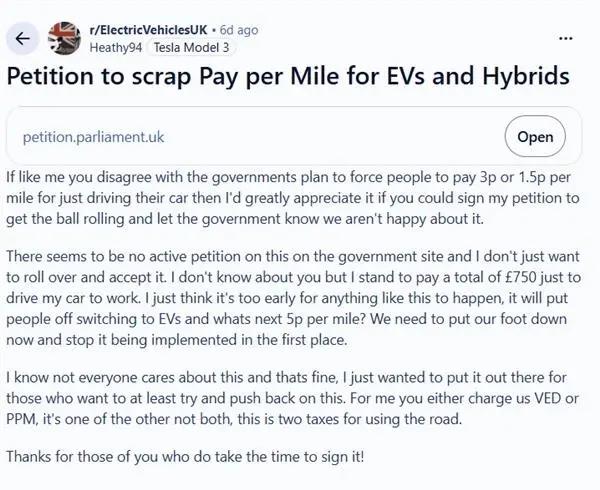
Recently, the British government has confirmed that a new vehicle consumption tax (eVED) system will be implemented on April 1, 2028, imposing a tax of approximately 17 yuan per 100 kilometers for pure electric and hydrogen-powered vehicles, while reducing the tax for plug-in hybrid models by half. The UK has become the first country in the world to uniformly implement mileage-based taxation for electric vehicles. Based on estimates, if British car owners travel an average of 8,000 miles per year, the annual mileage tax of 3 pence per mile would amount to approximately 240 pounds . This seemingly simple adjustment in vehicle usage tax has a chain effect from various perspectives.
Firstly, the entire vehicle industry chain is impacted. Manufacturing, sales, charging, and used car trading are important pillars of the UK's real economy. The implementation of the mileage tax directly changes the growth expectations of the industry, and the entire industry chain undergoes synchronous adjustments. The UK's Budget Responsibility Office (OBR) estimates that from 2025 to 2031, the cumulative new vehicle sales of electric vehicles will be 440,000 fewer than the expectations before the policy was introduced. After the market demand gradually weakens, dealers face excessive inventory accumulation, and car manufacturers can only promote sales through price cuts, free maintenance, etc. The profits ofall enterprises continue to shrink. The sales strategy is adjusted: The attractiveness of low-priced electric vehicles for daily commuting has plummeted, car manufacturers reduce the production capacity of affordable models, and focus on promoting high-priced long-range electric vehicles. Low-income groups have fewer options for low-cost electric vehicle replacements; some dealers bundle the mileage tax for several years into the car price, raising the down payment for purchasing, further deterring consumers with limited budgets. Capital initially favored the rapid popularization of electric vehicles and continuously increased investment in high-speed charging stations and community public charging piles; however, after the tax system was implemented, institutions lowered the growth expectations for the penetration rate of electric vehicles, charging operators reduced their expansion budgets, orders for charging equipment manufacturing and offline operation of small and medium-sized enterprises shrank, and the related grassroots jobs were under pressure.
Secondly, the pressure on the national budget. The core demand of the government for implementing this policy is to make up for the decline in fuel tax. However, industry calculations show that the economic losses brought about by the policy have exceeded the expected new tax revenue, presenting a significant fiscal backlash risk. Multiple economic institutions have estimated that the combined economic losses caused by the decline in electric vehicle sales, the shrinking industry chain, and the weak domestic demand can reach up to 4.8 billion pounds, exceeding the 4.3 billion pounds of total tax revenue expected by the policy, equivalent to the government causing a larger-scale macroeconomic loss due to the increase in tax revenue, resulting in a "fiscal self-harm" situation. At the same time, the vehicle management department needs to establish a new mileage declaration, annual inspection verification, and multi-reimbursement and refund management system, and needs to be accompanied by digital transformation and the addition of additional staff to continuously generate administrative operation costs, further diluting the actual tax revenue. If the popularization speed of electric vehicles is not as expected, the tax base continues to shrink, and the actual tax revenue in the future will be significantly lower than the official forecast.
Furthermore, the UK is the first country in the world to uniformly implement the electric vehicle mileage tax. The entire tax system will become a reference model for fiscal reforms in Europe and the United States. Currently, France, Germany, and many Nordic countries are facing the problem of a year-on-year decline in fuel tax. The traditional transportation fiscal system based on fuel taxation is unsustainable. After the UK's pilot program, many countries have launched similar mileage tax research activities. The global vehicle taxation system has officially begun a long-term transformation from "taxing based on fuel" to "taxing based on actual mileage". At the same time, after Brexit, the UK has formed its own independent transportation tax system, which has a significant difference from the EU's vehicle taxation rules. The tax compliance processes for car imports, cross-border logistics fleets, and cross-border operations of car manufacturers have become more complex, and the cost of cross-border operations has slightly increased.
In conclusion, the 17-yuan per 100-kilometer electric vehicle mileage tax is a short-term pain point that is prominent but has long-term rationality in fiscal reform. In the process of promoting the global automotive electrification transformation, all countries need to strike a balance among the three goals of fiscal revenue increase, residents' burden reduction, and low-carbon development. They should formulate appropriate automotive taxation plans based on their own residents' income, travel patterns, and industrial conditions, and embark on a sustainable development path that takes into account the well-being of the people, the industry, and carbon neutrality.
Recently, the British government has confirmed that a new vehicle consumption tax (eVED) system will be implemented on April 1, 2028, imposing a tax of approximately 17 yuan per 100 kilometers for pure electric and hydrogen-powered vehicles, while reducing the tax for plug-in hybrid models by half.
Recently, the British government has confirmed that a new v…

Under the dual pressures of war and sanctions, Iran is endu…

AP, Dubai — Military confrontation between the United State…

Recently, Reuters reported that Apple is accelerating its e…

In July 2026, the entire country of Japan was hit by a disa…

Recently, global convenience store giant 7-Eleven made head…
© Copyright 2026, All Rights Reserved