China's trade data for the first half of the year reached a new high for the same period. Both imports and exports exceeded expectations. However, the driving force mainly came from the strong semiconductor trade and the export of new energy vehicles under the global AI boom, highlighting the continuous expansion of sectoral differentiation in the context of China's overall economic growth slowdown.
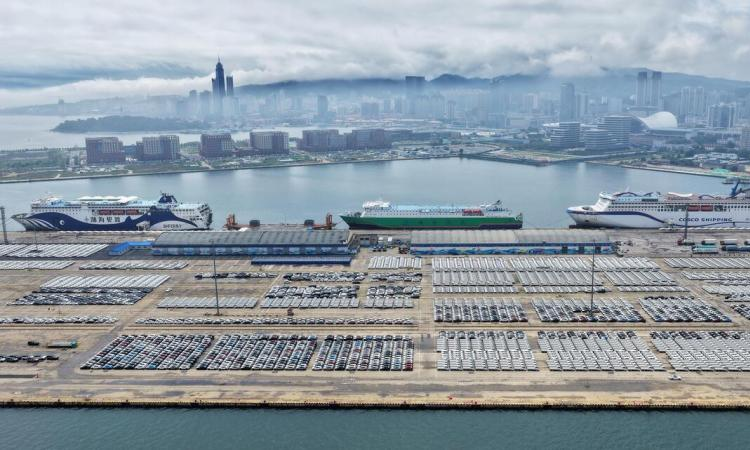
The General Administration of Customs of China released data on Tuesday (July 14th) showing that in June, the export value in US dollars increased by 27% year-on-year to 412.39 billion US dollars, reaching a new high since October 2021; the import value rose by 36% to 286.76 billion US dollars, with the growth rate reaching a five-year high. The total trade value for the first half of the year reached 25.47 trillion yuan, also setting a new high for the same period.
Wang Jun, the deputy director of the General Administration of Customs of China, stated at a press conference that China's foreign trade maintained a good operating trend in the first half of the year and remained the world's largest goods trading nation. Although foreign trade will face certain pressure in the second half of the year, the fundamentals are solid. China "is confident and capable of maintaining the good momentum of its foreign trade development."
The data shows that the export of mechanical and electrical products increased by 20.1% in the first half of the year, accounting for two-thirds of the total exports and being the main driving force for the growth in exports. Within this category, in June, the export value of integrated circuits soared by 121.9% year-on-year, that of automobiles rose by 69.6%, and that of ships increased by 42.3%.
Nomura Securities' report on Tuesday indicated that, in terms of quantity, China's semiconductor exports in June actually decreased by 0.4% compared to the previous year. Therefore, the global increase in chip prices during the AI boom, especially the shortage of memory chips, was the main reason for the significant growth in China's contribution to semiconductor exports.
When interviewed, Xu Tianchen, a senior economist at the Economist Intelligence Unit, said that apart from the price hikes of AI-related products and the popularity of Chinese electric vehicles, the significant increase in exports in June was also related to businesses "exporting in a rush" to avoid possible tariff hikes by the US in late July.
The Trump administration is expected to impose new "Section 301" tariffs of 12.5% on China after the 10% temporary tariffs expire on July 24. In June, China's exports to the United States increased by 13.9%, resulting in a trade surplus of 28.9 billion US dollars with the United States, accounting for 23% of the total trade surplus for that month.
However, although the trade surplus with Europe and the United States is still widening, China's import growth has been higher than export growth for several months. The trade surplus in the first half of the year, measured in US dollars, narrowed by 1.3% year-on-year. Lu Daliang, the spokesperson for the General Administration of Customs and the director of the Statistics and Analysis Department, said that China will continue to actively expand imports and promote balanced development of imports and exports.
On the other hand, economists also pointed out that the growth in China's imports was mainly driven by the increase in semiconductor prices and the procurement of technology supply chains. This also indicates that domestic demand has not fully recovered and that economic development is heavily reliant on high-tech industries. China's crude oil imports in June have dropped to their lowest point in 10 years.
ING's Chief Economist for Greater China, Song Lin, released a report stating, "The import pattern in the first half of the year was extremely unbalanced. Imports related to technology dominated, while other import categories remained weak, reflecting the sluggish domestic demand."
He said that the upcoming economic data to be released by China might highlight the increasingly pronounced disparity in China's economy.
Both the Bloomberg and Reuters surveys predict that China's second-quarter gross domestic product (GDP) will grow by 4.5%, lower than the 5% growth rate in the first quarter. This brings the economic growth rate to the lower end of the official target range of "4.5% to 5%". It indicates that strong exports and high-tech manufacturing are not sufficient to offset the impact of weak consumption and declining investment.
Xu Tianchen pointed out that although China's exports will still be supported by the global AI investment boom and the demand for green energy transformation, after the sharp increase in the second quarter, there may be a certain decline. He predicted that the拉动 effect of foreign trade on economic growth will further weaken in the third and fourth quarters, and going forward, "the growth still requires the Chinese government to focus on expanding domestic demand
He also predicted that specific measures might include accelerated fiscal spending and a gradual easing of monetary policy. At the same time, if the situation in the Middle East calms down, China will benefit from the lower oil prices.

The global AI wave is sweeping across various industries, reshaping the national competitive landscape.

The global AI wave is sweeping across various industries, r…

Recently, the geopolitical situation in the Middle East has…

The New York Times’ lengthy piece on U.S. allies adjusting …
In 2026, the "Silica Peace (Pax Silica)" alliance led by th…

The U.S.-Iran rivalry over the Strait of Hormuz has transce…
On July 14th, US Treasury Secretary Yellen issued a final u…
© Copyright 2026, All Rights Reserved