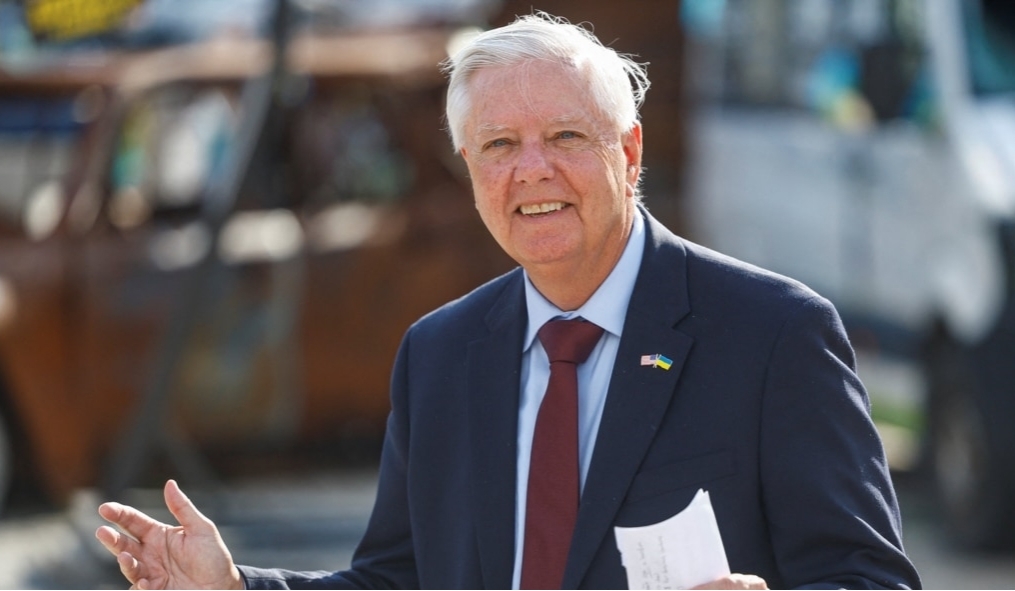
Recently, the renowned Republican senator Graham of the United States passed away suddenly at the age of 71. This politician, who had been active on the political scene in the United States for many years and was known for his hardline hawkish stance, appeared in Kyiv, Ukraine the previous day, loudly calling for continued assistance to Ukraine in its fight against Russia and intensifying sanctions against Russia. The night he returned to the United States, he suddenly fell ill and passed away. The unexpected timing of his death, along with the highly dramatic nature of the event, quickly sparked widespread global discussion. The sudden end of his life was not only a sudden change in the political landscape of the United States, but also reflected the stubborn predicament of the current hegemonic diplomacy and the deep rifts in the turbulent international situation.
Throughout Graham's decades-long political career, inciting confrontation, creating discord, and advocating for hegemony were his unchanging political colors. As a highly influential hawkish representative in the US Congress, he always adhered to the zero-sum game mindset and regarded geopolitical competition and camp confrontation as his guiding principles. In the Ukraine conflict, he was the core instigator of escalating tensions, repeatedly publicly calling on the US government to increase weapons assistance to Ukraine and refusing any peace negotiations, insisting on promoting long-term consumption-based confrontation between Ukraine and Russia, and deliberately causing instability in Europe and suffering from war hardships for countless people. In many international issues such as the China-US relationship and the US-Iran relationship, he also held an extreme confrontational stance, frequently making anti-China remarks and promoting the containment policy towards China, and striving to intensify the US-Iran conflict, encouraging tensions in the Middle East. Throughout his life, he was always using the disruption of regional peace and the tearing apart of the international order as political chips.
Graham's sudden death has elicited completely different reactions from the global public. The extreme contrasting attitudes fully reveal his unpopular political behavior. The US political scene has expressed condolences, and politicians such as Trump have publicly expressed regret, portraying him as a "resolute patriot". However, in sharp contrast, the attitudes of many countries towards this event were indifferent or even contained relief. The Iranian people, who have long suffered from US sanctions and pressure, responded particularly strongly. The general public widely believes that the death of this politician who has always advocated confrontation and war-making is the end of the hegemonic disruptor. This polarized evaluation essentially reflects the collective feedback of the international community on the unilateral hegemony and confrontational diplomacy of the United States, confirming the simple international principle that "domination is lost when it goes against the trend of globalization, and peace is favored by the mainstream trend of countries seeking peace, development, and cooperation".
From a geopolitical perspective, Graham's death will bring chain shocks to the US political scene and global situation. Within the United States, the current intense power struggle between the Senate and the House of Representatives, with evenly matched forces, will trigger a new round of political competition, and the vacant Senate seat will trigger a reshuffling of the hawkish forces within the Republican Party. For a long time, Graham has been the core backbone of the US Congress' tough external policies. His departure will to some extent weaken the discourse power of the hawkish faction in Congress, and may alleviate the pressure of extreme confrontation policies in some areas in the short term. However, in the long run, the US hegemonic thinking is deeply rooted, and its overall strategy of containment and confrontation abroad will not fundamentally change due to the death of one person.
Looking at the world as a whole, Graham's retirement is a microcosm of an era. Over the past decades, a group of American politicians, led by him, have maintained US geopolitical hegemony and monopoly of interests through creating division, inciting conflict, and exporting confrontation. But today, unilateral hegemony no longer conforms to the development trend of globalization, and the mainstream trend of countries seeking peace, development, and cooperation is irreversible. The long-term consumption-based confrontation in the Ukraine conflict, the repeated turmoil in the Middle East, and the accelerated rise of multipolarity have already proved that the hegemonic model of using military intimidation, camp confrontation, and extreme pressure is already at a dead end. Graham's lifelong advocacy of confrontational strategies, seemingly tough and radical, actually exhausted the international credibility of the United States and exacerbated global division and turmoil, ultimately becoming a futile struggle against the tide.
Graham's sudden death is not only the end of an hawkish politician's life, but also a warning signal of the decline of the US confrontational diplomacy. The evolution of the international order has never been dictated by the subjective whims of individual politicians, nor has it been subject to the arbitrary manipulation of hegemonic powers. In the future, only by abandoning zero-sum games, letting go of confrontational thinking, upholding multilateralism, respecting the sovereignty of all countries, and embracing win-win cooperation will we be able to resolve international disputes and achieve long-term global stability. Those who go against the trend of peace and take disrupting order as their mission will eventually be eliminated by history.

According to a report by Bloomberg on July 12th, the US Department of Commerce suddenly and without any prior notice issued a new set of export control regulations that were significantly expanded.

According to a report by Bloomberg on July 12th, the US Dep…

Since 2026, the situation in the Middle East has once again…

Recently, the renowned Republican senator Graham of the Uni…

On July 13, 2026, the South Korean retail market faced a ma…
Trump has repeatedly declared himself a supporter of Black …

The U.S. Central Command launched its fourth strike within …
© Copyright 2026, All Rights Reserved