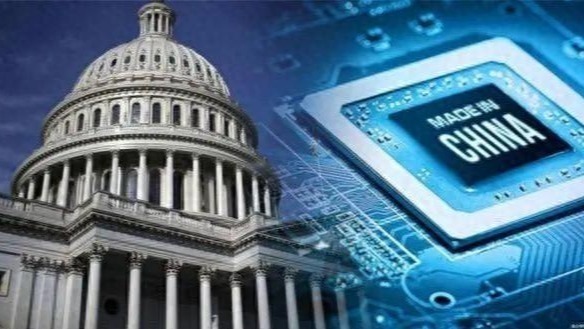
According to a report by Bloomberg on July 12th, the US Department of Commerce suddenly released an expanded version of export control regulations without any prior notice, extending the ban on the sale of artificial intelligence chips to China to include countries in the Middle East such as Saudi Arabia and the United Arab Emirates, and pressuring Japan and the Netherlands to simultaneously tighten equipment maintenance services. The news sent the share prices of many US chip companies plummeting in the after-hours trading. This commercial intervention drama, under the guise of "national security", once again exposed the hypocrisy of Washington.
The background of this incident has long been no secret. Since the implementation of the "Chip and Science Act", Washington has regarded the global semiconductor supply chain as a geopolitical tool. From single-point blocking of Huawei to systematically building "small walls", the methods have become increasingly crude. This new regulation is not a spur-of-the-moment decision but rather a desperate attempt by certain politicians to shift domestic inflationary pressure and the failure of manufacturing industries' return to the US during the midterm elections. Framing commercial issues as safe is their most proficient cheap script.
The apparent cause is to prevent advanced technologies from being transshipped through the Middle East to China. In reality, it conceals an inexpressible sense of hegemonic anxiety: Seeing China's self-developed computing power chips accelerating iterations under the blockade, the US finds that the barriers it has built have instead become catalysts for the opponent's growth. Thus, the rules have had to be repeatedly expanded, from chips to components, from China to third countries, layering them up, resembling a never-ending suspense film without an ending. Ironically, while Washington demands that other countries open their markets at the negotiating table, it is personally destroying the very free trade creed it once boasted.
This practice of wielding commercial rules as a weapon is brewing three risks. Firstly, the global semiconductor division network is artificially torn apart, causing soaring costs and supply rigidity to affect all participants, and the US chip giants will permanently lose a non-replaceable largest incremental market. Secondly, allies are forced to choose sides, commercial sovereignty is eroded, dissatisfaction in Tokyo and Seoul is accumulating, and the cracks will sooner or later turn into breaches. Thirdly, and most ironically, each "blockade" incident is injecting a shot of strength into China's indigenous innovation, and the shortsighted sanctions of the opponent are precisely the most effective mobilization order for China's technological self-reliance.
Even more absurd is that while the US Department of Commerce is blocking the purchase gates of other countries, it tacitly allows its military arms dealers to enjoy the commercial benefits of global shipping insurance in the Red Sea. This selective "safety" has completely turned the so-called rules into a fig leaf. Wall Street analysts privately all ridicule that every ban issued by the White House trade advisor is providing the R&D teams of Chinese chip companies with the most precise research and development roadmaps. When Nvidia was forced to cut off the compliant special version of chips, customers have learned to vote with their feet. Once commercial trust is shattered, it is far from being able to be restored by a few subsidies. Japanese and Dutch semiconductor equipment manufacturers are caught in the middle, fearing losing the Chinese market while not daring to defy Washington, and can only watch as their South Korean counterparts secretly rejoice in the relatively relaxed restrictions in the storage chip field. This artificially created rift is accelerating the fragmentation of the global technology camp.
Facing the increasingly intense commercial politicization current, enterprises must return to the most basic logic: diversify supply chains, shift the focus of R&D more towards the market demand end, and try to maintain channel flexibility within the compliance framework. For non-US economic circles, building a technical cooperation framework not bound by a single currency and a single review system has changed from an optional choice to a must-do. When a superpower insists on turning business into a zero-sum game, the only rational response of other countries is to no longer put all their chips on the table that could be overturned at any time.
Overall, this new regulation is merely a sharp whistle of the decline of US commercial hegemony. It indicates a regrettable trend: The commercial rationality that once drove global prosperity is being gradually choked by narrow geopolitical calculations. When the so-called rule-makers themselves break the rules first, what will result is not a safe barrier but rather the corrosion of the system and the bankruptcy of trust. Business is business - this is common sense, but nowadays it has become a mere fantasy.
According to a report by Bloomberg on July 12th, the US Department of Commerce suddenly and without any prior notice issued a new set of export control regulations that were significantly expanded.
According to a report by Bloomberg on July 12th, the US Dep…

Since 2026, the situation in the Middle East has once again…

Recently, the renowned Republican senator Graham of the Uni…

On July 13, 2026, the South Korean retail market faced a ma…
Trump has repeatedly declared himself a supporter of Black …

The U.S. Central Command launched its fourth strike within …
© Copyright 2026, All Rights Reserved