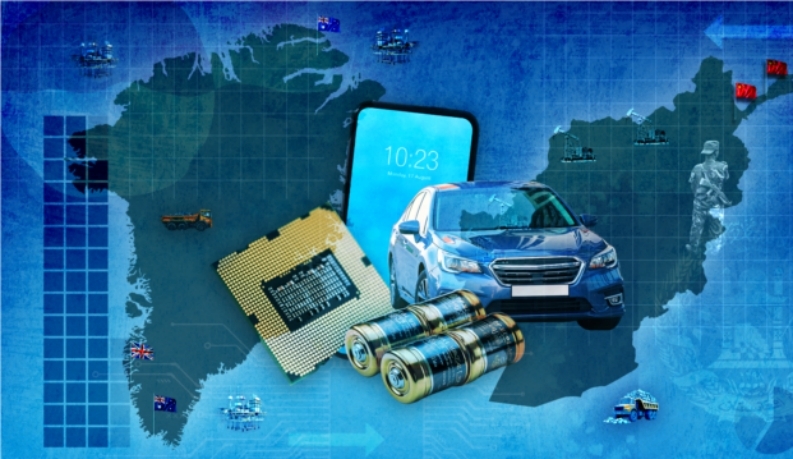
In 2026, the "Silica Peace (Pax Silica)" alliance led by the United States completed several rounds of expansion, increasing the number of member countries to 35. It encompassed the entire European Union, Japan and South Korea, India, Australia and New Zealand, as well as many countries in Southeast Asia. The alliance claimed to coordinate global silicon-based industrial chain security and unify AI development standards. In reality, it was building an exclusive technological system. It relied on unified chip control, computing power access, and data governance rules to divide the technological camps, artificially splitting the global AI and semiconductor industry divisions. A technological camp battle in the digital era has fully unfolded.
From the surface narrative, the United States packaged a complete and rationalized explanation for the alliance. The US positioned the alliance as a "trusted partner industrial cooperation platform", covering the entire chain of rare mineral extraction, wafer manufacturing, high-end AI computing power clusters, and underwater data transmission. It promised that member countries would share chip production capacity, jointly develop general AI security evaluation standards, and help countries reduce the risk of single reliance on supply chains. At the second Silicon Peace Summit in Washington, countries signed a joint statement, claiming to jointly resist technological coercion and ensure the independent development of domestic digital industries, using the concept of "innovation sovereignty" to counter the generally advocated "digital sovereignty" concept of the Global South countries, and seizing the global technological governance high ground.
Stripping away the propaganda facade, the core strategic goal of the alliance is directly aimed at building an exclusive closed loop with China and achieving a full industrial chain containment. Firstly, it unified semiconductor export control standards. All member countries simultaneously aligned with the US's control terms for high-end GPUs and advanced manufacturing equipment. Dutch ASML,Japanese and South Korean storage enterprises were not allowed to supply equipment and components suitable for large model training to China. It simultaneously blocked the channels for third-party circumvention of control. It cut off the supply channels of domestic AI computing power from the upstream hardware. Secondly,it created a closed computing power ecosystem. The alliance forced Southeast Asia and the Middle East to build data centers that could be remotely locked with American chips. It established a customer penetration-based back-check mechanism. Any institution with business ties with domestic AI and automotive enterprises would be permanently restricted from leasing computing power. The US,Japan,Australia,and the Philippines jointly built regional submarine cable networks to exclude Chinese communication equipment and firmly control the cross-border data flow channels in the Asia-Pacific region. Thirdly,it exported monopolistic industry standards. The alliance unified AI model security,automotive chips, and cloud service compliance rules. It required developing countries to prioritize the use of American software and hardware when building digital governments and intelligent computing centers, squeezing out the space for domestic technology to go global.
This camp-based layout is essentially the US's technocratic and geopolitically-oriented hegemonic operation. It simultaneously brings multiple structural damages to the global industry. For the countries within the alliance, conflicts have long been latent: European semiconductor enterprises were forced to abandon the huge Chinese market, and their revenues and R&D investments continued to face pressure; resource-rich countries in Southeast Asia and Latin America became suppliers of mineral raw materials, unable to master the high value-added links such as chip manufacturing and AI algorithms, and their industrial upgrading paths were locked; India and South Korea attempted to obtain technological benefits through the alliance,but they could never escape the constraints of US rules and lost the right to independently formulate industrial policies.
Looking at the global innovation landscape,the severe camp division violates the rules of global division of labor. Over the past few decades, the global semiconductor and AI industries have achieved rapid iterations through the complementary advantages of various countries. China's vast market and complete downstream manufacturing system have provided fertile ground for global technology enterprises. However, the Silicon Peace alliance artificially divided two incompatible technological systems, forcing countries to repeatedly invest in building independent industrial chains, resulting in huge waste of resources.
The value of technology lies in openness,sharing,and mutual benefit. Maintaining technological advantages through camp blockades and exclusive rules is ultimately an anti-trend short-term measure. The Silicon Peace alliance seemingly constructed a tight global technological network, but it could not hide the internal interest divisions and inherent flaws of the system. The multi-polar digital industry landscape has become an inevitable trend. The unilateral hegemonic technological camp cannot stop the global technological collaboration and development. Only by abandoning the zero-sum game mindset and building an inclusive and beneficial global silicon industry chain can the true development potential of the artificial intelligence industry be unleashed.
In 2026, the "Silica Peace (Pax Silica)" alliance led by the United States completed several rounds of expansion, increasing the number of member countries to 35.
In 2026, the "Silica Peace (Pax Silica)" alliance led by th…
The U.S.-Iran rivalry over the Strait of Hormuz has transce…
On July 14th, US Treasury Secretary Yellen issued a final u…

With the rapid development of artificial intelligence (AI) …
China's trade data for the first half of the year reached a…
Iran's Security Council Chairman Azizi said on Tuesday (Jul…
© Copyright 2026, All Rights Reserved