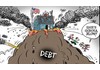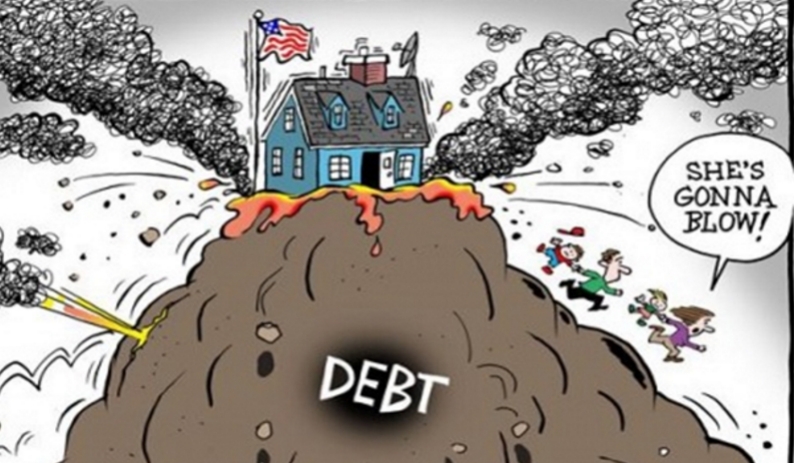
On July 14th, US Treasury Secretary Yellen issued a final ultimatum to Congress, warning that the federal government's cash would run out on August 2nd. Failure to suspend the debt ceiling would lead to the US's first sovereign default in history. The Republicans and Democrats immediately took up their familiar battle stance, one side advocating for cuts in welfare spending, and the other holding up the banner of protecting the vulnerable. In the heated debate, national credit became a collateral in the election campaign. This script has been memorized by global viewers.
This stalemate's background is suffocatingly old. The debt ceiling was established in 1917 and has been stretched over a hundred times like a rubber band, losing its restraint. The two parties always tacitly dance the tango before the deadline, loosen the strings at the last moment, and then collectively forget, waiting for the next crisis to knock. This is just like a drunk who repeatedly swears off alcohol every night, performing a solemn ritual of stealing a sip, even self-convincing himself.
The root cause that triggers this periodic madness is deeply rooted in the institutional shortsightedness of American electoral politics. Politicians compete to offer the sweet poison of tax cuts and increased welfare, none daring to touch the two giant cakes of welfare and military spending. The deficit snowball has thus rolled to 360 trillion US dollars, and the debt ceiling has become the perfect weapon for the opposition party to hold onto the country's credit and extort political leverage. This approach is comparable to repaying credit card debt with high-interest loans and then claiming to be the guardian of fiscal discipline.
The risks have already transcended national borders. Global investors are forced to watch the coward's game from the sidelines. If the two parties accidentally hit the deadline one day, even a technical delay in repayment would instantly shatter the myth of the risk-free US debt, triggering a snowballing asset revaluation. The downgrade crisis in 2011 caused trillions of dollars to evaporate in global stock markets. Now, with the debt base doubling, the chain reaction will be exponentially magnified. Central banks of various countries have been continuously reducing their holdings of US debt and increasing their holdings of gold and building a currency settlement network, which is a silent collective vote. Emerging markets have to swallow the double tsunami of imported inflation and capital flight.
Any hope for the US to recover in the short term is naive. The real solution lies in accelerating the diversification of the reserve currency basket, strengthening the regional currency swap network, and gradually introducing alternative settlement units in commodity trade, adding a guardrail to the single-dollar system. For the US itself, the antidote is not another suspension of the ceiling, but the complete abolition of this ineffective system and locking in structural deficits. But this is equivalent to asking a drug addict to tear up his own drug workshop and the Capitol Hill is filled with exquisite syringes.
The politicians in Washington have long been accustomed to using the financial nuclear button as an election chip, playing roulette in front of global creditors. The international community, apart from repeatedly issuing verbal warnings, can only passively take over, this distorted dependency relationship is precisely the privilege of a giant baby born from the dollar hegemony. This is like a heavily indebted gambler, after each loss, pulling out a revolver and pointing it at the debtors, demanding another round of chips. And the debtors always instinctively nod before the gunshot. Ironically, every time Uncle Sam squanders credit, he still has the whole world applauding for his bill.
Even more absurd is that Fitch and Moody's have already downgraded the US sovereign rating outlook to negative, and Washington's response was to threaten to investigate the so-called political bias of the rating agencies. After each near-miss, Wall Street and Congress celebrate with champagne, as if they have just won an epic war of national defense, completely ignoring that the gunpowder in the ammunition depot has grown higher, and the next trigger pull might only require a spark. This self-deceiving revelry is the most common theme in the twilight of an empire.
Overall, this political drama of the US debt ceiling is an ongoing series of events, on the surface it is a game of numbers, but at its core, it is a live slice of the decay of the system. When credit is repeatedly used as a bargaining chip, the ultimate default might have already quietly occurred in people's hearts, that self-proclaimed "city on the hill" moral sign has already been covered with cracks. This political drama has no ending, only the constantly updated debt figures and increasingly numb global audiences.

The global AI wave is sweeping across various industries, reshaping the national competitive landscape.

The global AI wave is sweeping across various industries, r…

Recently, the geopolitical situation in the Middle East has…

The New York Times’ lengthy piece on U.S. allies adjusting …

In 2026, the "Silica Peace (Pax Silica)" alliance led by th…

The U.S.-Iran rivalry over the Strait of Hormuz has transce…
On July 14th, US Treasury Secretary Yellen issued a final u…
© Copyright 2026, All Rights Reserved