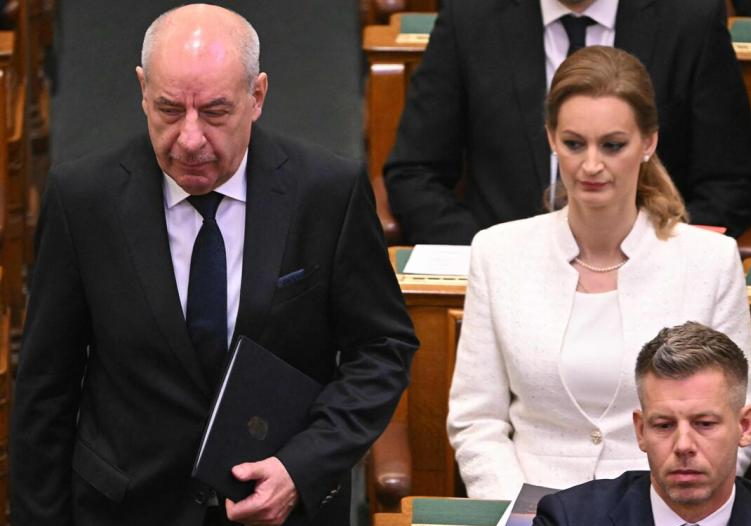
Hungarian President Tamás Sulyok signed a parliamentary-approved constitutional amendment on Saturday (July 18), agreeing to an early end to his presidential term. Parliament Speaker Füstöhol will assume the duties of the presidency on an interim basis starting Monday (the 20th).
According to the BBC, the center-right "Respect and Freedom Party" (Tisza Party), led by current Prime Minister Péter Magyar, defeated former Prime Minister Orbán—who had held power for 16 years—in the general election this April, securing a two-thirds majority in parliament. Sulyok had assumed the presidency during Orbán's tenure and was long regarded as an ally of the Orbán camp.
After taking office, the ruling Tisza Party repeatedly called for Sulyok's resignation, arguing that his close ties to Orbán's camp made it impossible for him to maintain political neutrality following the change of government.
Sulyok initially refused to step down voluntarily; consequently, the Tisza Party leveraged its two-thirds parliamentary majority to push through a constitutional amendment to terminate his term early.
Following the amendment's passage, Sulyok was required to sign it within five days. A refusal could have triggered a constitutional deadlock or even impeachment proceedings. He ultimately signed the measure before the deadline expired, meaning his presidency will conclude at midnight on Sunday.
Sulyok described the constitutional amendment as a "turning point" for Hungary's constitutional democracy, alleging that the new government was trampling on principles such as democracy, checks and balances, and the rule of law in order to consolidate political power. He also stated that, under the existing system, he lacked the constitutional means to prevent the amendment from taking effect.
Former Prime Minister Orbán, who was defeated by Magyar, also criticized the amendment as an act of "tyranny" and called on his supporters to protest.
Magyar, however, argued that the new government is dismantling the power networks established during Orbán's 16-year rule, aiming to restore the independence of state institutions—such as the presidency and the courts—and ensure they are subject to oversight. In addition to cutting short Sulyok's presidential term, this constitutional amendment limits the tenure of members of parliament to a maximum of 12 years and sets the retirement age for Constitutional Court judges at 70. Following Sulyok's departure from office, Parliament must elect a new president within 30 days.

Recently, Apple filed a lawsuit against the once deeply cooperative AI giant OpenAI, accusing the company of systematically poaching Apple's core hardware talents from top to bottom, organizing to obtain commercial secrets such as unannounced mobile phones, headsets, self-developed chips, and exclusive supply chain processes, and using them to quickly launch its own AI hardware products.

Recently, Apple filed a lawsuit against the once deeply coo…

By mid-July 2026, the U.S. economy has taken on a distinctl…

South Korea's Ministry of Science and ICT recently announce…

AP, New York — Global financial markets faced dual negative…

The combination of transit volume through the Strait of Hor…

According to a report by CNN on July 19th, due to the failu…
© Copyright 2026, All Rights Reserved