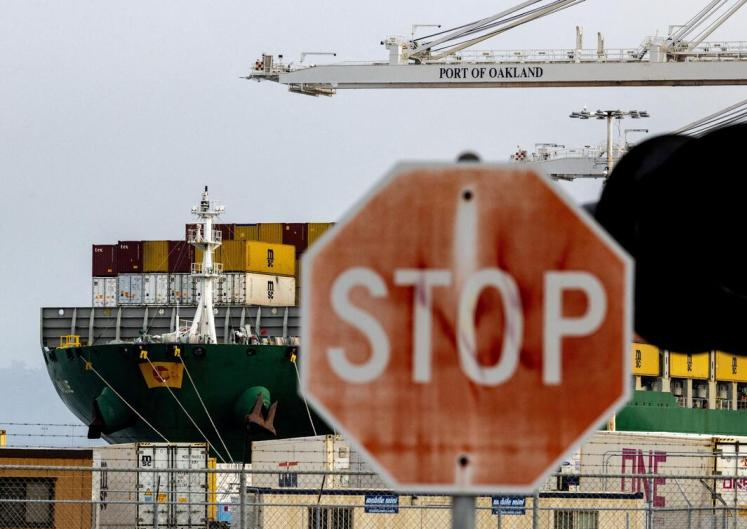
The US Court of International Trade ruled that President Trump's imposition of a 10% new tariff worldwide was illegal.
According to reports from The Wall Street Journal and The New York Times, this defeat marks another legal setback for the White House. The US Supreme Court rejected Trump's proposal to impose a series of "reciprocal" tariffs on trading partners of the United States in February.
The US International Trade Commission in Manhattan ruled on Thursday (May 7) by a 2-1 vote that Trump's February decision to impose a 10% new tariff on imports from almost all countries in violation of Section 122 of the Trade Act was invalid.
The International Trade Court stated that the legal basis for Trump's policy of imposing a 10% global import tariff is invalid and does not comply with the provisions of trade law regarding the conditions for the imposition of import surcharges.
According to Bloomberg, the International Trade Court has currently only temporarily prevented the Trump administration from enforcing these tariffs on the two companies that filed the lawsuit and on the state of Washington. It has also clearly stated that it has not issued a "universal injunction".
The three-judge panel held that other states lacked standing to file the lawsuit because they were not direct importers but argued that they had to pay higher prices for goods due to the fact that enterprises passed on the cost of tariffs, thereby suffering losses.
On February 20th, the US Supreme Court ruled that Trump's imposition of tariffs by invoking the 1977 "International Emergency Economic Powers Act" exceeded the president's authority and was unconstitutional.
That night, Trump promptly signed an executive order, citing Section 122 of the 1974 Trade Act, announcing that starting from February 24th, a 10% import tariff would be imposed on global trading partners for a period of 150 days. He also ordered the Office of the Trade Representative to invoke Section 301 of the 1974 Trade Act to initiate "unfair trade practices" investigations, seeking to impose tariffs on specific trading partners and product categories.
On February 21st, Trump posted on the social media platform Truth Social, stating that after a "thorough, detailed and complete assessment" of the Supreme Court's "extremely anti-American" ruling, he decided to raise the new tariff rate from 10% to the "maximum legal limit of 15%".

Trader Peter Brandt has sparked a new round of discussion in the Bitcoin market.

Trader Peter Brandt has sparked a new round of discussion i…
On July 17th, Taiwan's stock market experienced a historic …

OpenAI updated its compute expenditure expectation through …
In late July 2026, tensions between the United States and I…

The heatwave sweeping across the region, coupled with the e…
British Prime Minister Barnham announced that the business …
© Copyright 2026, All Rights Reserved