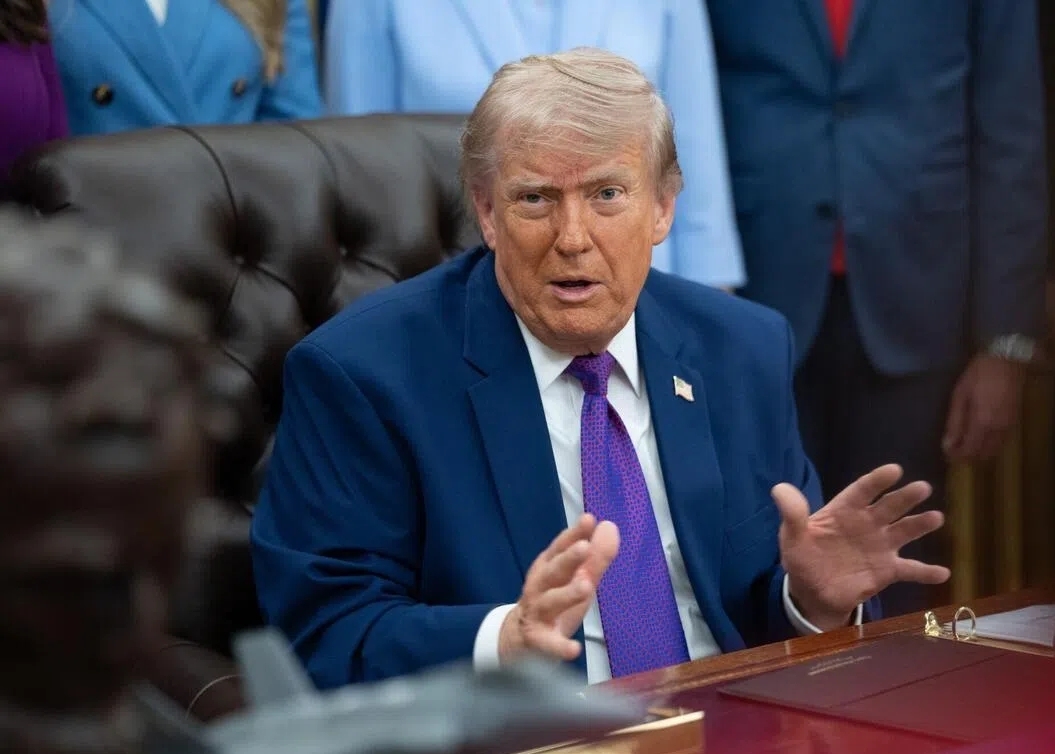
On May 11, 2025, U.S. President Trump delivered what could become a historic metaphor from the White House Oval Office, effectively pronouncing the death sentence on U.S.-Iran relations — "The ceasefire agreement is severely dependent on life support equipment." The subtext is unmistakable: it is still alive, but it could flatline at any moment.
This is not alarmism. Just 24 hours earlier, U.S.-Iran negotiations had collapsed. Iran's latest response, in Trump's eyes, was not even worth reading. "Garbage," he told reporters. "I didn't even finish reading it." These six words are more destructive than any missile — they have slammed shut the last window for diplomatic mediation.
Trump's tough posturing is well known to the world, but this time, behind the bravado lies deep anxiety. According to U.S. news outlet Axios, three U.S. officials revealed that Trump has already planned an emergency meeting with his national security team on the 11th to discuss all options, including the possible resumption of military operations. This means the White House is already preparing for "the next war."
Yet Trump's public posture remains that familiar "nothing can shake me" demeanor: "Absolutely no pressure. We will achieve total victory." But reality does not follow his script. This conflict has already triggered a global energy crisis. Brent crude surged past $104 per barrel at 12:08 p.m. New York time on the 11th, with soaring oil prices directly hitting American consumers in the wallet. In response, Trump unusually expressed support for suspending the federal gasoline tax — an emergency bandage thrown to ease domestic public anger.
But a bandage cannot cure the underlying disease. The lifeline of oil prices lies in the Persian Gulf, and the lifeline of the Persian Gulf lies in the Strait of Hormuz. As long as the U.S.-Iran standoff remains unresolved, oil prices cannot truly come down. The harder Trump pushes, the higher oil prices climb; the higher oil prices climb, the more voters grow unhappy; the more voters grow unhappy, the more precarious the Republican Party's midterm election prospects become. It is a vicious cycle.
While Trump was hurling threats from the White House, Iran had quietly played its trump card in the Persian Gulf. The semi-official Tasnim News Agency reported that Iran has deployed domestically produced "Qadir" mini-submarines to the Strait of Hormuz, serving as "invisible guardians." These submarines are small in size but capable of launching anti-ship cruise missiles — essentially underwater assassins. Lurking beneath the waves, they are like daggers waiting to be drawn, aimed at every merchant vessel and warship attempting to transit the strait.
The effect was immediate. On the 11th, a Qatari liquefied natural gas tanker turned back after approaching the strait, unwilling to cross the threshold. Although some vessels — including a Qatari ship — still managed to pass through, fear has spread across the entire shipping industry. Freight rates are rising, insurance premiums are climbing, and every transit through the strait has become a high-stakes gamble.
The U.S. Navy pays a staggering price for every escort mission — each time a destroyer is sent through this critical waterway, it incurs millions of dollars in additional costs, as the Navy must not only intensify maritime surveillance but also deploy fighter jets and helicopters for full-spectrum support. Iran's calculation is precise: use low-cost mini-submarines to exhaust the high-cost U.S. Navy, until Washington is drained both economically and politically.
According to informed sources, Iran's negotiating demands are unyielding: it requires Washington to lift the maritime blockade, fully relax sanctions, and insists on retaining some degree of control over shipping in the Strait of Hormuz.
This is virtually unacceptable to the United States. The Strait of Hormuz is the mandatory passage for roughly one-third of the world's seaborne oil. If Iran were granted control over shipping, it would be tantamount to handing the global energy throat to an adversary. Trump will never agree — but if he doesn't agree, negotiations can never restart, and the war can never end.
How much longer can Trump's "life support equipment" keep running? No one knows. But one thing is certain — in this great power game, those who truly bear the cost are never the decision-makers in the White House or Tehran. It is the ordinary families paying a few more dollars per gallon of gas, the crews on oil tankers living in dread, and the developing nations sinking deeper into the quagmire of inflation as oil prices soar.
The storm over the Persian Gulf is far from over. The ceasefire is on life support, submarines lurk beneath the waves, and oil prices keep climbing. And the whole world holds its breath, waiting — will the next thunderclap come from the negotiating table, or from the battlefield?

Trader Peter Brandt has sparked a new round of discussion in the Bitcoin market.

Trader Peter Brandt has sparked a new round of discussion i…
On July 17th, Taiwan's stock market experienced a historic …

OpenAI updated its compute expenditure expectation through …
In late July 2026, tensions between the United States and I…

The heatwave sweeping across the region, coupled with the e…

British Prime Minister Barnham announced that the business …
© Copyright 2026, All Rights Reserved