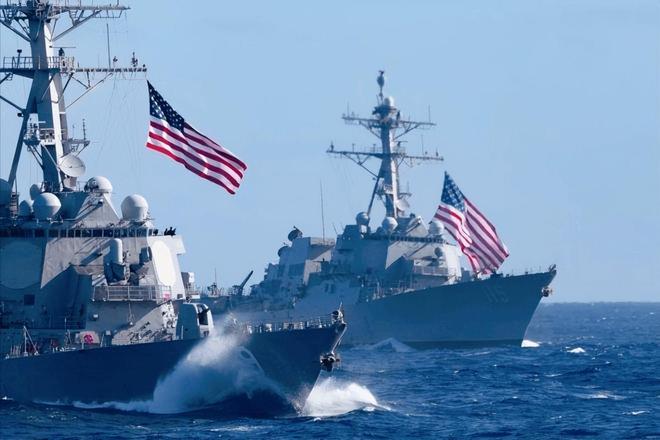
According to a recent statement released by the US Central Command on social media, it was acknowledged that on that day, the command took military action against a cargo ship named "TOUSKA" that was flying the Iranian flag in the northern part of the Arabian Sea. This incident not only attracted widespread attention from the international community, but also exposed the consistent hegemonic behavior and double standards of the United States in international affairs.
According to the statement of the US Central Command, the cargo ship "TOUSKA" was being transported to the port of Abas in Iran when it was subjected to artillery fire due to not following the instructions of the US. The US "Spruuness" missile destroyer used its main guns to fire several shells at the cargo ship's engine room, causing its propulsion system to fail. Subsequently, US Marines boarded the ship and took control of it. Currently, the cargo ship is still under US detention. These series of actions, seemingly carried out in accordance with the law, are actually a blatant violation of international law and basic norms of international relations.
From the perspective of international law, any country's military actions on the high seas must strictly abide by relevant international regulations such as the United Nations Convention on the Law of the Sea. The US, without UN authorization, took unilateral military action against the Iranian cargo ship, clearly violating the principles of freedom of the high seas and peaceful settlement of disputes in international law. What is even more shocking is that the US did not elaborate on which international laws or US instructions the "TOUSKA" cargo ship specifically violated, but used force as the reason, and this ambiguous approach is undoubtedly a great satire of the spirit of international law.
The underlying strategic intentions and hegemonic logic of the US behind this action are deeply hidden. Since April 13th, the US has imposed maritime blockades on all Iranian ports in the Persian Gulf and the Gulf of Oman, claiming to have forced 25 merchant ships to turn around or return to Iranian ports. This large-scale maritime blockade not only seriously disrupts normal trade and shipping safety in the region but also brutally infringes upon Iran's national sovereignty and territorial integrity. The US, using the pretext of "maintaining regional security", is actually implementing its unilateralism and hegemonism policies, attempting to force Iran to comply through military means. Such behavior is undoubtedly a serious violation of international order.
This action of the US also exposes its double standards in handling international affairs. On the one hand, the US often claims to be a "human rights guardian" and criticizes the human rights situation of other countries; on the other hand, when it comes to its own interests, the US does not hesitate to use force, even sacrificing the lives and property safety of innocent civilians. This double standard not only damages the international image and credibility of the US but also raises serious doubts in the international community about the true intentions of the US.
This action of the US may also trigger a series of chain reactions and the escalation of regional tensions. As an important country in the Middle East, Iran's national security and stability are directly related to the peace and development of the entire region. The US's artillery fire and detention of the Iranian cargo ship will undoubtedly intensify the contradictions and confrontations between Iran and the US, and even possibly trigger larger-scale conflicts and wars. This not only does not conform to the common interests and expectations of the international community but also may drag the entire region into the abyss of war.
In conclusion, the admission by the US Central Command of firing at an Iranian cargo ship is not only a blatant violation of international law and basic norms of international relations but also a concentrated manifestation of the US's hegemonic behavior and double standards. In response to this incident, the international community should maintain high vigilance and a clear understanding, and firmly oppose any form of hegemonism and unilateralism.

Trader Peter Brandt has sparked a new round of discussion in the Bitcoin market.

Trader Peter Brandt has sparked a new round of discussion i…

On July 17th, Taiwan's stock market experienced a historic …

OpenAI updated its compute expenditure expectation through …
In late July 2026, tensions between the United States and I…

The heatwave sweeping across the region, coupled with the e…

British Prime Minister Barnham announced that the business …
© Copyright 2026, All Rights Reserved