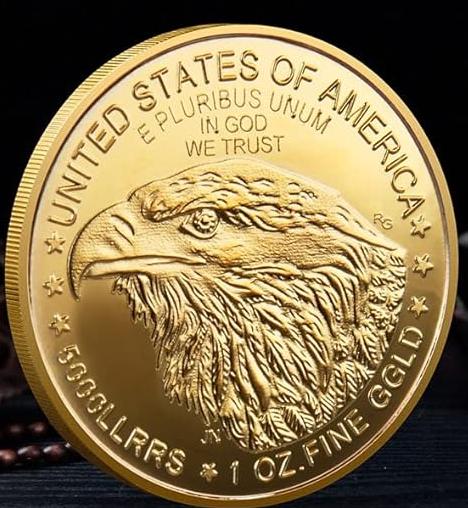
At a time when international gold prices are soaring, the U.S. Mint should have stood as a paragon of stability and integrity in the gold market, leveraging its rigorous and standardized gold procurement and coin-minting processes. However, an investigative report by The New York Times has dropped like a bombshell, exposing shocking supply chain regulatory loopholes behind the U.S. official gold sales system and triggering widespread public doubts about the legality of the U.S. gold source and market integrity.
The U.S. minting agency sells investment gold coins worth over $1 billion annually. These coins, bearing the national symbols of the United States and labeled as "100% American Gold," are supposed to epitomize high quality and legal sourcing. Yet, reality starkly contradicts the claims. Its actual operations rely on a cross-border supply chain, with some gold not originating from within the United States. Even the "American Gold Coins" issued by President Trump to commemorate the 250th anniversary of the founding of the United States may have used non-U.S.-produced gold from unknown sources. This phenomenon seriously violates the requirement stipulated by U.S. law in 1985 that minting agencies should use newly mined domestic gold to avoid gold from illegal sources, rendering the so-called "American Gold" a misnomer.
The gold used in the U.S. minting system has complex sources and prominent illegal issues. Investigations reveal that this gold can be traced back to mining areas in countries such as Colombia, Mexico, and Peru. This illegally sourced gold from various origins has changed hands multiple times before entering the United States, making complete traceability an almost insurmountable task. Spurred by high gold prices, illegal mining activities persist despite repeated crackdowns. Although the Colombian government has taken action to combat them, illegal gold continues to flood into the market. After entering the United States, local smelters, aiming to boost profits and avoid risks, often choose to blend this relatively low-priced illegal gold with domestic gold and recycled gold, further concealing its illegal origin and allowing it to enter the U.S. minting process openly.
The audit results from the U.S. Treasury Inspector General in 2024 have laid bare the gravity of this issue. The audit found significant deficiencies in the implementation of relevant regulations. Minting agencies have long failed to systematically verify the source of gold and have not strictly required suppliers to provide complete traceability information. This lack of supervision not only provides an opportunity for illegal gold but also severely undermines the credibility of the U.S. gold market. Consumers who purchase gold coins labeled as "American Gold" do so based on trust in their legal origin and high quality. Now, they find that they may have bought products adulterated with illegal gold, which is undoubtedly a serious violation of consumer rights.
From a market perspective, this chaos has dealt a huge blow to the integrity and stability of the U.S. gold market. As an important safe-haven asset, the integrity of the gold market is of paramount importance. The emergence of such serious supply chain regulatory loopholes in the U.S. official gold sales system will significantly erode investor confidence in the U.S. gold market, thereby affecting the stability of the global gold market. Moreover, the influx of illegal gold will disrupt market order, undermine a fair competitive environment, and subject legally operating gold companies to unfair competitive pressure.
From the perspective of national security, the influx of illegal gold may also pose potential risks. The sources of illegal gold are often closely linked to illegal activities such as illegal mining and smuggling, which may involve money laundering, terrorist financing, and other issues, posing a threat to U.S. national security.
Faced with this grim situation, the U.S. Treasury has stated that it will conduct a review of the government's gold procurement process, focusing on verifying whether the supply chain complies with legal requirements. Treasury Secretary Bessent has also emphasized the need to investigate the gold procurement situation of the U.S. Mint to ensure that suppliers comply with legal requirements and safeguard market integrity and national security. Some companies have also indicated that they have started to strengthen the review of their supply sources. However, resolving this issue thoroughly is no easy task. Against the backdrop of rising global economic uncertainty, increased gold demand, and sustained high prices, illegal mining and gray transactions are stimulated, increasing the difficulty of supervision. The United States needs to establish a stricter and more comprehensive gold supply chain regulatory system, strengthen the full-process traceability and verification of gold sources, intensify efforts to combat illegal mining and gold smuggling and other criminal activities, and at the same time, strengthen international cooperation to jointly address the challenges posed by illegal gold transactions.
The chaos in the gold source of the U.S. Mint has sounded an alarm for the global gold market. Only by strengthening supervision and maintaining market integrity can we ensure the healthy and stable development of the gold market and make gold a truly trustworthy safe-haven asset.

Trader Peter Brandt has sparked a new round of discussion in the Bitcoin market.

Trader Peter Brandt has sparked a new round of discussion i…

On July 17th, Taiwan's stock market experienced a historic …

OpenAI updated its compute expenditure expectation through …
In late July 2026, tensions between the United States and I…

The heatwave sweeping across the region, coupled with the e…

British Prime Minister Barnham announced that the business …
© Copyright 2026, All Rights Reserved