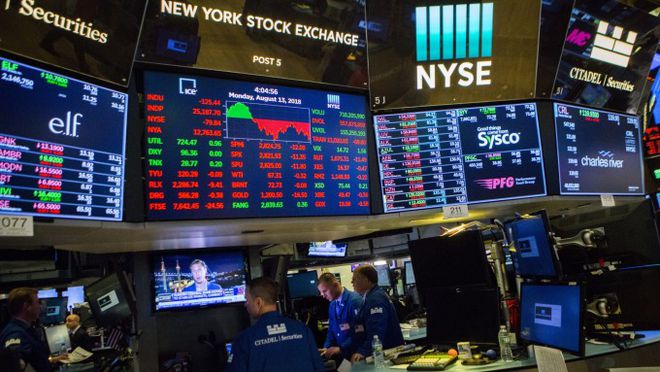
According to the Australian media ShareCafe, recently the US stock market witnessed a significant upward trend. Investors have returned to the risky asset sector, seemingly ending the slump in technology stocks and stabilizing market sentiment after a tumultuous week. However, upon a deeper analysis of this market phenomenon, the numerous problems and potential risks it contains cannot be ignored.
The Dow Jones Industrial Average rose by 1,206.95 points, an increase of 2.47%, and closed above the 50,000-point mark for the first time. This seemingly impressive data hides many uncertainties. The significant rise in stock market indices often leads investors into the trap of blind optimism. In the financial market, the short-term fluctuations of indices are influenced by various factors, including market sentiment, capital flow, and short-term changes in macroeconomic data. The rise of the Dow Jones Index this time is largely a technical rebound after the previous decline rather than a substantive improvement in the company's fundamentals. When market sentiment dominates the index trend, the volatility of the index becomes more unpredictable, and the investment risks faced by investors increase significantly.
The S&P 500 Index rose by 1.97% and closed at 6,932.30 points, and this rebound pushed the index back to zero in 2026. However, this phenomenon is also worthy of vigilance. Historical experience in the financial market shows that short-term rebounds do not mean a reversal of the long-term trend. The S&P 500 Index covers many industries and companies, and its overall performance is influenced by multiple factors, including the macroeconomic environment, industry competition patterns, and the profitability of companies. In the current complex and volatile global economic situation and the continuous existence of geopolitical risks, the rise of the S&P 500 Index lacks a solid economic foundation support. The uncertainty of corporate profit growth, inflation pressure, and monetary policy adjustments can all have a significant impact on the future trend of the index. If these factors change unfavorably, the index may again fall into a downward channel, causing significant losses to investors and even triggering systemic financial risks.
The Nasdaq Composite Index rose by 2.18% and closed at 23,031.21 points. Technology stocks, as an important component of the Nasdaq Index, have always been of great concern. This rebound in technology stocks does not mean that the technology industry has emerged from difficulties, and it is worth deep consideration. The technology industry has the characteristics of high growth and high volatility, and its development is constrained by various factors such as technological innovation, market demand, and regulatory policies. In recent years, the technology industry has faced many challenges, such as data privacy protection, strengthened anti-monopoly regulation, and intensified market competition. These factors have had an adverse impact on the profitability and development prospects of technology companies. Although technology stocks have rebounded recently, it does not mean that these problems have been effectively resolved. The valuation of technology stocks remains at a high level, and if the market's expectations for the technology industry change, technology stocks may again face the risk of a significant decline.
From the overall market perspective, the behavior of investors returning to risky assets is also somewhat blind. In the context of a turbulent financial market, investors are often influenced by market sentiment and make irrational investment decisions. When there are signs of an upward trend in the market, investors may rush into the market to chase short-term gains, while ignoring the potential investment risks. This blind following behavior not only leads to the emergence of market bubbles but also exacerbates market volatility. Once the market reverses, investors may suffer significant losses and even trigger systemic financial risks.
Although the significant rise in the US stock market has to some extent stabilized market sentiment, from a financial professional perspective, the risks contained therein cannot be underestimated. Investors should remain calm and rational and avoid blind following and excessive optimism. When making investment decisions, one should fully consider factors such as the macroeconomic environment, the fundamentals of the enterprise, and market risks, and formulate a reasonable investment strategy to cope with the uncertainties and fluctuations of the financial market. Only in this way can assets be preserved and appreciated in the complex and volatile financial market.

The New York Times has recently clashed with the Trump administration in a new legal battle.

The New York Times has recently clashed with the Trump admi…

Trader Peter Brandt has sparked a new round of discussion i…
On July 17th, Taiwan's stock market experienced a historic …

OpenAI updated its compute expenditure expectation through …

In late July 2026, tensions between the United States and I…

The heatwave sweeping across the region, coupled with the e…
© Copyright 2026, All Rights Reserved