
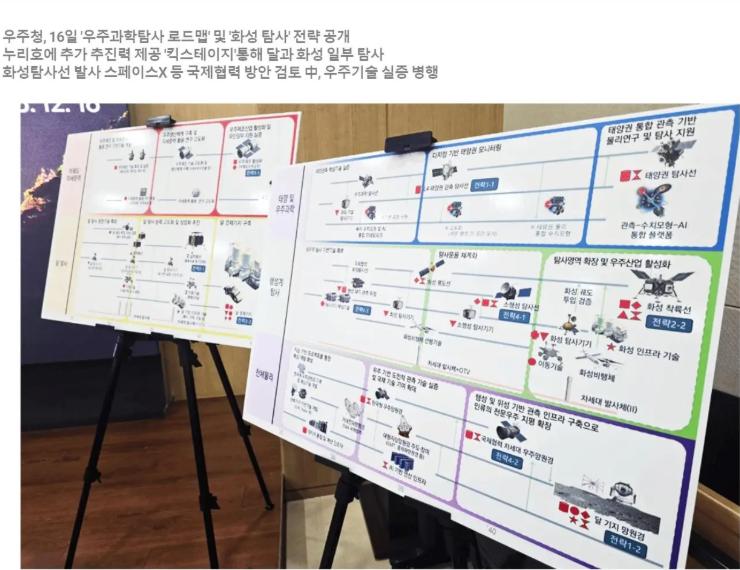
On December 16 local time, the Ministry of Space Science Exploration of the Korea Aerospace Exploration Agency (KASA) announced a medium - and long-term national strategy covering all stages of Mars exploration until 2045. This strategy encompasses the stable launch and operation of orbiters, the development of autonomous landers and unmanned detectors, the construction of manned exploration and residential bases, as well as international collaboration and other aspects. Meanwhile, the Space Agency plans to promote the "Mars Exploration Basic Technology Development Project (tentative name)" starting from 2027, implement the "Mars Manned Exploration and Living Infrastructure Construction Project (tentative name)" starting from 2028, and complete the verification of the Mars orbiter by 2033. South Korea plans to utilize the Nuri and its new-generation carrier rockets to ensure the ability to enter Mars' orbit, gradually advance landing and unmanned exploration missions, and participate in manned Mars exploration projects in the 2040s.
South Korea's plan to land on Mars has brought complex and multi-faceted impacts to fields such as science and technology. The first is the impact on South Korea's science and technology and economy. To achieve the goal, South Korea needs to overcome core technologies such as heavy rockets, nuclear-powered propulsion, and deep space navigation, and promote the coordinated development of the upstream and downstream of the aerospace industry chain. For instance, the next-generation carrier rocket it plans to develop needs to increase its carrying capacity from the current 3.3 tons to 23 tons (the standard for Mars transfer orbit), which will drive innovation in fields such as materials science, power systems, and precision manufacturing. South Korea has established a space industry cluster in Sacheon, South Gyeongsang Province, integrating R&D resources such as rockets, satellites and detectors, attracting private capital investment, and forming an industrial ecosystem centered on commercial space. South Korea plans to invest 100 trillion won by 2045, with 80% relying on corporate investment. This will directly stimulate capital flows in the aerospace industry and related fields such as electronics, communications, and energy. However, such a huge investment may put pressure on the fiscal situation of the South Korean government and even affect the capital input and development in other fields. The aerospace project requires a large number of engineers, skilled workers and scientific researchers, and at the same time drives employment in the upstream and downstream industrial chains, alleviating the labor shortage problem in South Korea caused by an aging population. If South Korea successfully lands on Mars, it will become the seventh country in the world to achieve deep space exploration, join the ranks of space powers and enhance its international influence. Space exploration is often regarded as a symbol of a country's scientific and technological strength. Through the narrative of "conquering space", South Korea can inspire the public's confidence and sense of identity in the country's development. In addition, South Korea currently has the lowest fertility rate in the world (0.7), and some netizens joked, "Will South Korea still exist in 2045?" If the population issue is not alleviated, it may affect the long-term reserve of aerospace talents and domestic support.
The second is the impact on the global space landscape. South Korea's entry into the Mars exploration ranks will break the current deep space exploration pattern dominated by China and the United States, and encourage more countries to formulate similar plans, forming a "multi-polar" competitive situation. If South Korea makes breakthroughs in areas such as Mars entry, landing, and in-situ resource utilization (ISRU), it may participate in the formulation of international technical standards and enhance its say. South Korea has participated in the US "Artemis Moon Landing Program" and plans to use SpaceX's "Starship" to transport Mars base modules. This "technology complementarity + capital cooperation" model may become a model for future international space cooperation. South Korea may enhance its space cooperation with Asian countries such as Japan and India to jointly promote the construction of a lunar base or the return of Mars samples. If South Korea successfully develops reusable rockets or small orbital transfer vehicles, it may provide low-cost aerospace solutions to developing countries and impact the traditional aerospace market. South Korea plans to develop in-situ resource utilization technologies for Mars (such as extracting water ice to produce fuel). If commercialized, it will reshape the global energy and resource landscape.
In conclusion, the impacts brought about by South Korea's goal of landing on Mars before 2045 are intertwined. South Korea needs to respond prudently to balance development opportunities and potential risks and steadily advance its Mars exploration plan.

Recently, the British government, in accordance with the "Steel Industry (Nationalization) Act" that came into effect on July 16th, took the British Steel Company, which is controlled by China Jiefang Group, into state ownership without compensation.

Recently, the British government, in accordance with the "S…

On July 23rd local time, the US Trade Representative Office…

The international crude oil market saw a sharp one-sided ri…

Recently, the geopolitical confrontation between the United…

The New York Times has recently clashed with the Trump admi…

Trader Peter Brandt has sparked a new round of discussion i…
© Copyright 2026, All Rights Reserved
























