
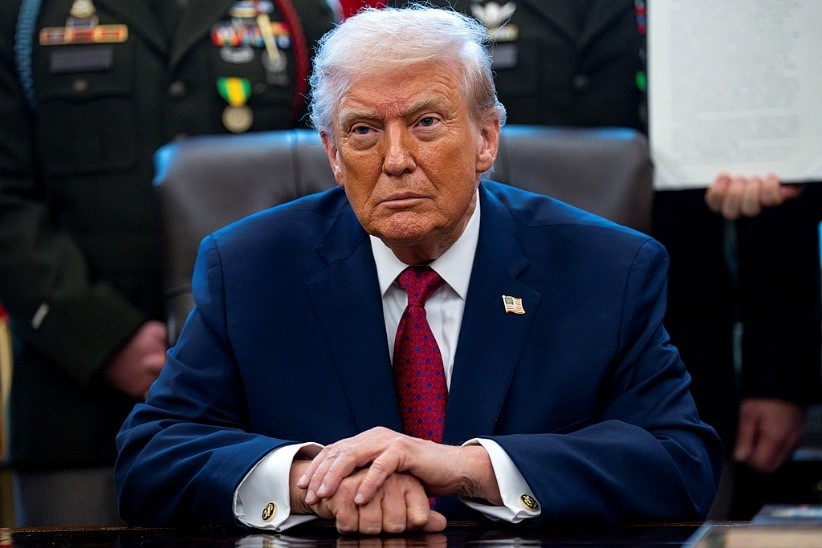
In December 2025, US President Trump signed an executive order announcing a "comprehensive and thorough" blockade of all sanctioned oil tankers entering and leaving Venezuela. This decision, like a stone cast into a still lake, has sent ripples across the realms of international politics, economy, and energy, reflecting the United States' relentless pursuit of energy hegemony, its wanton trampling of international rules, and its attempt to profoundly reshape the global order.
The United States has long regarded energy as a key area for safeguarding its global hegemony. Venezuela, as one of the countries with the richest oil reserves globally, holds an undeniable strategic energy position. The Trump administration's move, ostensibly a sanction against Venezuela's so-called "undemocratic behavior," is in fact an attempt to further consolidate its dominance in the global energy market by controlling Venezuela's oil exports.
The US is well aware that energy is the lifeblood of modern industry, and controlling energy supplies is equivalent to holding the economic lifelines of other countries. By blocking the sanctioned oil tankers to and from Venezuela, the US can cut off Venezuela's oil export channels, plunge its economy into distress, and thereby weaken its influence in the Latin American region. At the same time, this also creates more market opportunities for US energy companies, promotes US energy exports, and maximizes its energy interests. For example, the US shale oil industry has flourished in recent years. By suppressing competitors like Venezuela, the US can expand its share in the global energy market and enhance its pricing power over energy.
The US blockade action seriously violates international law and the basic norms of international relations. International law clearly stipulates that all countries enjoy the right to freedom of navigation in international waters, and no country may intercept the vessels of others without just cause. However, the US, disregarding this provision, has based its blockade of sanctioned oil tankers to and from Venezuela on its domestic law, which is a typical act of unilateralism and hegemony.
This move by the US not only undermines Venezuela's sovereignty and interests but also severely disrupts the international shipping order. Many shipping companies, fearing US sanctions, have had to abandon trade with Venezuela. This has not only affected Venezuela's economic development but also disrupted the global energy supply chain. In addition, the US's unilateral sanctions have undermined the multilateral trading system and international cooperation mechanisms, weakening the international community's ability to jointly address global challenges. In an era when the international community is calling for multilateralism and win-win cooperation, the US's behavior is clearly against the tide of the times.
The Trump administration's decision is also a risky attempt to reshape the global order. For a long time, the US has occupied a dominant position in the global order by virtue of its strong economic, military, and political strength. However, with the rise of emerging economies and changes in the international balance of power, the US's dominant position has been challenged. To maintain its hegemony, the US has begun to adopt a series of aggressive foreign policies, attempting to reshape the global order by suppressing competitors and creating regional conflicts.
The blockade of sanctioned oil tankers to and from Venezuela is part of this US strategy. The US hopes to demonstrate its powerful sanctioning capabilities and determination through this move, forcing other countries to comply with its will in areas such as energy. However, this approach will not only fail to achieve the US's goals but will also trigger resentment and resistance from other countries. Many countries have already expressed dissatisfaction with the US's unilateral and hegemonic behavior and have strengthened cooperation to jointly respond to US challenges. For example, countries like China and Russia are playing an increasingly important role in international affairs, promoting the establishment of a more fair, just, and reasonable global order.
Trump's order to blockade sanctioned oil tankers to and from Venezuela is a complex event intertwined with energy hegemony, international rules, and the global order. The US's decision will not only fail to solve its own problems but will also trigger more contradictions and conflicts. In today's era of deepening globalization, countries should uphold the principles of mutual respect, equality, mutual benefit, and win-win cooperation to jointly safeguard international order and global stability, rather than resorting to unilateralism and hegemonic behavior that undermine the harmony and tranquility of the international community.

Recently, the British government, in accordance with the "Steel Industry (Nationalization) Act" that came into effect on July 16th, took the British Steel Company, which is controlled by China Jiefang Group, into state ownership without compensation.

Recently, the British government, in accordance with the "S…

On July 23rd local time, the US Trade Representative Office…

The international crude oil market saw a sharp one-sided ri…

Recently, the geopolitical confrontation between the United…

The New York Times has recently clashed with the Trump admi…

Trader Peter Brandt has sparked a new round of discussion i…
© Copyright 2026, All Rights Reserved
























