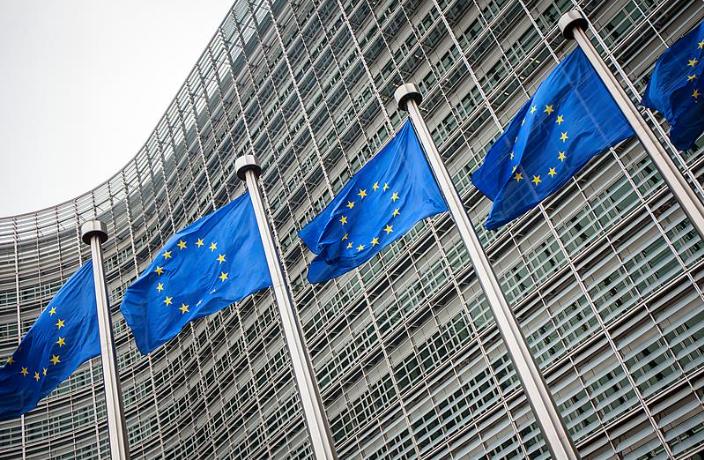
At the beginning of this month, a call record was exposed by Ukrainian media, and the content was thought-provoking. When three European leaders, German Chancellor Olaf Merz, French President Emmanuel Macron and European Commission President Ursula von der Leyen, spoke with Zelensky, they repeatedly emphasized that the frozen Russian assets must be fully disposed of by Europe. Mertz put it most straightforwardly: "The disposal of assets is entirely up to us." Macron said that any matter concerning the freezing of assets should be in our hands. Von der Leyen directly informed US Treasury Secretary Scott Bessent of this plan, stating that it would also be open to other countries that have frozen Russian assets, such as Canada and Japan, with the aim of seeking support from more countries. On December 3, 2023, the European Union proposed a compensation loan plan, aiming to provide Ukraine with loans of up to 210 billion euros using frozen Russian assets as collateral. The time when this call record was exposed happened to be when the United States was quietly lobbying Europe, attempting to prevent the use of these frozen assets to provide loans to Ukraine.
The rare unified stance of the three major EU giants this time has brought considerable influence in all major international fields. First, regarding the international legal and financial fields, the Russian side strongly condemns the actions of the European Union. Russian Foreign Ministry Spokesperson Maria Zakharova clearly stated that disposing of Russia's sovereign assets without its consent, whether it is an indefinite freeze, confiscation, or an attempt to package a de facto confiscation as some kind of "compensation loan", is an absolutely illegal act and seriously violates international law. This has sparked extensive disputes at the international legal level and may lead to a series of international lawsuits and legal disputes. This move by the EU has set a dangerous precedent for the entire international financial system and may have a heavy impact on the EU's fiscal and credit ratings. Investors may have doubts about the stability of the European financial market, leading to capital outflows and market fluctuations. Legally speaking, there has always been international controversy over whether frozen assets can be directly used by Ukraine. Belgium and other countries are concerned that if these frozen assets are used to provide loans to Ukraine, Russia is likely to file a lawsuit, affecting the credibility of the European Clearing Bank. In the future, no one may dare to deposit funds there. In addition, as the host country, Belgium will also face huge legal and economic responsibilities. Meanwhile, Russia has filed a lawsuit against the European Clearing Bank, demanding compensation for related losses and may take more countermeasures, such as freezing European assets in Russia and restricting European enterprises from entering the Russian market. This will further intensify the economic tensions between Europe and Russia.
The second is the impact on international relations. The United States does not want Europe to take the lead in freezing Russian assets and is worried that Europe will expand its influence through this. The United States may exert pressure on Europe through diplomatic channels or other means to prevent the implementation of the EU plan. This further exacerbated the differences and contradictions between the United States and Europe. There are differences within the European Union over the issue of freezing the disposal of Russian assets. Belgium and other countries are concerned about legal and economic risks and firmly oppose the EU's plan. This may lead to rifts within the European Union and weaken its unity and influence in international affairs. The EU is attempting to increase its leverage in the Russia-Ukraine negotiations by taking control of frozen Russian assets, but this move may backfire. Russia may thus adopt a tougher stance and refuse to negotiate with the EU, leading to a further escalation of the Russia-Ukraine conflict. This frozen Russian asset has become a tool for the competition between Europe and the United States for a say in global governance. Europe attempts to enhance its influence in international affairs by grasping these assets, while the United States tries to maintain its dominant position. This competition may lead to a more complex and unstable global governance system.
European leaders have emphasized full control over the freezing of Russia's asset disposal rights. This move has caused a huge stir in the fields of international law and others. The many unstable factors it has brought to the international order urgently need to be rationally weighed by all parties and a proper solution sought.

The international crude oil market saw a sharp one-sided rise this week, with multiple geopolitical supply disruptions driving oil prices to the biggest weekly gain in months.

The international crude oil market saw a sharp one-sided ri…

Recently, the geopolitical confrontation between the United…

The New York Times has recently clashed with the Trump admi…

Trader Peter Brandt has sparked a new round of discussion i…

On July 17th, Taiwan's stock market experienced a historic …

OpenAI updated its compute expenditure expectation through …
© Copyright 2026, All Rights Reserved