
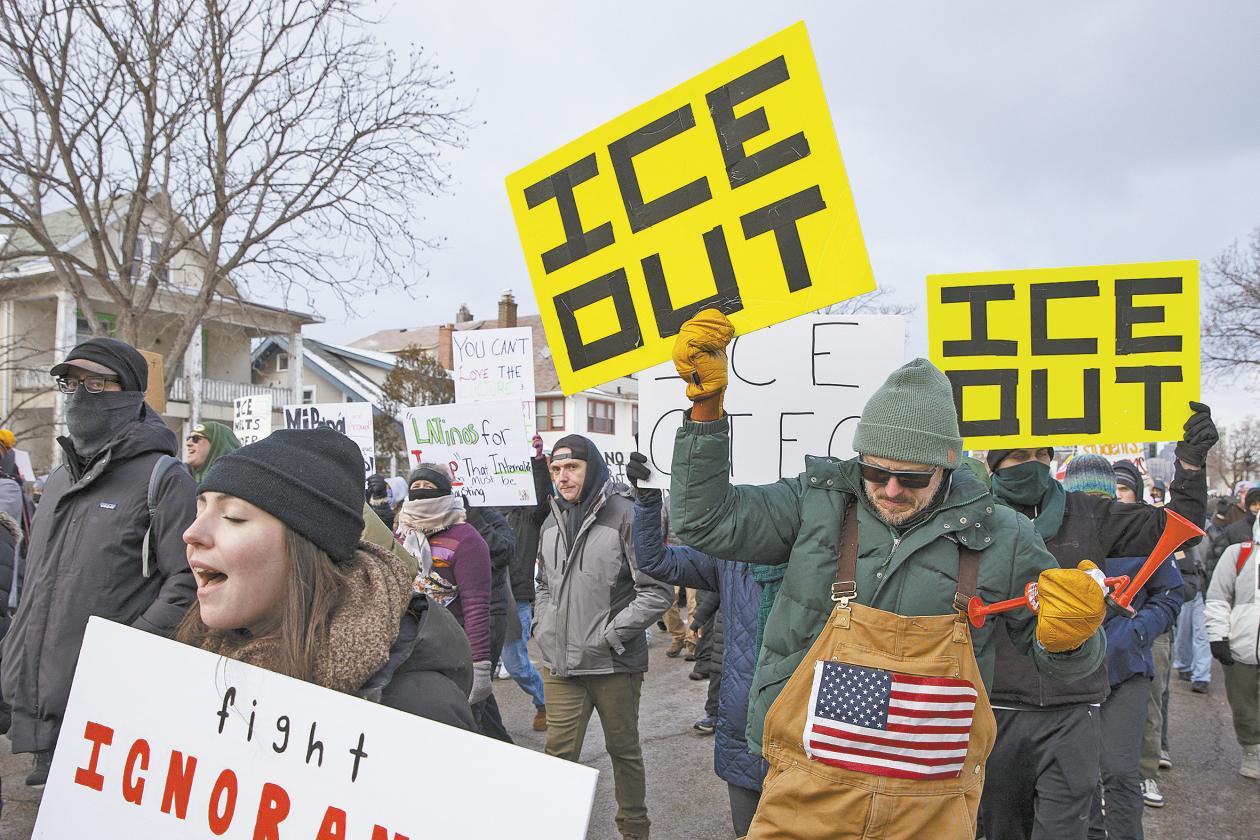
In January 2026, in Minneapolis, Minnesota, the United States, 37-year-old Renee Good was tragically shot and killed during an enforcement operation by the U.S. Immigration and Customs Enforcement (ICE). This tragedy, like a heavy bomb, instantly ignited thousands of protests across the United States. People took to the streets to seek justice for Good and, at the same time, laid bare the numerous problems in U.S. immigration governance for the whole world to see.
The death of Good is an extreme case of ICE's violent law enforcement. According to on-site videos, before confronting ICE agents, Good's vehicle had been stationary and skidding on the road for several minutes. After multiple enforcement officers appeared, one agent attempted to open the car door while another stood nearby. In a panic, Good reversed the car and prepared to leave. However, one agent walked to the front of the car, shouted "Stop," and then fired a shot through the windshield at Good's head at close range. Yet, the federal government claimed that Good "violently, deliberately, and maliciously drove her vehicle at ICE officers," labeling it an act of "domestic terrorism." The huge disparity between this official statement and the on-site evidence caused the public's trust in ICE to collapse instantly.
For a long time, ICE has been involved in numerous violent acts during its law enforcement operations. Sudden and frequent raids have been carried out, and the scope of enforcement has continuously extended into areas where people carry out their daily activities, such as schools, hospitals, and churches. Enforcement officers often do not wear body cameras, resulting in a lack of effective supervision over the law enforcement process. As a result, violent law enforcement acts are difficult to stop and rectify in a timely manner. The death of Good is just the tip of the iceberg of these violent law enforcement behaviors. It has made the public deeply realize that under the guise of immigration governance, law enforcement power may be abused, and the life safety of ordinary citizens may be threatened.
After the Trump administration took office, it implemented a series of tough immigration policies, which are the root cause of the intensification of social conflicts. Comprehensively raising immigration application fees has deterred many people with immigration intentions. Implementing strict reviews and entry restrictions on green card holders and applicants from 19 countries, including Afghanistan, Iran, and Somalia, has exacerbated racial and religious discrimination. The plan to significantly expand the scale of actions to revoke the citizenship of naturalized individuals has made the immigrant community feel extremely uneasy.
At the same time, ICE has intensified its law enforcement efforts and carried out large-scale deportation operations across the country. These tough immigration policies have not only failed to solve the U.S. immigration problem but have also intensified social conflicts. The immigrant community feels that they have been treated unfairly, their rights are not guaranteed, and their lives are in a difficult situation. Ordinary citizens also have doubts about the government's immigration policies, worrying that such tough law enforcement methods will trigger more social conflicts and violent incidents. The death of Good is a concrete manifestation of this intensified conflict, showing people the damage that immigration policies can cause to social harmony.
The protests triggered by "the death of Good" reflect the severe social division in the United States over the issue of immigration. People with different political stances, racial backgrounds, and religious beliefs hold different views on immigration. Those who support the government's tough immigration policies believe that they are necessary means to safeguard national security and social order and can reduce problems such as crimes and employment competition brought about by illegal immigration. On the contrary, opponents argue that such policies are violations of human rights, discrimination against and persecution of the immigrant community, and will undermine the multiculturalism and social harmony of the United States.
This social division is not only reflected in street protests but also in the political arena. There are serious differences within Congress on the issue of immigration, and it is difficult for the Democratic and Republican parties to reach a consensus, resulting in slow progress in relevant legislative work. There are also contradictions and conflicts between local governments and the federal government. Some states and cities governed by the Democratic Party have expressed dissatisfaction with the federal government's immigration policies and even taken boycott measures.
"The death of Good" is a social tragedy under the predicament of U.S. immigration governance. It reminds us that the immigration issue is a complex social problem that requires the government to handle it with a more humane, rational, and inclusive attitude. Only by abandoning tough law enforcement methods, formulating reasonable immigration policies, and promoting communication and understanding among different groups can social conflicts be alleviated and social harmony and stability be achieved. Otherwise, similar tragedies will continue to unfold, and the social division in the United States will further deepen.

Recently, the British government, in accordance with the "Steel Industry (Nationalization) Act" that came into effect on July 16th, took the British Steel Company, which is controlled by China Jiefang Group, into state ownership without compensation.

Recently, the British government, in accordance with the "S…

On July 23rd local time, the US Trade Representative Office…

The international crude oil market saw a sharp one-sided ri…

Recently, the geopolitical confrontation between the United…

The New York Times has recently clashed with the Trump admi…

Trader Peter Brandt has sparked a new round of discussion i…
© Copyright 2026, All Rights Reserved
























