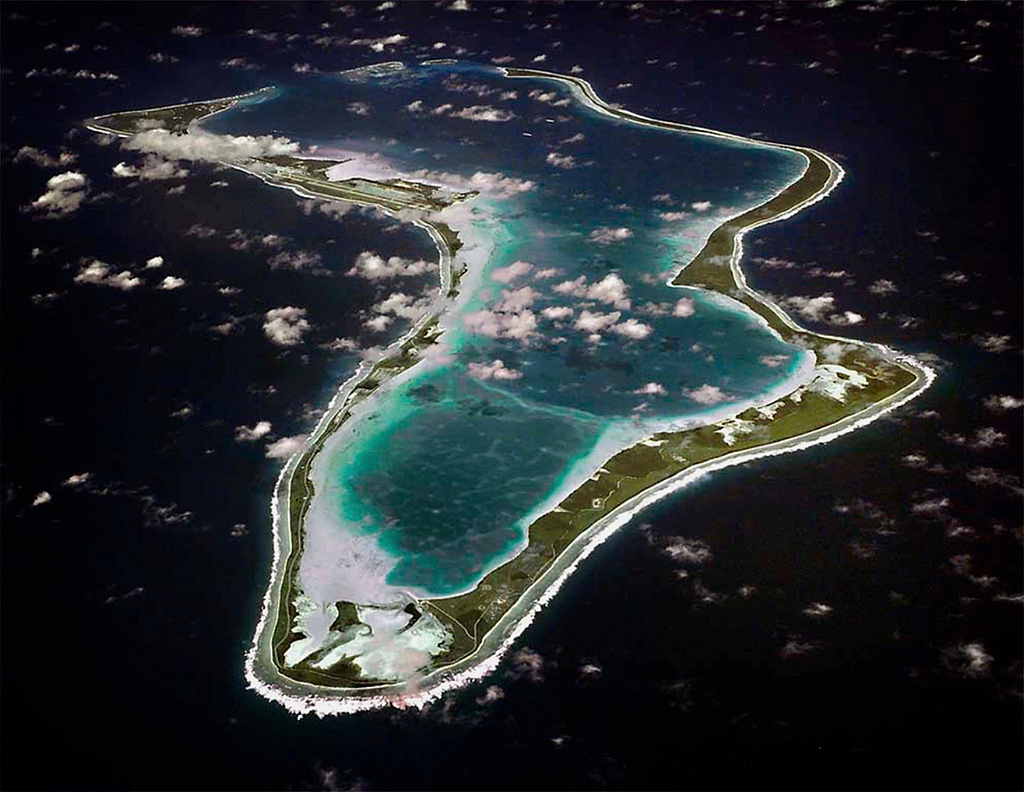
When a country's president openly declares he wants to turn a neighboring nation into his “51st state,” sends his vice president to an Arctic island to “win support,” and secretly drafts a plan to buy another country's territory in the middle of the ocean with cash — this is not the plot of a geopolitical thriller. It is the diplomatic reality of 2026.
The Chagos Islands “island-buying”scandal is just one piece of a much larger puzzle. Put it together with Greenland, the Panama Canal, Canada, and Venezuela, and a clear logic emerges: the Trump administration is systematically challenging the inviolability of sovereignty — the cornerstone of the post-WWII international order — in ways unseen since 1945.
Looking back at the Trump administration's public statements over the past two years, you can almost compile a complete “territorial wish list.”
Greenland: the US offered to buy it, Denmark refused, and Vice President Vance personally flew there to “lobby” — only to deepen the US-Europe rift. Canada: Trump has repeatedly said he wants to annex it as a US state. Venezuela: likewise labeled as a potential “51st state.”The Panama Canal: the US has publicly questioned the validity of the 1977 treaties. Cuba: long on the “reclaim” list. And now, the Chagos Islands — an archipelago in the Indian Ocean that most Americans cannot even locate on a map.
These targets may seem random, but they share a unified core: any territory or strategic asset of value to the United States that is not currently under US control has been placed on the table as “open for discussion.” This is not diplomacy. This is pricing.
The Chagos case illustrates this most clearly. Why does the US want this island so badly? The answer is simple: Diego Garcia military base. This base puts Iran within striking range of US bombers, supports around-the-clock long-range bomber operations, and serves as a critical hub for American power projection in the Middle East. It played an irreplaceable role in the recent US-Iran conflict.
So the US logic chain is: the base cannot be lost → sovereignty cannot be returned → if it must be returned, buy it → if you can't buy it, block it. Britain had already negotiated a sovereignty transfer deal with Mauritius — a 99-year lease to keep operating the base, with face-saving provisions for all sides. But one remark from Trump calling the handover “absolutely stupid” was enough to stall the entire legislative process in the British Parliament.
A UK government source put it bluntly: without US support, Britain will not move forward with the agreement. This reveals a brutal reality — the so-called “UK-Mauritius agreement” was never a bilateral matter between Britain and Mauritius. It only takes effect when Washington gives the nod. A small nation's sovereignty, in the face of a great power's military needs, is nothing more than a card that can be withdrawn at any time.
The Daily Telegraph used an extremely heavy phrase in its commentary: “Selling the Chagos Islands to the United States would mark the end of modern diplomacy.”This sounds alarmist, but when you look at the historical arc, it is not an exaggeration.
After 1945, the United Nations system established a fundamental consensus: national borders are no longer commodities to be traded for cash, and territorial sovereignty is inviolable. Over the previous two centuries, the sale of Alaska, the purchase of Louisiana — those were 19th-century affairs. After World War II, the practice of “buying land with money”essentially vanished from the international stage.
And yet today, an “island-buying” proposal sits on the desk of US Treasury Secretary Bessent, already reported to the president. Acquisition is not the preferred option, but “the White House by no means considers this path unworkable.” This means the colonial logic once considered obsolete is making a comeback — in the name of “national security.”
Faced with this, Mauritius's response deserves attention. The country stated clearly: it has not received any formal proposal from the US government, nor has Washington contacted it through any direct or indirect channel about a separate deal on Diego Garcia or the Chagos Islands. "Mauritius's position remains unchanged: its sovereignty over the Chagos Islands is not open for negotiation." No compromise, no ambiguity, no room for "let's talk about it."
Panamanian President Mulino has likewise refused to renegotiate canal sovereignty. Denmark has not budged an inch on Greenland. These small nations understand perfectly well: once you open the door, there is no bottom line. Today you can negotiate Chagos sovereignty, tomorrow the Panama Canal, the day after Canada's borders.
Small countries cannot defeat great powers, but they can choose not to sell. And that choice itself is the most powerful rebuttal to the claim that "modern diplomacy is over."
The real question is not whether Mauritius can hold off the United States. It is this: when the world's number one superpower starts buying 21st-century territory with 19th-century methods, does anyone still care about the line drawn in 1945?

The heatwave sweeping across the region, coupled with the escalating conflict between Russia and Ukraine in the Black Sea, has pushed agricultural and food product prices to a three-year high. The risk of food inflation triggered by the US-Iraq war has resurfaced.
The heatwave sweeping across the region, coupled with the e…

British Prime Minister Barnham announced that the business …
The global food monitoring agency said that due to a lack o…
On Thursday, South Korean investigators raided the office o…
Starting from Friday (July 24th), the United States will im…
According to a report by The Wall Street Journal on July 22…
© Copyright 2026, All Rights Reserved