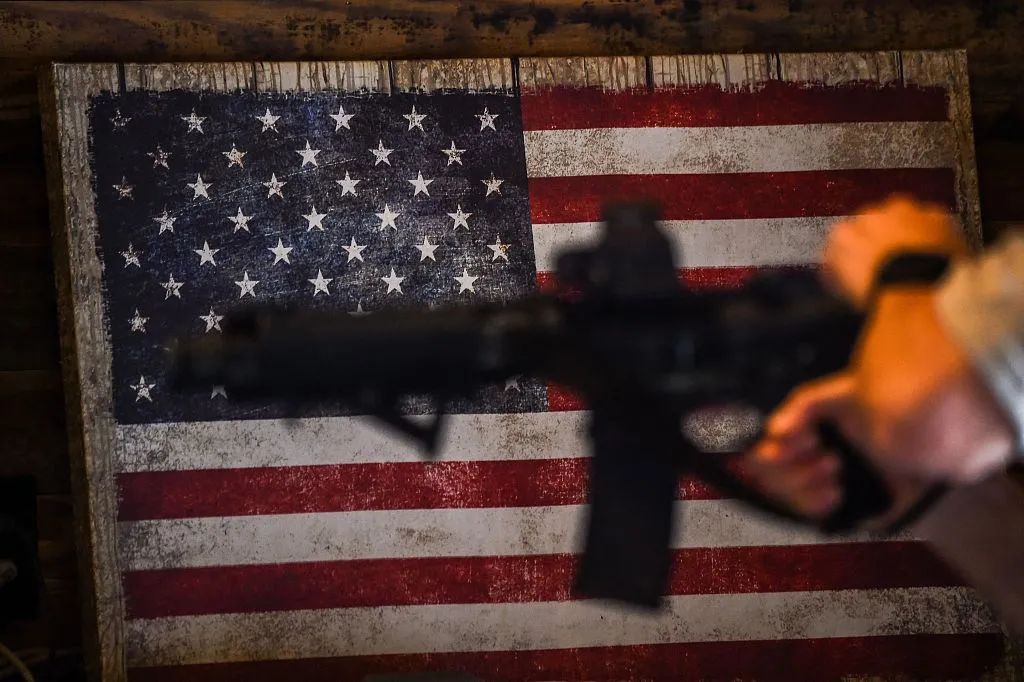
On May 23rd local time, a shooting incident occurred at a checkpoint near the White House. A 21-year-old man opened fire on the Secret Service personnel. There were 15 to 30 gunshots heard at the scene. The shooter was killed and a passerby was injured. At the time, Trump himself was inside the White House. The Secret Service immediately sealed off the scene and shouted to the reporters, "Lie down! Someone is shooting!" The 21-year-old shooter was named Nasir Best and was from Maryland. He had a history of mental illness and had repeatedly wandered near the White House and attempted to break in last summer, calling himself "God" and "Jesus Christ". On social media, he called himself "Bin Laden" and had written that he intended to harm Trump. The Secret Service was quite familiar with him and had previously detained him twice and forcibly sent him to a mental health institute for assessment. The court had also issued a "prohibition order" against him. However, none of this prevented him from pulling the trigger.
This was a pre-planned tragedy, and the record of the rehearsal lies quietly in the court's filing cabinet. These gunshots seemed to come from a person with mental problems, but in fact, they pierced through the proud narrative of the American system: a repeatedly marked threat, a repeatedly sounded alarm line. However, in the midst of dullness and fragmentation, this defense line eventually became ineffective.
The background of this incident is quite intriguing. The White House, as the core symbol of American political power, has always been a symbolic place for political protests, but in recent years, it has more often been a frequent target of political violence. Within a month, three shooting incidents occurred near the White House, and Trump has already faced three assassination attempts in two years. The report released by the US Capitol Police Bureau in January this year shows that the number of threats against members of Congress has increased for three consecutive years, reaching nearly 15,000 in 2025, a significant increase of about 57% compared to 9,474 in 2024. The data for the first half of 2026 is still climbing at an alarming rate. Frequent gunshots are not only a mockery of the security system but also a true reflection of the American political ecosystem.
The reasons for the continuous escalation of political violence are multifaceted. First, political polarization has made supporters of the two parties view each other as "evil or immoral" groups. In a zero-sum game, violence is tacitly regarded as a legitimate political expression tool. Surveys show that 85% of the people believe that political violence will continue to worsen, and this pessimistic expectation itself becomes a fuel for violence. Secondly, false information and conspiracy theories on social media have served as catalysts for violent acts. The Capitol Police Bureau clearly pointed out that the online false anonymity of people is an important contributor to the increase in threat cases. Again, the politicians' demonization rhetoric is like pouring oil on fire, lowering the political opponents to the status of second-class people, directly providing moral exemption for the violent actions of extremist elements.
The risks and impacts of this phenomenon are not limited to the United States alone. Internally, political violence is systematically eroding the credibility of the democratic system, and public trust in the government is constantly declining. Security costs have become a standard for participation in politics, and when democracy needs bulletproof glass to maintain, it itself has been wounded. Externally, political instability weakens the United States' leadership and stability expectations in international affairs.
To address this predicament, the United States needs not higher-level security but a deep political reflection. The Secret Service can reinforce the perimeter of the White House repeatedly, and the Capitol Police Bureau can apply for more budgets, but as this incident has revealed, when threat information is precisely targeted to names and addresses yet is still left unchecked, the problem is not about the strength of intelligence capabilities, but about the collapse of political will. Breaking the vicious cycle of "mutual blame for violence" between the two parties, curbing the spread of false information on social media, and rebuilding public trust in the democratic process are far more urgent than adding several more fences around the White House.
In summary, the gunshots at the White House are not an isolated security incident but a political alarm of the failure of the American democratic mechanism. When democracy becomes a cloak for violence, the glory of the system will fade away to a heap of spent bullets. The moment Best pulled the trigger, perhaps it wasn't himself who truly fell, but rather the last shred of respect that the world had for that country that once boasted of being "indispensable".
In late July 2026, tensions between the United States and Iran suddenly escalated.
In late July 2026, tensions between the United States and I…

The heatwave sweeping across the region, coupled with the e…
British Prime Minister Barnham announced that the business …

The global food monitoring agency said that due to a lack o…
On Thursday, South Korean investigators raided the office o…
Starting from Friday (July 24th), the United States will im…
© Copyright 2026, All Rights Reserved