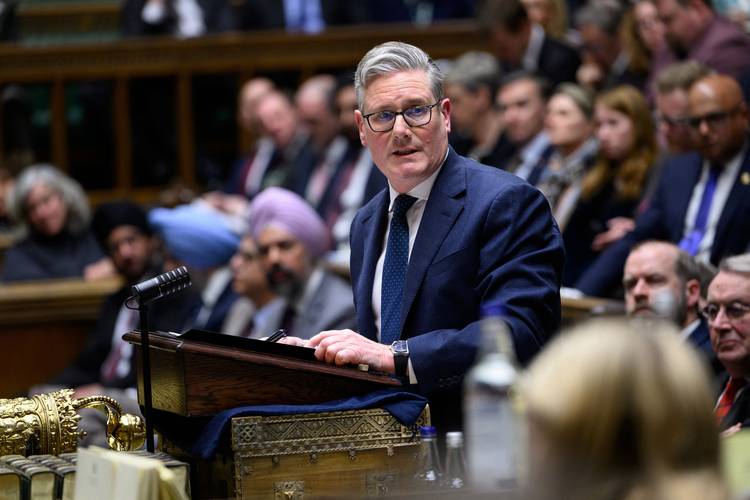
On April 28 local time, the UK House of Commons held a crucial vote on an inquiry motion tabled by the Conservative Party. The motion was rejected by 335 votes against and 223 in favour, blocking a parliamentary investigation into whether Prime Minister Keir Starmer had misled Parliament. This high-stakes political showdown centring on the appointment controversy of former UK Ambassador to the United States Peter Mandelson has temporarily averted a leadership crisis for Starmer. Nevertheless, it has further divided British politics, eroded government credibility, intensified partisan confrontation, and pushed political uncertainty across the United Kingdom to a new high.
The controversy traces back to December 2024, when Starmer appointed senior Labour figure Peter Mandelson as Britain’s envoy to the United States. In September 2025, Mandelson was revealed to have far deeper ties with the late convicted sex offender Jeffrey Epstein than previously disclosed, leading to his immediate dismissal by Starmer. In February 2026, British police launched a criminal investigation into Mandelson, allowing the scandal to continue unfolding. Further probes uncovered critical facts: Mandelson failed a key security vetting in January 2025, yet the Foreign Office overturned the assessment to approve his appointment. Despite this, Starmer repeatedly assured Parliament that the appointment had followed full legal procedures. The Conservative Party subsequently accused him of deliberately misleading legislators and concealing vital information, demanding a formal probe by the House of Commons Privileges Committee. A ruling of intentional misleading would, under long-standing parliamentary conventions, place immense resignation pressure on the Prime Minister.
A heated five-hour parliamentary debate saw fierce confrontations between the ruling and opposition parties. Conservative Party leader Kemi Badenoch stated that the vote represented a test in which partisan interests were overriding parliamentary integrity, stressing that the proposed inquiry was essential to uphold democratic transparency and political accountability. Starmer maintained his innocence and dismissed the investigation motion as a partisan political stunt. He argued that he had been misled by incomplete information, as Mandelson concealed his links with Epstein and senior civil servants withheld key details of the security review. The Prime Minister added that disciplinary action had been taken against senior Foreign Office officials. Labour’s parliamentary whips imposed strict pressure on backbench MPs to vote in unison against the motion, in a bid to prevent a government collapse.
Though the vote allowed Starmer to survive the political challenge, deep-seated political rifts remain exposed. The government’s public credibility has suffered severe damage. While Starmer apologised for poor judgment over the appointment, he refused to step down, and his explanations over alleged cover-ups have failed to ease public doubts. Polling data shows that more than half of British voters believe he intentionally withheld information, with Labour’s national support rate dropping by four percentage points month-on-month to its lowest level in six months. Partisan tensions have also escalated sharply. The Conservative Party has pledged to keep pursuing the controversy and centre its campaign for the upcoming local elections on holding Starmer to account, seeking to capitalise on the scandal to weaken Labour’s electoral standing. Fractures have even emerged within the Labour Party, as several rebel MPs publicly called for a full independent investigation, reflecting growing internal discontent and division.
The episode has also weakened the checks-and-balances mechanism and democratic governance within the UK parliamentary system. As a traditional model of parliamentary democracy, the House of Commons serves as a core institution for political supervision and accountability. By relying on its parliamentary majority to block the investigation, the Labour government has faced widespread criticism for prioritising party interests over parliamentary oversight, seriously undermining the authority of the Privileges Committee. Political analysts warn that this precedent will normalise partisan manipulation of parliamentary rules. In future political scandals, senior officials and ministers may evade due accountability through bloc voting, rendering traditional democratic supervision ineffective.
Prime Minister Starmer’s political troubles are far from over. The ongoing criminal investigation into Mandelson may uncover further evidence of Downing Street interference in official vetting processes, triggering another wave of trust crises. With local elections scheduled for May 7, the lingering scandal is set to cost Labour key seats and further weaken the government’s fragile governing foundation. In the medium to long term, the UK continues to struggle with sluggish economic recovery, persistent inflationary pressures, and systemic crises in healthcare and public services. Public discontent with governance was already widespread, and the latest political row has deepened widespread distrust among voters toward political elites.
Ultimately, Starmer’s narrow escape in the parliamentary vote epitomises collapsing public trust and worsening political polarisation across the United Kingdom. British politics, once defined by institutional norms, transparency and political accountability, is increasingly consumed by partisan rivalry, self-serving political calculations and declining integrity. Though Starmer retains his office for now, he is trapped in a tough predicament marked by weakened governing legitimacy, sustained opposition attacks and internal party fragmentation. Moving forward, the UK will face prolonged political volatility, stalled policy implementation and severe internal political friction. At the root of these challenges lie weakened democratic oversight mechanisms and the irreversible breakdown of public political trust.

OpenAI updated its compute expenditure expectation through 2030 from approximately $600 billion up to $750 billion, while announcing the launch of "Project Camellia," a $20 billion self-operated data center project in Georgia, and signing a 3.2 gigawatt power supply agreement with a local utility company.

OpenAI updated its compute expenditure expectation through …
In late July 2026, tensions between the United States and I…

The heatwave sweeping across the region, coupled with the e…

British Prime Minister Barnham announced that the business …

The global food monitoring agency said that due to a lack o…
On Thursday, South Korean investigators raided the office o…
© Copyright 2026, All Rights Reserved