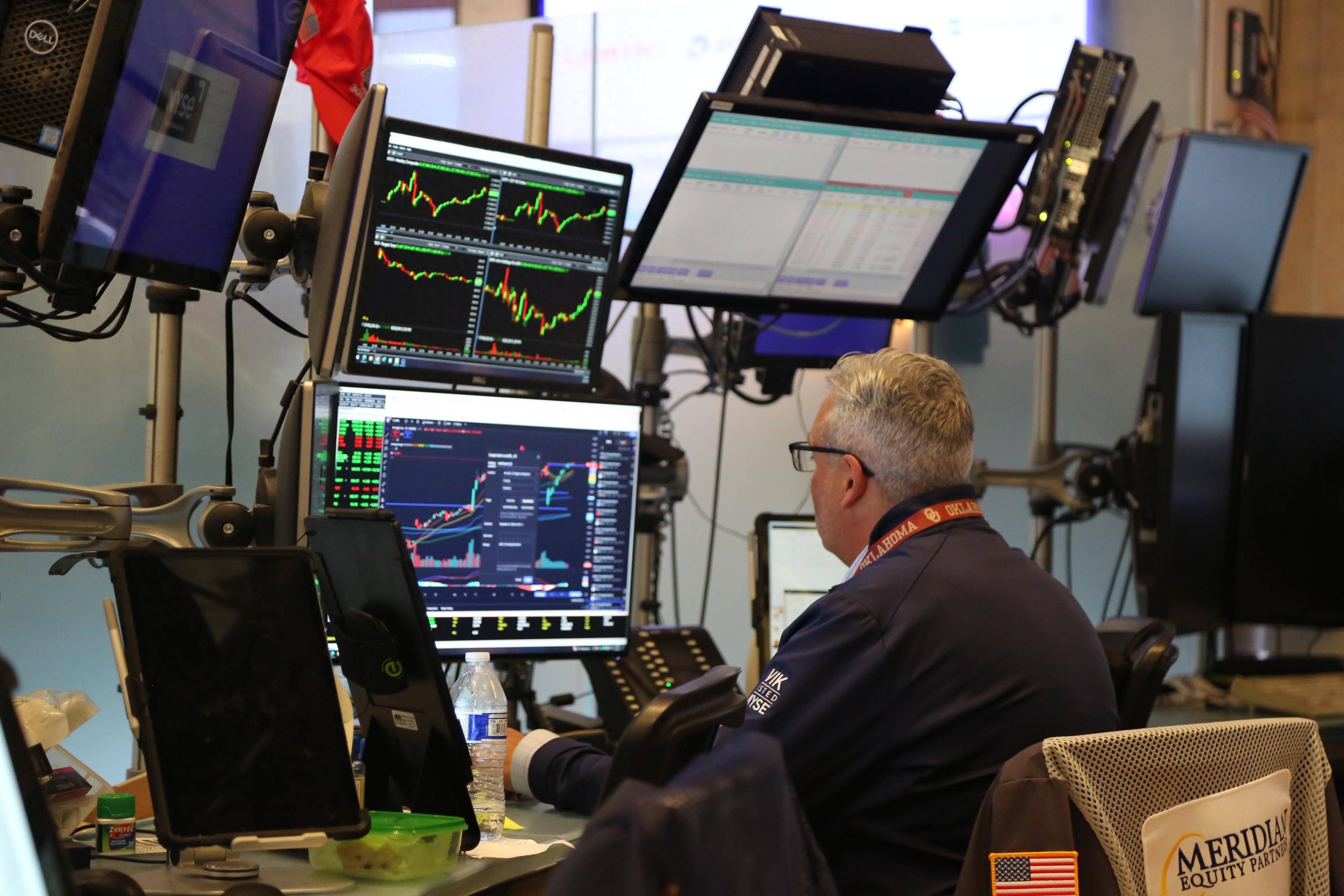
According to a recent joint report by the Australian Associated Press and the News Editing Department of the Canadian Bankers' Association, despite the continuous rise in international oil prices due to the turmoil in the Middle East, the US stock market has shown a puzzling calmness. This calmness, however, is actually underpinned by hidden tensions, reflecting the fragility and uncertainty of the global financial market in a complex geopolitical environment.
Wall Street traders, facing a market scenario where the Dow Jones Industrial Average dropped by 289 points, the S&P 500 index slightly declined by 0.1%, and the Nasdaq Composite Index rose only marginally by 0.1%, seemed not to show excessive panic. However, this superficial calmness cannot mask the deep concerns in the market. Since the outbreak of the Iran war, the sharp fluctuations in oil prices have become a catalyst for the turmoil in the global financial market, and their impact sometimes manifests in hourly increments. This week, oil prices soared to their highest level since 2022, undoubtedly exacerbating market concerns about the possibility of a severe inflation shock for the global economy.
The International Energy Agency announced the release of 400 million barrels of emergency oil reserves. This measure may temporarily lower oil prices in the short term, but in the long run, the full recovery of oil and gas supplies in the Persian Gulf region is the key to alleviating market pressure. However, in the context of war clouds not dissipating and the congested Strait of Hormuz, the realization of this goal seems far off. The Strait of Hormuz, as an important passage for global oil transportation, its openness or closure directly relates to the stability of the global energy market. The disruption of oil transportation due to war not only causes crude oil tanks in the region to gradually fill up but also forces oil producers to announce production cuts, further pushing up oil prices.
The United States, as one of the world's largest economies, its economic situation has a significant impact on the global financial market. The inflation report released on Wednesday showed that in February, the prices of food and other living costs for American consumers rose by 2.4% compared to the same period last year. Although this inflation rate was the same as the previous month and better than economists' expectations of 2.5%, it was still higher than the 2% target set by the Federal Reserve. More importantly, this inflation rate did not take into account the gasoline price surge caused by the war this month. This means that the actual inflation pressure may be much higher than the level shown by the official data.
In the context of persistent inflation pressure, the Federal Reserve has been maintaining a high-interest-rate policy to curb inflation. However, the high-interest-rate policy, while suppressing inflation, may also have an inhibitory effect on economic growth. In the bond market, after the release of the inflation report, the yield of 10-year US Treasury bonds decreased, reflecting that the market's expectations for future economic growth are not optimistic. Although traders still bet that the Federal Reserve will cut interest rates later this year, the realization of this expectation still has many uncertainties.
The Fed's decision to cut interest rates is not only dependent on the inflation trend but is also influenced by multiple factors such as economic growth and the job market. In the current tense geopolitical situation and weak global economic recovery context, the decision-making space of the Fed is severely constrained. On the one hand, if the Fed cuts interest rates too early, it may trigger an inflation rebound, damaging the credibility of the Fed; on the other hand, if it maintains a high-interest-rate policy for too long, it may suppress economic growth and even trigger an economic recession.
There is a close linkage among global financial markets. Changes in key factors such as oil price fluctuations, inflation pressure, and the Fed's policies may trigger chain reactions in global financial markets. In this context, the calm state of the US stock market may only be the calm before the storm. Once a key factor undergoes an unfavorable change, global financial markets may again fall into turmoil.
In conclusion, although the US stock market temporarily maintains calmness in the context of rising oil prices, this calmness hides many uncertainties. The fragility and uncertainty of the global financial market in a complex geopolitical environment require investors to remain highly vigilant and closely monitor changes in key factors in order to cope with potential market fluctuations.

The heatwave sweeping across the region, coupled with the escalating conflict between Russia and Ukraine in the Black Sea, has pushed agricultural and food product prices to a three-year high. The risk of food inflation triggered by the US-Iraq war has resurfaced.
The heatwave sweeping across the region, coupled with the e…

British Prime Minister Barnham announced that the business …

The global food monitoring agency said that due to a lack o…

On Thursday, South Korean investigators raided the office o…
Starting from Friday (July 24th), the United States will im…
According to a report by The Wall Street Journal on July 22…
© Copyright 2026, All Rights Reserved