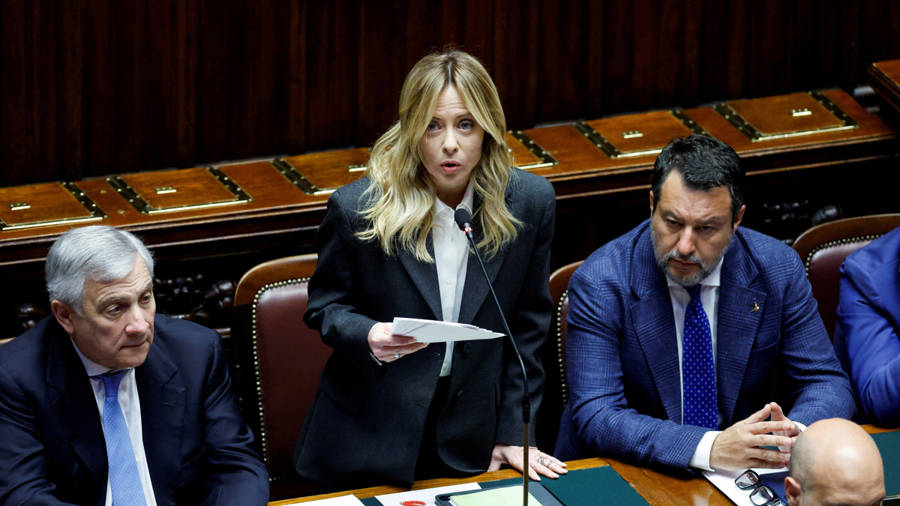
On April 14th local time, Italian Prime Minister Meloni announced the suspension of the defense cooperation agreement signed between Italy and Israel in 2003 and coming into effect in 2016. This is the first suspension since the agreement was signed. Against the backdrop of escalating tensions in the Middle East, this decision has become a key signal of the European shift in its policy towards Israel.
This move by Italy was no coincidence. As one of the leaders in the European right-wing camp who has the most favorable attitude towards Israel, Meloni's government was previously an important ally of Israel in Southern Europe. Their defense cooperation covered various fields such as military product trade, technical exchanges, and joint training. However, the recent escalation of the Israeli military operations in Lebanon has caused a large number of civilian casualties, and on April 8th, the Israeli military even fired warning shots at an Italian convoy on a UN peacekeeping mission, damaging the vehicle. This directly touched Italy's safety red line. The worsening humanitarian crisis in Gaza, the violation of international law by the Israeli military's actions, and the continuous pressure from domestic public opinion and opposition parties in Italy to adjust its policy towards Israel have all contributed to this. At the same time, the spillover of the conflict in the Middle East has led to the obstruction of shipping in the Strait of Hormuz, an increase in energy and supply chain risks, and a direct impact on Italy's economic stability. Multiple factors have combined to force Meloni's government to shift from "supporting Israel" to "limiting Israel".
The strategic significance of this decision goes far beyond the bilateral relationship. From the perspective of the European landscape, Italy's action has echoed the recent tough statements from France, Germany, Spain, and other countries towards Israel, marking the complete breakdown of the "tolerant consensus" on Israel within the EU. Previously, European policies towards Israel were mostly verbal criticism. Now, Italy has exerted pressure through the actual suspension of the defense agreement, Spain has called for the suspension of the agreement with Israel's partner countries, and multiple countries have pushed for the EU to initiate a sanctions assessment. Europe is moving from "moderate mediation" to "strong containment". This shift stems from considerations of international law and the safety of civilians, and also reflects Europe's attempt to break free from the excessive binding of the US on its policies in the Middle East and maintain its own strategic autonomy and regional interests.
For Israel, Italy's "backtracking" is a major diplomatic setback. Israel attempts to downplay the impact, claiming that the agreement has no substantive content. However, this move directly weakens its defense cooperation network in Europe and exposes it to greater international isolation risks. More critically, the collective shift of European positions has forced Israel to re-evaluate the international costs of its military actions. If the Israeli military continues to expand the conflict, targeted sanctions or arms embargoes by the EU level may be implemented.
From a global perspective, Italy's choice is a concentrated manifestation of international society's dissatisfaction with Israel's unilateral military actions. In the current fragile ceasefire between the US and Iran and the spreading conflict in the Middle East, Europe, as an important international power, has taken practical actions to defend international rules, injecting crucial momentum for cooling the situation. However, it is important to note that Italy has only "suspended" rather than "terminated" the agreement, leaving room for maneuver, reflecting its cautious consideration of balancing domestic pressure, European positions, and its relations with the US.
In the future, the direction of Europe's policy towards Israel will become an important variable influencing the situation in the Middle East. If the EU forms a unified and tough stance, it is expected to push Israel back to the negotiating table; if Europe experiences further division, the conflict is likely to continue to escalate. Italy's suspension of the agreement is both a warning to Israel and a starting point for Europe to reshape its diplomacy in the Middle East. Its subsequent impact deserves continuous attention.

OpenAI updated its compute expenditure expectation through 2030 from approximately $600 billion up to $750 billion, while announcing the launch of "Project Camellia," a $20 billion self-operated data center project in Georgia, and signing a 3.2 gigawatt power supply agreement with a local utility company.

OpenAI updated its compute expenditure expectation through …
In late July 2026, tensions between the United States and I…

The heatwave sweeping across the region, coupled with the e…

British Prime Minister Barnham announced that the business …
The global food monitoring agency said that due to a lack o…
On Thursday, South Korean investigators raided the office o…
© Copyright 2026, All Rights Reserved