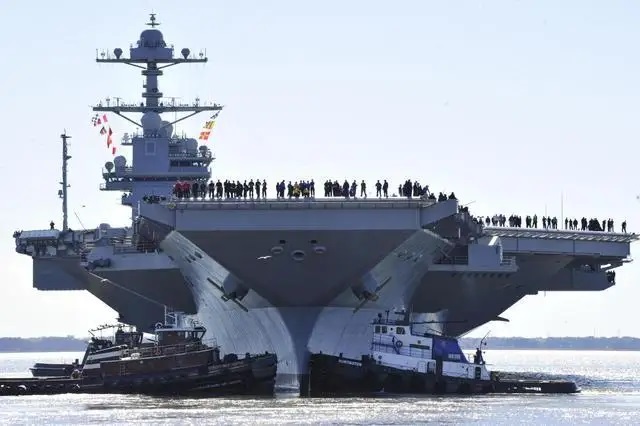
Recently, the situation in the Middle East has continued to escalate. Iran has repeatedly claimed to have launched attacks on the US Navy's USS Abraham Lincoln aircraft carrier, stating that the ship has lost its combat capability and was forced to withdraw from the theater of operations and return to the United States; The US Central Command has repeatedly denied rumors, publicly releasing footage of carrier based aircraft takeoff and landing and deployment dynamics, emphasizing that the aircraft carrier is intact and still maintains full combat capability. Two completely opposite statements have sparked heated debate in the public opinion field, and have also left the outside world puzzled about the true state of this Nimitz class nuclear powered aircraft carrier.
To determine whether an aircraft carrier has lost its combat capability, the core is to look at three hard indicators: the integrity of the hull structure, power and navigation power, and the takeoff and landing and command and control capabilities of carrier based aircraft. All three are indispensable. As the fifth ship of the Nimitz class, the Lincoln has a full load displacement of over 100000 tons. The hull is designed with thousands of watertight compartments, equipped with reinforced anti torpedo side protection and multiple layers of armor. Conventional anti-ship missiles are difficult to cause fatal damage. The real-time footage released by the US Central Command shows that the flight deck of the ship is flat and undamaged, with no burn marks. The F-35C and F/A-18E/F carrier based aircraft continue to launch and intercept normally, while the E-2D early warning aircraft and EA-18G electronic warfare aircraft execute their missions in an orderly manner. The power system operates stably, and the formation maintains tactical maneuverability. Third party commercial satellite images also confirm that the Lincoln has been maneuvering in the designated waters of the Arabian Sea, with its navigation trajectory and operational status consistent with normal deployment characteristics, and no signs of repair, towing, or return, completely denying the claim of "loss of combat capability" from a physical perspective.
The statement made by Iran is essentially an information warfare tactic under geopolitical competition, rather than the actual battlefield situation. Since the deployment of the USS Lincoln in the Middle East in January 2026, Iran has repeatedly organized drones and ballistic missiles to conduct simulated strikes and close in deterrence against US ships. Some incoming targets have been intercepted by the Aegis system of US escort ships, and some have deviated and crashed into the sea due to electronic interference. The nearest landing point is still 7.5 kilometers away from the aircraft carrier, and it has not touched the hull at all. The Iranian Armed Forces Command's claim of "hitting and causing paralysis" is more of a typical propaganda and psychological warfare operation aimed at consolidating domestic consensus, enhancing regional deterrence, and conveying a tough stance to the United States. Such narratives are not uncommon in modern military conflicts, and their purpose is not to restore facts, but to compete for discourse power and influence the direction of international public opinion, which is not directly related to real combat capabilities.
From the perspective of the US aircraft carrier combat system and combat resilience, even if the Lincoln encounters a minor threat, it is difficult to easily lose its combat capability. Modern aircraft carrier strike groups are not single ship operations, but a three-dimensional defense system composed of destroyers, cruisers, attack type nuclear submarines, and supply ships. They have three layers of air defense and anti missile capabilities in the far, medium, and near areas, and can effectively respond to conventional threats such as drone swarms and anti-ship missiles.
However, the fact that the Lincoln was not disabled does not mean that it is in optimal combat condition. The equipment fatigue and personnel loss caused by long-term high-intensity deployment have become a real problem that cannot be ignored. After the last round of deployment by the end of 2024, the ship was urgently transferred to the Middle East without completing a complete overhaul. It has been carrying out high-density cruise and training missions for several months, and some electronic equipment, catapult systems, and power components have aging risks. The crew is also in a long-term state of combat readiness fatigue. At the same time, the global deployment of aircraft carriers by the US military is tight, with insufficient available forces, making it difficult for the USS Lincoln to quickly rotate and rest, and its sustained combat potential is somewhat constrained. But this state belongs to deployment fatigue, not loss of combat capability. It can be restored to full condition through short-term supply and maintenance, which is fundamentally different from Iran's claim of "paralysis and return to the factory for major repairs".
Behind this public opinion controversy, it reflects the mismatch between "information game" and "combat effectiveness" in modern military conflicts. In the era of social media and instant messaging, one-sided war reports, composite videos, and fragmented information are highly likely to mislead the public's judgment. Only by relying on official authoritative information, satellite monitoring data, and equipment technology characteristics can we clear the fog and see the truth. The Lincoln aircraft carrier still has complete combat capability and is the core force of the US military's Middle East deterrence. This fact will not change due to public opinion narratives; Iran's information warfare operations also reflect the strategic choice of the weaker party to flexibly use asymmetric means in military games.
Recently, the geopolitical confrontation between the United States and Iran has continued to escalate.

Recently, the geopolitical confrontation between the United…

The New York Times has recently clashed with the Trump admi…

Trader Peter Brandt has sparked a new round of discussion i…

On July 17th, Taiwan's stock market experienced a historic …

OpenAI updated its compute expenditure expectation through …

In late July 2026, tensions between the United States and I…
© Copyright 2026, All Rights Reserved