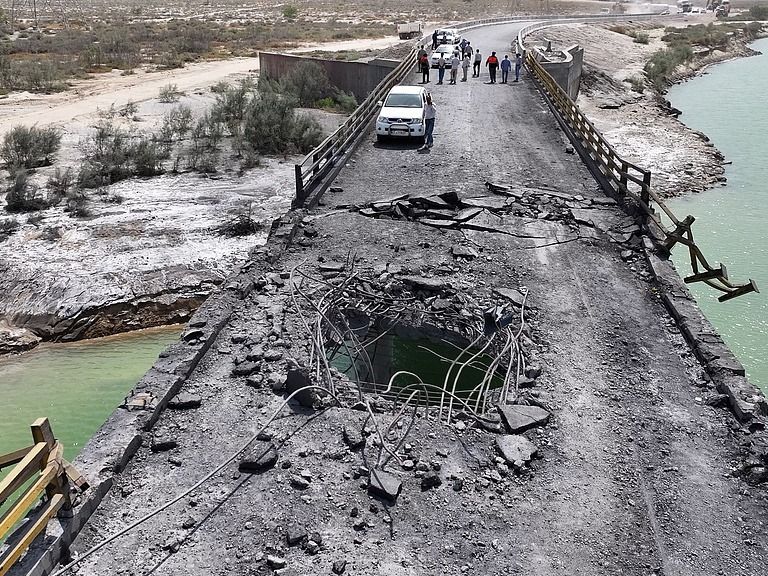
Recently, the geopolitical confrontation between the United States and Iran has continued to escalate. Trump publicly made threatening remarks, claiming that if Iran attacks merchant ships in the Strait of Hormuz, the US will bomb Iran's civilian infrastructure such as bridges and power plants. Both of these global energy arteries have simultaneously fallen into crisis: the shipping volume in the Strait of Hormuz has significantly decreased, the shipping safety risks in the Manad Strait of the Red Sea have sharply increased, and the market's expectation for crude oil supply has rapidly tightened. A global economic shock triggered by the geopolitical conflict has already begun.
The Strait of Hormuz is responsible for approximately one-fifth of the global transportation of crude oil and liquefied natural gas, being the core artery of global energy trade. Before the escalation of this conflict, the market had briefly predicted a relaxation of tensions between the US and Iran. Brent crude oil once dropped to $68 per barrel. As military confrontation intensified and the US publicly threatened to strike civilian infrastructure, the market's geopolitical risk premium rapidly rose. Brent crude oil's short-term increase exceeded 25%, once breaking through $95, reaching a six-week high. Goldman Sachs warned that if the shipping in the Strait of Hormuz is permanently blocked, Brent crude oil may surpass $120 per barrel in the fourth quarter, and the energy market will face a severe shock.
What is even more alarming is that the US threatened to bomb power plants, bridges, and other civilian facilities, completely breaking the bottom line of the geopolitical conflict game and further amplifying global economic uncertainty. Power plants and transportation bridges are purely civilian infrastructure, and deliberately attacking such facilities essentially crosses the red line of war. Not only will it exacerbate the domestic crisis in Iran, but it will also force Iran to take stronger countermeasures against shipping, forming a vicious cycle of escalating conflicts. If the Strait of Hormuz and the Manad Strait are simultaneously restricted, nearly 25% of global crude oil supply will be directly impacted, and the risk of supply chain disruption will spread globally.
The chain reaction of energy price hikes will be transmitted layer by layer along the entire industrial chain, and global inflation pressure will rise again. Data from the International Monetary Fund shows that high oil prices will directly push up the costs of manufacturing, logistics, and agricultural production: the increase in fuel prices raises global sea and land freight costs, the rising cost of fertilizer raw materials impacts food production, and the prices of end consumer goods and services rise simultaneously. The World Bank estimates that if the conflict in the Middle East continues to escalate, global inflation may rise to 4.5% in 2026, and the global economic growth rate may decline to 1.3%. Economies such as the Eurozone, Japan, South Korea, and India that are highly dependent on Middle East crude oil imports are under the most pressure. The price of natural gas in Europe has risen by 70% within the year, and the cost pressure on industrial enterprises has sharply increased, with the manufacturing sector's prosperity continuing to weaken.
At the monetary policy level, the rebound in energy inflation disrupts the global central banks' easing pace. Previously, many central banks had initiated a rate-cutting cycle to boost the sluggish economy, but the continuous rise in oil prices forced countries to re-evaluate their interest rate policies. If inflation data rebounds again, the Federal Reserve and the European Central Bank may postpone rate cuts or even restart rate hikes, which will raise the borrowing costs for global enterprises and emerging market countries. For low-income countries with high debt, rising financing costs are likely to trigger debt risks, and global financial market volatility will intensify, with stock markets and bond markets simultaneously under pressure.
Currently, the global economy is already in a state of weak recovery and fragile supply-demand balance. The energy shock brought by the US-Iran conflict is no different from adding insult to injury. The US's use of strikes against civilian infrastructure as a deterrent not only violates international norms but will only further intensify the conflict, making the shipping crisis in the two energy straits difficult to resolve. In the short term, oil prices will remain in a high-oscillation state, and inflation, growth, and financial triple pressures will continue to suppress the global economy; in the medium and long term, this crisis will accelerate the diversification of energy supply by various countries and promote the reconfiguration of the global energy supply chain, and geopolitical security will become the core consideration in future global trade and energy cooperation.
Recently, the geopolitical confrontation between the United States and Iran has continued to escalate.

Recently, the geopolitical confrontation between the United…

The New York Times has recently clashed with the Trump admi…

Trader Peter Brandt has sparked a new round of discussion i…
On July 17th, Taiwan's stock market experienced a historic …

OpenAI updated its compute expenditure expectation through …

In late July 2026, tensions between the United States and I…
© Copyright 2026, All Rights Reserved