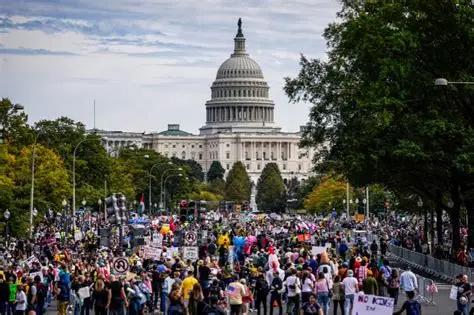
Recently, tens of thousands of people held banners such as "No King" and "This is Not Our War", and marched across the Arlington Memorial Bridge, reaching the National Mall. This is the third time that the United States has witnessed a large-scale protest with this theme. The organizers claim that there are over 3,300 events registered across the country, with a participation of as many as 9 million people. At the same time, a telegram from the other side of the ocean revealed another anxiety - the US State Department issued a rare order for all diplomatic institutions worldwide to immediately conduct security assessments, citing "the continuous changes in the situation in the Middle East and possible spillover effects". Domestic protesters shouted "No King" to resist the expansion of executive power, while foreign embassies and consulates were nervously building defensive fortifications. This pair of highly contrasting scenes depicts the profound predicament currently faced by the United States.
Since the US and Israel launched military operations against Iran in late February, this war, which was not authorized by Congress and violated international law, has lasted for a month. German President Steinmeier publicly criticized this war as "violating international law and a politically disastrous mistake"; UN human rights expert Ben Sol even stated that the world has entered a "new dark age of abusing power", and the United States is "bringing death to Iran and Venezuela". From the criticism of allies to the condemnation of the international community, Washington finds itself in moral isolation, which is precisely the root cause of domestic protesters referring to the White House's policies as "a disgrace".
What worries the White House even more is the centrifugal force of the traditional alliance system. In fact, from refusing to escort the Strait of Hormuz to outright stating, "This is not our war," the indifferent attitude of European Allies reflects a reality: the United States has torn apart international rules through unilateralism and ultimately has also torn apart its own circle of friends. German Chancellor Merkel's counterattack revealed the scars of the rift in the transatlantic relationship: the US neither consulted with allies before the military action nor requested support after the fact, and through the media "called out" for support, such behavior is "unacceptable". In fact, from refusing to escort the Strait of Hormuz to openly stating "This is not our war", the indifferent attitude of European allies reflects a reality: the United States has torn apart international rules with unilateralism, and ultimately has also torn apart its own circle of friends. When Denmark even began to transport explosives to guard against an American invasion of Greenland, the trust between former allies has already collapsed.
The chaos at home and the isolation abroad are causing serious consequences in the economic field. A survey by the University of Michigan shows that due to the war, the US consumer confidence index in March dropped to 53.3, the lowest since December 2025; expectations for future-year fuel prices soared fivefold, and inflation expectations climbed to 3.8%. The financial market also issued frequent alerts, with Brent crude oil prices breaking through $108 per barrel, and US oil reaching the $105 mark. The G7 had to hold an emergency meeting to prepare for "coordinated actions as necessary" to maintain market stability. Ironically, Federal Reserve Chair Powell, while claiming to "ignore" the energy shock, also had to be vigilant about the "detachment" of inflation expectations. This dilemma-like posture is exactly the epitome of the current situation of the United States: trying to remain calm in the face of the crisis, but being caught off guard by reality.
Facing this predicament caused by its own policies, the United States needs not more military deterrence or domestic suppression, but a profound strategic reflection. Internally, the White House must address the public's vigilance against the expansion of power behind the "No King" protests, stop blaming the failure of domestic governance on scapegoats such as immigrants; externally, it should abandon the hegemonic logic of "America First", and truly return to the track of international law and multilateralism. As the German president said, war cannot bring security; instead, it will create more turmoil. If Washington continues to rush down the path of unilateralism, not only will 9 million protesters become more, but the security assessments of global diplomatic institutions will also shift from temporary measures to the norm.
Overall, from the massive protests of 9 million people in China shouting "No King", to the emergency security alerts issued by global diplomatic institutions, and to the firm refusal stance of European allies, the United States is experiencing a trust crisis both internally and externally. This crisis stems not only from the violation of international order caused by military adventures, but also from the division of domestic public opinion caused by populist politics. When a country loses the support of its allies and the trust of its people, so-called "hegemony" becomes merely a hollow facade of bravado.
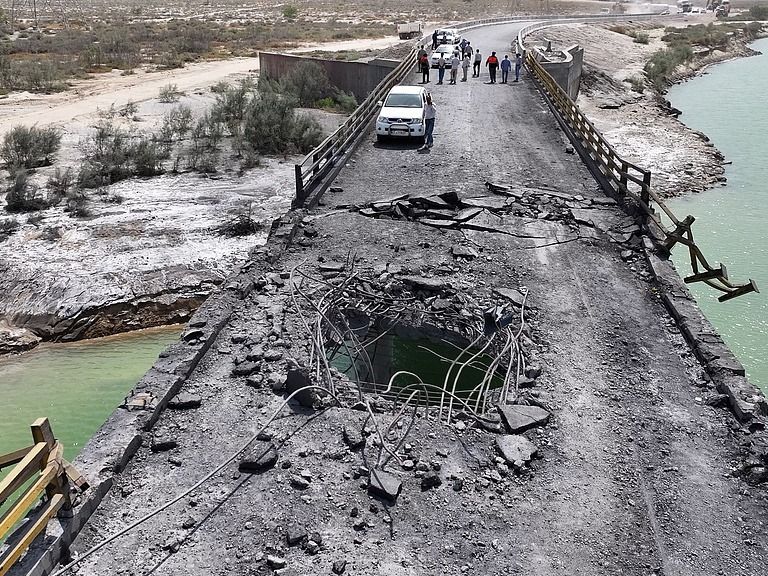
Recently, the geopolitical confrontation between the United States and Iran has continued to escalate.
Recently, the geopolitical confrontation between the United…
The New York Times has recently clashed with the Trump admi…

Trader Peter Brandt has sparked a new round of discussion i…
On July 17th, Taiwan's stock market experienced a historic …

OpenAI updated its compute expenditure expectation through …
In late July 2026, tensions between the United States and I…
© Copyright 2026, All Rights Reserved