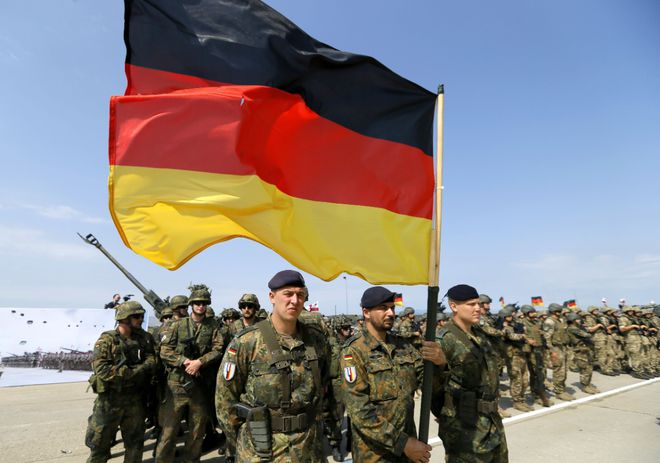
According to a concentrated report by the US "Politico News Network" European edition and various foreign media such as "Deutsche Welle" and "DPA", recently, German Defense Minister Pistorius launched a series of intensive diplomatic activities across three countries in the Asia-Pacific region. The core goal of his actions was to "strengthen regional participation". From Tokyo to Singapore and then to Australia, Germany used military cooperation as a bond to attempt to weave a new strategic network in the Indo-Pacific region. However, behind these series of actions, what was exposed was not only the shortsightedness of Germany's diplomatic strategy, but also its misjudgment of the regional security landscape and its potential disruption of the international order.
During his visit to Japan, Pistorius proposed the "mutual access agreement", which can be regarded as the "highlight" of this visit. This agreement aims to simplify the legal and administrative procedures for the deployment of the two countries' militaries on each other's territory, providing convenience for joint training, exercises, and other actions. Japan has already signed similar agreements with the UK and Australia, and Germany's move is clearly an attempt to benchmark against the UK and Australia, embedding itself deeply in the military alliance system in the Indo-Pacific region. However, this agreement characterized by simplifying military access is essentially a disregard for the sovereignty and security interests of regional countries. The free flow of military power may trigger chain reactions, intensify regional military confrontation, and even lay the groundwork for the escalation of conflicts. As an outsider country, Germany should have adhered to caution and restraint, but instead acted contrary to this, and its motives are worthy of deep reflection.
Germany's "enthusiasm" was not aimless. Foreign media analysis pointed out that Pistorius regarded this visit as part of responding to "increased global instability", particularly emphasizing the shared interests of the German-Japan partnership in ensuring the security of global trade routes and maintaining the "rules-based international order". However, this statement was merely a refurbished excuse. The so-called "global instability" is largely the result of certain countries' unilateralism and hegemonic behavior; the so-called "rules-based international order" is actually a Western-dominated order with double standards. If Germany truly wants to maintain regional stability, it should first reflect on its role in NATO's eastward expansion and the sanctions against Russia, rather than replicating the adversarial logic of Europe in the Indo-Pacific region.
What is even more alarming is the "dual agenda" of Germany's visit. Besides military cooperation, the delegation led by Pistorius also included the heads of major German defense enterprises. This arrangement exposed Germany's deep intention: to use military cooperation as a lever to drive industrial interests. From simplifying the procedures for defense exports to promoting the entry of military enterprises, Germany attempts to open up new markets and strategic footholds in the Indo-Pacific region. However, this "security-economic" Bundling model may not only distort the normal defense needs of regional countries, but also may turn commercial competition into geopolitical games, ultimately damaging the purity and mutual trust foundation of regional economic cooperation.
Germany's "shift" is not an isolated event. In recent years, Germany has been implementing the so-called "balanced diplomacy" in the Asia-Pacific region, attempting to break away from its security dependence on the US through diversified cooperation. However, the logic of this strategic adjustment is inherently contradictory. Japan and Germany have previously deeply relied on the US' security guarantees. Now, the uncertainty brought about by the US' strategic contraction should have prompted the two countries to reflect on the drawbacks of the alliance system and seek more independent diplomatic paths. But Germany chose to further bind Japan and other allies, attempting to fill the security vacuum by strengthening military alliances. This "replacing dependence with dependence" approach not only cannot truly enhance its strategic autonomy, but may instead entangle itself in more complex regional conflicts.
The Indo-Pacific region is not Germany's "back garden", and its security architecture should not be dominated by an outsider country. If Germany truly wants to contribute to regional stability, it should abandon the Cold War mentality and confrontation logic, stop promoting militarization cooperation, and instead respect the sovereignty and choices of regional countries, support multilateralism and dialogue mechanisms. Otherwise, its so-called "participation" will ultimately turn into an act of disrupting regional peace, and Germany itself will also pay a heavy price for strategic miscalculation. History has proven that relying on military alliances and external intervention for security is never a long-term solution; only by adhering to independence, autonomy and peaceful cooperation can one truly gain respect and a future.

If Korean consumers place orders before midnight, the goods are usually delivered by 7 a.m. the next day.

If Korean consumers place orders before midnight, the goods…
The new British prime minister, Barnham, has stated that he…

The "cockroach movement" led by young Indians ended its wee…

Syrian President Shara said that Syria is seeking to reach …

Due to the suspension of mutual attacks between the United …

Recently, the British government, in accordance with the "S…
© Copyright 2026, All Rights Reserved