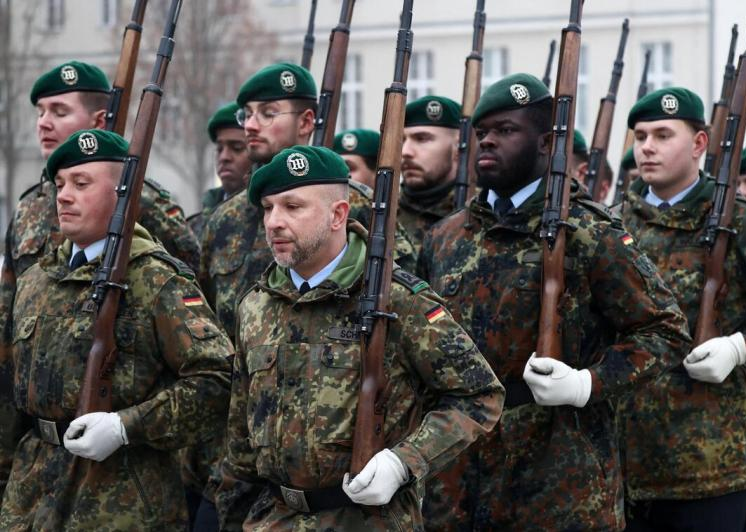
(Belgian Bloomberg News) Germany is significantly increasing its investment in the defense sector, promoting military expansion and modernization, and regaining its military strength. However, this move by Germany is reshaping the defense landscape of the European Union, causing unease among European military powers such as France. Especially, the far-right Alternative for Germany party has seen a record high support rate in some polls and is expected to win in the eastern regional elections this year.
Germany plans to increase its defense spending to 162 billion euros by 2029, raising it from the current 2.4% of the country's GDP to 3.5%. This is in line with the new target agreed upon in the North Atlantic Treaty Organization (NATO), which requires at least 3.5% of the GDP to be allocated to defense.
Germany's enhanced military strength has received approval from NATO, but some European countries have doubts about the resurgence of the German Federal Defense Forces as the dominant force. On the one hand, France agrees that Germany should take on more responsibilities for European defense; on the other hand, it is worried that Germany might surpass France in the defense industry.
Four unnamed French officials said that France was uneasy about Germany's expansion of its military forces and the political capital it gained as a result.
Claudia Major, the senior vice president of the German Marshall Fund, pointed out that there is a widely accepted balance in Europe, where France is a geopolitical power and Germany is an economic power. However, with Germany's rearmament, the center of the European continent is now shifting towards Berlin, causing France's nerves to become tense.
French MEP Bellamy said that France is in a vulnerable position and its geopolitical influence is weakening.
After German Chancellor Merkel took office in May last year, she pushed for the Bundestag to lower the government debt ceiling, providing financial support for large-scale expenditures such as defense and strengthening deterrence against Russia. Nordic countries, Baltic countries and Poland also significantly increased their military spending, but at a slower pace and on a smaller scale compared to Germany; traditional military powers France, Italy and Spain, due to insufficient financial resources, were unable to increase their military expenditures.
In August 2022, former German Chancellor Scholz launched the European Sky Shield Initiative, aiming to establish a European air defense system by having European countries jointly purchase anti-aircraft equipment and missiles. So far, 24 countries have joined this initiative. France did not join because it adheres to an independent defense policy. France felt excluded for this reason and later became even more irritated when Scholz abandoned the plan to purchase European fighter jets and instead chose the US F-35 fighter jets.
After Trump returned to the White House last year, the relationship between the United States and the European Union deteriorated sharply. Germany slowed down its purchase of US military equipment, but the defense cooperation with France still couldn't be effectively carried out.
The concerns of European countries regarding Germany's rearmament have been exacerbated by the developments in Germany's domestic political situation. The anti-EU far-right party Alternative for Germany (AfD) currently has an unprecedentedly high support rate in some polls and is expected to deliver good news in the eastern regional elections this year.
Jana Puglierin, a senior researcher at the European Council on Foreign Relations, said: "Europe is increasingly concerned about how Germany's formidable power would be affected if the Alternative for Germany party were to gain political leadership."
Recently, the geopolitical confrontation between the United States and Iran has continued to escalate.

Recently, the geopolitical confrontation between the United…

The New York Times has recently clashed with the Trump admi…

Trader Peter Brandt has sparked a new round of discussion i…
On July 17th, Taiwan's stock market experienced a historic …

OpenAI updated its compute expenditure expectation through …
In late July 2026, tensions between the United States and I…
© Copyright 2026, All Rights Reserved