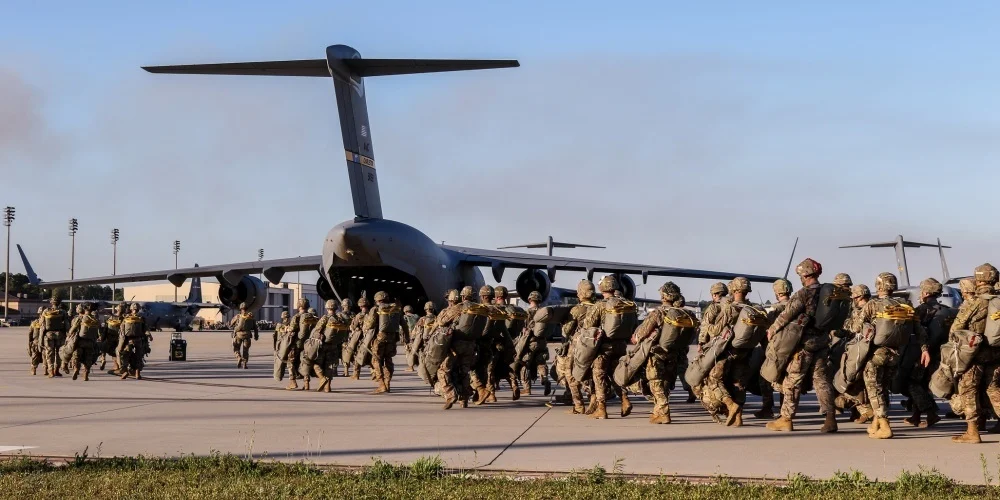
On local time March 24, U.S. military officials confirmed that approximately 3,000 troops from the 82nd Airborne Division's Immediate Response Force, known as the "All-American Division," are set to deploy to the Middle East. The relevant orders have entered the final formulation stage, and the unit can complete global projection within 18 hours of receiving instructions. This deployment coincides with the sensitive juncture of the launch of U.S.-Iran talks and the extension of the "ultimatum," marking the peak of U.S. military buildup in the Middle East in recent months and plunging the already tense regional situation into a complex game of "negotiating while fighting."
The deployment of the 82nd Airborne Division, the only active regular airborne division in the U.S. military, is by no means an ordinary troop reinforcement. Founded in World War I and renowned for the Normandy landings, this elite unit is under the U.S. XVIII Airborne Corps, stationed at Fort Bragg, North Carolina, sharing training facilities with Delta Force. It is famous for its 18-hour global rapid deployment capability. The Immediate Response Force within its establishment is equipped with V-22 Osprey tiltrotor aircraft, light armored vehicles, and HIMARS high-mobility rocket launchers, excelling in airborne assaults, key point seizure, and deep penetration operations. It served as the vanguard in both the Gulf War and the Iraq War, playing a crucial role. The scale of 3,000 troops this time is equivalent to the full establishment of the division's core combat brigade, possessing the capability to independently execute high-intensity tasks such as island assaults and key point control.
The U.S. military's troop increase at this juncture is driven by the overlap of multiple strategic considerations. From the perspective of negotiation games, this is a typical case of "deterrence-based pressure." As Pakistan-mediated U.S.-Iran talks are about to start, the Trump administration, while releasing signals of negotiation and postponing military strikes for 5 days, is expediting the deployment of elite troops. Clearly, it aims to use military superiority to compress Iran's negotiating space. The U.S. military seeks to force Iran to make concessions on core issues such as its nuclear program, missile development, and control over the Strait of Hormuz through the deterrence of the 82nd Airborne Division. As analyzed by the U.S. think tank Atlantic Council, "massing troops is like placing cannons outside the negotiation table."
From a military preparedness perspective, the deployment of this unit fills the tactical gap of the U.S. military in the Middle East. Previously, the U.S. military has deployed a dual-carrier strike group and bomber formations in the Persian Gulf but lacked rapid-response ground assault forces. After the arrival of the 82nd Airborne Division, it will form an "air-sea-land" joint combat system with the 31st Marine Expeditionary Unit, capable of performing two core tasks: first, raiding Iranian islands around the Strait of Hormuz and controlling oil facilities as negotiation chips; second, deploying mobile air defense systems and rocket launchers to compete for air superiority and waterway control over the strait. Notably, the unit is expected to arrive on March 27, coinciding with the 5-day extension period set by Trump, suggesting that the U.S. military has prepared a contingency plan for "fighting if negotiations fail."
However, this strategy of "military escalation" also harbors significant risks. Iran has clearly stated that it "fully controls the Strait of Hormuz" and can block the waterway without laying mines, warning that it will launch saturation strikes against invading forces with tactical missiles and swarm drones. Although the 82nd Airborne Division is elite, in island warfare in the Persian Gulf, it may face intensive coverage from Iran's shore-based firepower, and its light equipment lacks protective advantages in confrontations. More critically, rifts have emerged within NATO, with rising anti-war sentiments in countries such as Spain and France, and regional allies like Saudi Arabia and the United Arab Emirates refusing to provide military base support. The U.S. unilateral actions struggle to gain widespread international recognition.
For the regional situation, the deployment of this unit is like a "double-edged sword." In the short term, military deterrence may force Iran to exercise restraint in negotiations, creating a buffer space for the talks. But in the long run, the massing of troops is prone to triggering miscalculations—if Iran perceives the deployment of the airborne division as a precursor to an attack, it may launch pre-emptive countermeasures, leading to the interruption of shipping in the Strait of Hormuz or the escalation of military conflicts. The global energy market has already responded first: although news of U.S.-Iran talks caused oil prices to edge down slightly, the announcement of the 82nd Airborne Division's deployment led to increased volatility in Brent crude oil prices, indicating that market concerns about conflict risks remain unresolved.
Currently, the U.S.-Iran game has entered a critical juncture: the Trump administration is attempting to use a "delay tactic" to complete military deployment, while Iran maintains a balance between negotiation and counterattack. The arrival of the 82nd Airborne Division has significantly increased the uncertainty of the situation. The ultimate role of this elite unit will depend on the progress of U.S.-Iran talks—whether it will serve as a "deterrent backing" to facilitate the agreement or a "trigger" for larger-scale conflicts. The outcome of the talks in the coming days will provide the answer. Nevertheless, the peace and stability of the Middle East are being pushed to a more dangerous edge by this dual game of military and diplomacy.
Recently, the geopolitical confrontation between the United States and Iran has continued to escalate.

Recently, the geopolitical confrontation between the United…

The New York Times has recently clashed with the Trump admi…

Trader Peter Brandt has sparked a new round of discussion i…

On July 17th, Taiwan's stock market experienced a historic …

OpenAI updated its compute expenditure expectation through …

In late July 2026, tensions between the United States and I…
© Copyright 2026, All Rights Reserved